

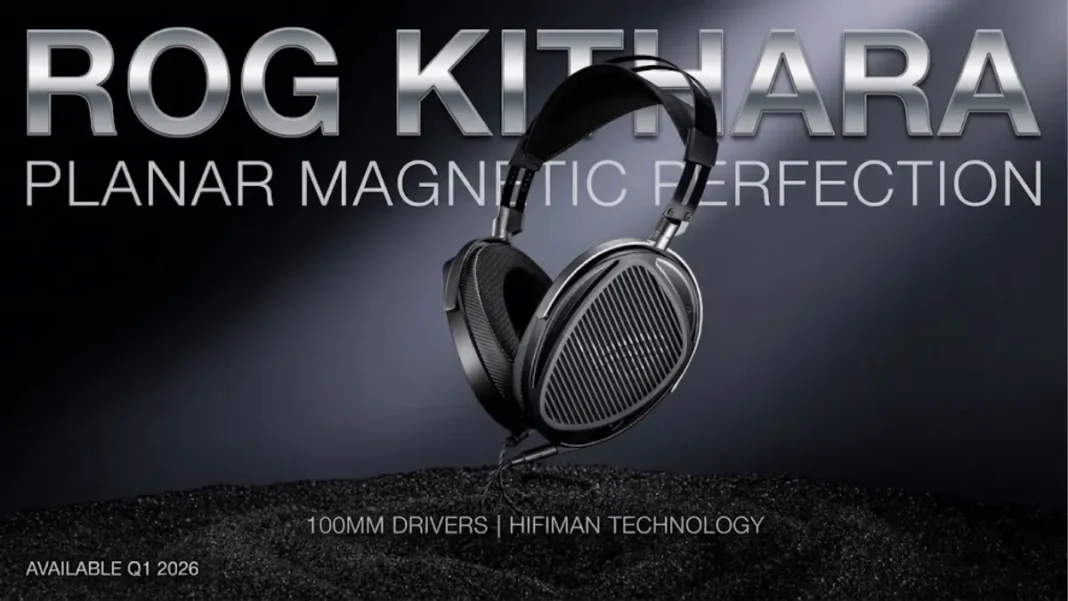
ASUS Republic of Gamers announced the ROG Kithara on January 6, 2026 its first high-fidelity gaming headset powered by planar magnetic drivers. Developed in partnership with HIFIMAN, a leading planar headphone manufacturer, the Kithara targets competitive gamers and audiophiles with 100mm custom drivers, open-back acoustics, and a full-band MEMS boom microphone. The headset launches in Q1 2026 with pricing yet to be disclosed.
What Makes the ROG Kithara Different
The ROG Kithara uses ROG-customized 100mm HIFIMAN planar magnetic drivers instead of traditional dynamic drivers found in most gaming headsets. Planar magnetic drivers move air evenly across a flat diaphragm suspended between magnets, reducing distortion and delivering tighter bass with better instrument separation. The headset covers an 8Hz–55kHz frequency range far wider than standard gaming gear enabling it to reproduce subtle audio cues like distant footsteps or weapon reloads.
The open-back design allows sound waves to pass through the earcups rather than reflecting inside, creating a wider soundstage and clearer channel separation. ASUS matched drivers across both earcups for perfect left-right consistency, critical for pinpointing directional audio in competitive shooters. The metal frame and 420-gram weight balance durability with comfort for extended sessions.
Mic and Connectivity Built for Flexibility
A full-band MEMS boom microphone captures voice across the entire 20Hz–20kHz spectrum with separate signal channels to prevent crosstalk. This design outperforms typical ECM mics in gaming headsets, delivering higher signal-to-noise ratios and minimal background noise. The on-cable mic keeps the headset lightweight while maintaining broadcast-quality voice clarity.
The Kithara ships with a high-quality OFC balanced cable featuring swappable 4.4mm balanced, 3.5mm, and 6.3mm plugs. This works with DACs, amplifiers, PCs, Macs, consoles, and mobile devices. ASUS includes a USB-C-to-dual-3.5mm adapter for laptops and smartphones.
How It Compares to Audeze Maxwell
| Feature | ROG Kithara | Audeze Maxwell |
|---|---|---|
| Driver Type | 100mm planar magnetic | 90mm planar magnetic |
| Design | Open-back | Closed-back |
| Connectivity | Wired, swappable plugs | Wireless + wired |
| Weight | 420g | ~490g |
| Mic | On-cable MEMS | Detachable boom |
The Kithara prioritizes sound stage and driver size for competitive advantage, while Maxwell offers wireless convenience and active noise isolation.
What’s Next
ASUS confirmed a Q1 2026 launch window but has not announced pricing or specific availability dates. Given the HIFIMAN partnership and premium build metal frame, velour and leatherette earcup options, and audiophile-grade cabling the Kithara will likely compete in the $400–$600 range occupied by Audeze and HiFiMan’s existing planar models. The headset was revealed at CES 2026 alongside other ROG audio products, including the ROG Cetra earbuds.
Gamers seeking competitive audio may need to invest in a dedicated DAC or amplifier, as planar magnetic drivers often require more power than standard gaming motherboards provide. ASUS has not specified impedance or sensitivity specs, which will determine whether the Kithara works well with consoles and mobile devices using the included adapters.
Featured Snippet Boxes
What is the ASUS ROG Kithara?
The ROG Kithara is ASUS’s first gaming headset with 100mm planar magnetic drivers, developed with HIFIMAN for audiophile-grade sound. It features an open-back design, MEMS boom mic, and swappable cable plugs for multi-device compatibility.
When will the ROG Kithara be available?
ASUS announced a Q1 2026 release window during CES 2026 but has not confirmed exact dates or regional rollout plans. Pricing details remain unannounced as of January 6, 2026.
What are planar magnetic drivers?
Planar magnetic drivers use a flat diaphragm suspended between magnets, moving air evenly to reduce distortion. Unlike cone-shaped dynamic drivers, they deliver tighter bass, better instrument separation, and faster transient response for detecting subtle audio cues.
Does the ROG Kithara work with consoles?
Yes, the headset includes 3.5mm and 6.3mm plugs for consoles, plus a USB-C adapter for mobile devices. However, planar magnetic drivers may require external amplification for optimal volume and clarity on lower-powered devices.

