

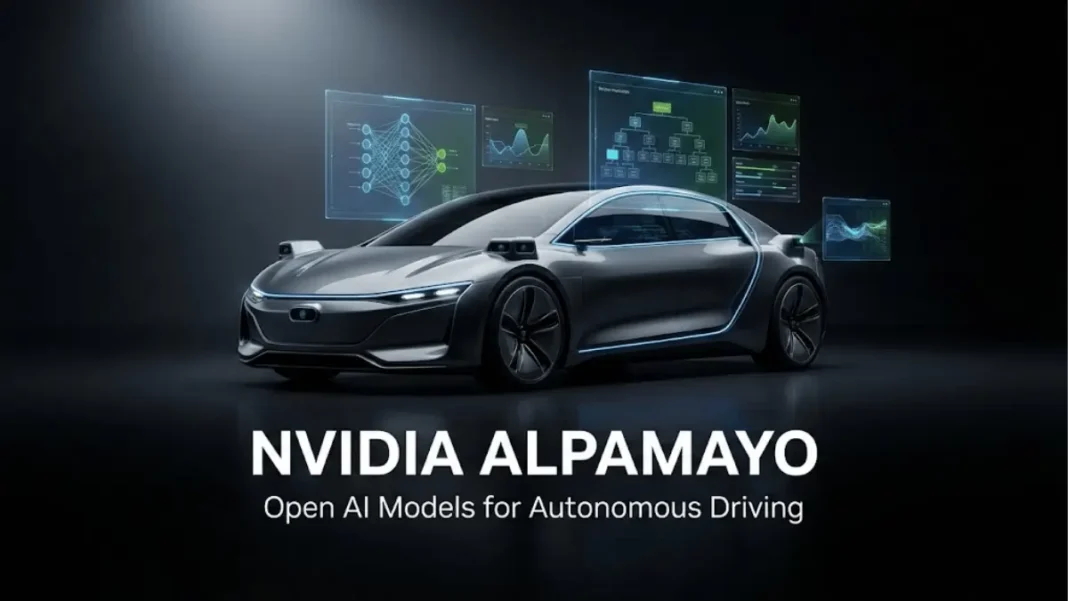
Nvidia unveiled the Alpamayo family of open-source AI models at CES 2026, marking the first industry-scale release of reasoning-based autonomous vehicle technology. The platform includes Alpamayo 1, a 10-billion-parameter vision-language-action (VLA) model, AlpaSim simulation framework, and 1,700+ hours of real-world driving datasets. Major mobility companies including Lucid, JLR, and Uber are adopting the technology to accelerate Level 4 autonomous vehicle deployment.
What’s New in Alpamayo
Alpamayo introduces chain-of-thought reasoning to autonomous driving, enabling vehicles to think through rare scenarios step-by-step rather than relying solely on pattern recognition. The model processes video input from vehicle sensors and generates driving trajectories alongside reasoning traces that explain each decision. This represents a fundamental shift from traditional AV architectures that separate perception and planning into distinct modules.
Nvidia CEO Jensen Huang called it “the ChatGPT moment for physical AI,” highlighting the model’s ability to understand, reason, and act in real-world driving conditions. The system functions as a large-scale teacher model that developers can fine-tune and distill into smaller runtime models suitable for in-vehicle deployment. Unlike direct deployment, Alpamayo serves as foundational infrastructure for building complete AV stacks.
The platform launched at CES on January 6, 2026, with three core components now available:
- Alpamayo 1: 10B-parameter reasoning VLA model on Hugging Face with open weights and inference scripts
- AlpaSim: Open-source simulation framework on GitHub with realistic sensor modeling and closed-loop testing
- Physical AI datasets: 1,700+ hours of driving data covering diverse geographies and edge cases on Hugging Face
Why It Matters
Alpamayo addresses autonomous driving’s hardest challenge, the “long tail” of rare, complex scenarios that traditional systems struggle to handle safely. Examples include traffic lights that malfunction at busy intersections, unexpected construction zones, or unpredictable pedestrian behavior. By enabling vehicles to reason through these edge cases and explain their logic, Alpamayo improves both safety and regulatory compliance.
The open-source approach democratizes access to advanced AV technology for researchers and developers who previously lacked resources to compete with proprietary systems. This transparency is critical for safety validation and regulatory approval, as autonomous systems must demonstrate explainable decision-making. Industry analysts note that explainability is essential for scaling trust in intelligent vehicles.
Mobility leaders view Alpamayo as a catalyst for reaching Level 4 autonomy, where vehicles handle all driving tasks in specific conditions without human intervention. Uber’s global head of autonomous mobility stated the technology “creates exciting new opportunities for the industry to accelerate physical AI” and increase safe deployments.

How Alpamayo Differs from Traditional AVs
| Traditional AV Systems | Alpamayo Reasoning Model |
|---|---|
| Separate perception and planning modules | Unified end-to-end VLA architecture |
| Pattern recognition from training data | Chain-of-thought reasoning for novel scenarios |
| Black-box decision-making | Explainable reasoning traces |
| Limited handling of edge cases | Humanlike judgment for long-tail scenarios |
| Proprietary, closed systems | Open-source weights and tools |
Industry Adoption and Partnerships
Lucid Motors, Jaguar Land Rover, and Uber are actively exploring Alpamayo integration into their AV development roadmaps. Berkeley DeepDrive called the release “transformative,” enabling research teams to train at unprecedented scale. S&P Global analysts noted the open-source nature “accelerates industry-wide innovation” by allowing partners to adapt the technology for specific use cases.
The platform integrates with Nvidia’s broader ecosystem including DRIVE AGX Thor compute hardware, Cosmos world-modeling platform, and Omniverse simulation tools. Developers can fine-tune Alpamayo models on proprietary fleet data and validate performance in simulation before real-world testing.
What’s Next
Future Alpamayo releases will feature larger parameter counts, more detailed reasoning capabilities, and expanded input/output flexibility. Nvidia plans to introduce commercial licensing options alongside the current research-focused release. The company has not announced specific timelines for production-ready deployments in consumer vehicles.
AlpaSim’s closed-loop testing capabilities will continue expanding to cover more weather conditions, traffic scenarios, and regulatory frameworks. The Physical AI datasets will grow as Nvidia collects additional real-world driving data from partner fleets. Open questions remain around compute requirements for on-vehicle inference and certification pathways for reasoning-based systems.

Featured Snippet Boxes
What is Nvidia Alpamayo?
Alpamayo is an open-source family of AI models, simulation tools, and datasets for autonomous vehicle development announced at CES 2026. It uses chain-of-thought reasoning to help self-driving cars handle rare scenarios and explain decisions.
How does Alpamayo’s reasoning model work?
Alpamayo 1 processes video from vehicle sensors using a 10-billion-parameter VLA architecture. It generates driving trajectories alongside reasoning traces that show the step-by-step logic behind each decision, similar to how humans think through complex situations.
Is Alpamayo open source?
Yes. Alpamayo 1 model weights, AlpaSim simulation framework, and 1,700+ hours of driving datasets are available on Hugging Face and GitHub for research use. Commercial licensing options will be offered in future releases.
What is Level 4 autonomy?
Level 4 autonomy means vehicles can handle all driving tasks in specific conditions without human oversight or intervention. Alpamayo is designed to accelerate development toward this capability through reasoning-based decision-making.

