

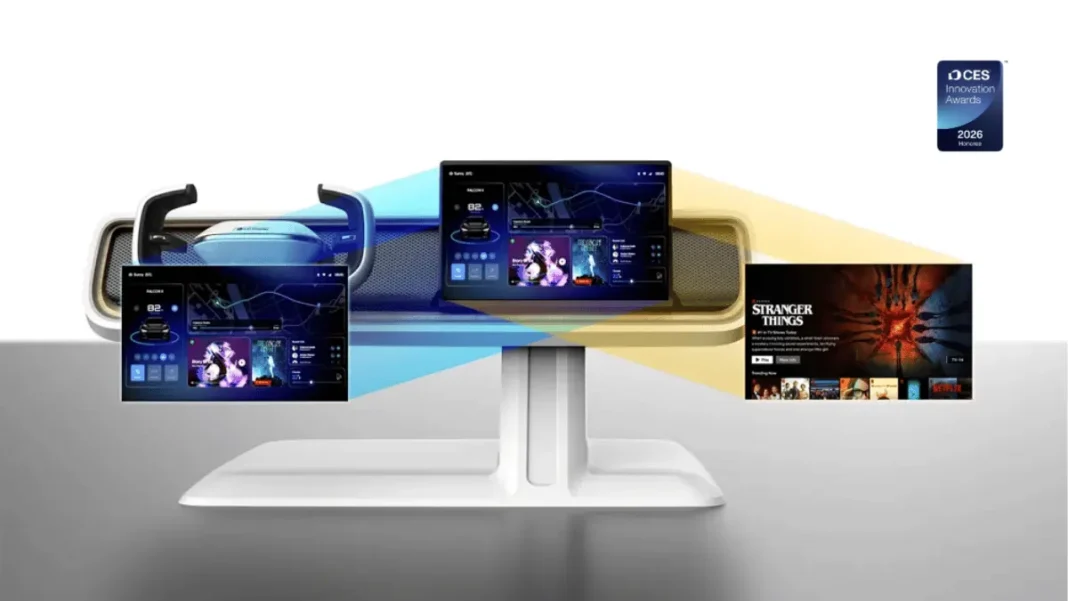
LG Display’s 16-inch Dual View OLED has won a CES 2026 Innovation Award in the In-Vehicle Entertainment category. The automotive display shows different content to the driver and passenger simultaneously on a single screen enabling navigation for one person and movie streaming for another. The award was announced in November 2025, with the technology set to debut at CES 2026 in Las Vegas this January.
What’s New in Dual View OLED
LG Display calls this the world’s first automotive display capable of position-based content separation. The 16-inch screen uses an optimized pixel structure that allows the driver to see navigation while the front passenger watches entirely different content on the same panel.
The display supports touchscreen controls without interference when the passenger pauses a video, the driver’s interface remains unaffected. It can function as a Center Information Display (CID), Co-Driver Display (CDD), or Rear Seat Entertainment (RSE) system.
LG Display built the product using Tandem OLED architecture, which stacks multiple light-emitting layers for enhanced brightness and durability. The display operates reliably in extreme automotive conditions from -40°C to 85°C.
Why This Matters for Car Interiors
Dual View OLED addresses a longstanding design challenge: personalized entertainment without adding extra screens. Traditional multi-display setups consume cabin space, increase costs, and complicate wiring.
A single screen that delivers separate experiences reduces hardware complexity while maintaining minimalist interior aesthetics. For rear-seat applications, two passengers can watch different movies simultaneously, maximizing limited space.
The technology also enables automakers to meet emerging driver-monitoring regulations without sacrificing screen real estate LG Display won a second CES award for UDC-IR OLED, which hides the camera behind the display.

How Dual View OLED Works
The technology relies on three core innovations:
- Tandem OLED structure: Multiple stacked OLED layers boost brightness, efficiency, and lifespan by distributing electrical load across layers
- Directional pixel design: Optimized pixel arrangement ensures each viewer sees only their designated content based on seating position
- Touch isolation: Advanced algorithms prevent one user’s touch input from disrupting the other viewer’s display
Tandem OLED’s four-layer design delivers superior contrast and near-instantaneous response times while meeting automotive-grade reliability standards.
Single-Screen vs. Dual View OLED
| Feature | Traditional Multi-Display | Dual View OLED |
|---|---|---|
| Content separation | Requires 2+ physical screens | One screen, two views |
| Space efficiency | Higher cabin space usage | Minimalist single-panel design |
| Touch control | Separate touch zones per screen | Independent touch without interference |
| Temperature range | Typically -30°C to 70°C | -40°C to 85°C |
| Installation complexity | Multiple wiring harnesses | Single display integration |
What’s Next for Automotive OLED
LG Display will showcase the Dual View OLED at CES 2026 at the Las Vegas Convention Center from January 6–9, 2026. The company has set up a dedicated booth for automotive display solutions and will host customer-exclusive demonstrations at the Conrad Hotel.
No commercial release date or automaker partnerships have been announced yet. LG Display is targeting top-tier automotive suppliers and equipment manufacturers at the show.
The company is also unveiling new large-format OLED gaming panels at CES, including a 720Hz display, though these are separate from the automotive lineup.

Featured Snippet Boxes
What is Dual View OLED display technology?
Dual View OLED is LG Display’s automotive screen that shows different content to the driver and passenger simultaneously on one 16-inch panel using position-based viewing technology. It won a CES 2026 Innovation Award.
Can both users control the Dual View OLED screen?
Yes, the display supports independent touchscreen controls for each viewer without interference. The optimized pixel structure ensures one person’s touch input doesn’t affect the other’s content.
What is Tandem OLED and why does it matter?
Tandem OLED stacks multiple light-emitting layers to increase brightness, efficiency, and lifespan while reducing power consumption. For automotive use, it enables reliable operation in extreme temperatures from -40°C to 85°C.
When will cars have Dual View OLED displays?
LG Display will demonstrate the technology at CES 2026 in January but hasn’t announced production timelines or automaker partnerships yet. The company is in discussions with automotive suppliers.

