

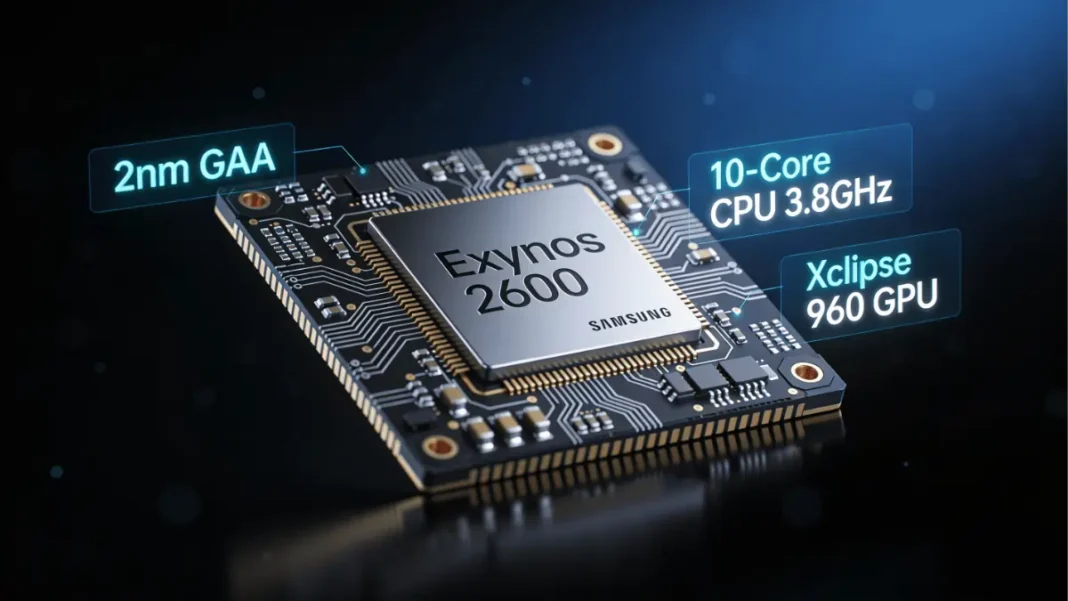
Summary: Samsung’s Exynos 2600 is the world’s first 2nm smartphone processor, launching December 2025 for the Galaxy S26 series. Built on Samsung Foundry’s GAA technology, it delivers 39% faster CPU performance, 2x GPU compute power, and 113% better AI processing than the Exynos 2500. The 10-core CPU peaks at 3.8GHz, paired with the Xclipse 960 GPU featuring hardware ray tracing and AI upscaling. A breakthrough Heat Path Block system tackles Samsung’s historic overheating issues. While benchmarks show it trails Snapdragon 8 Elite by 6-10%, Samsung’s thermal innovations and gaming-focused ENSS technology position it as a compelling mid-tier flagship option with meaningful real-world improvements.
Samsung has officially announced the Exynos 2600, marking a pivotal moment in mobile computing as the industry’s first 2nm smartphone processor. Launching in December 2025 ahead of the Galaxy S26 series debut in early 2026, this chip represents Samsung’s most aggressive response to years of criticism about Exynos performance and thermal management. The question isn’t just whether it’s faster, it’s whether Samsung has finally closed the gap with Qualcomm’s dominance.
What Makes Exynos 2600 Revolutionary
The Exynos 2600 leverages Samsung Foundry’s 2-nanometer Gate-All-Around (GAA) fabrication process, beating Apple, Qualcomm, and MediaTek to market with this advanced node. This manufacturing leap isn’t just about smaller transistors; it fundamentally changes how power flows through the chip. Samsung claims 39% higher CPU performance and significantly better power efficiency compared to the Exynos 2500.
Industry-First 2nm GAA Process Explained
Traditional FinFET transistors control current from three sides. GAA technology wraps the gate completely around the channel, reducing power leakage and enabling higher performance at lower voltages. Think of it like upgrading from a garden hose with small holes to a sealed pipe less waste, more pressure where you need it. This translates to longer battery life during intensive tasks like gaming or AI processing.
- Industry-first 2nm process – Leads Apple, Qualcomm to market with advanced GAA technology
- 39% faster CPU – Substantial generational leap over Exynos 2500
- 2x GPU compute power – Meaningful gaming improvements with hardware ray tracing
- Heat Path Block – Novel thermal solution addresses historic overheating issues
- ENSS AI upscaling – Enables higher gaming frame rates with lower power draw
- 113% better AI performance – Competitive edge for on-device Galaxy AI features
- 320MP camera support – Prepares for next-gen smartphone imaging
- 10% slower than Snapdragon 8 Elite (single-core) – Still trails flagship competitor
- 6% slower multi-core – Not the outright performance king
- ENSS requires developer adoption – Limited game library at launch
- Regional availability only – North America likely gets Snapdragon exclusively
- No confirmed RDNA architecture – Unclear if Xclipse 960 uses RDNA3 or RDNA4
- Unproven thermal performance – HPB effectiveness requires real-world validation
- Lower GPU clock than predecessor – 985MHz vs 999MHz, though overall performance increases
Exynos 2600 Specifications
The Exynos 2600 features a 10-core CPU with 1 Arm C1-Ultra core at 3.8GHz, 3 C1-Pro cores at 3.25GHz, and 6 C1-Pro cores at 2.75GHz. It includes the Xclipse 960 GPU, a 32K MAC NPU with 113% faster AI, supports 320MP cameras, LPDDR5X RAM, UFS 4.1 storage, and 4K 120Hz displays.
CPU Architecture and Clock Speeds
The Exynos 2600 abandons the traditional big.MIDDLE.little configuration for a refined 10-core structure based on Arm v9.3 architecture. The single C1-Ultra prime core operates at 3.8GHz, handling burst workloads like app launches. Three performance-focused C1-Pro cores clocked at 3.25GHz manage multi-threaded tasks like video editing, while six efficiency-tuned C1-Pro cores at 2.75GHz replace traditional “little” cores for background system management.
This design mirrors Apple’s approach eliminating the weakest cores and distributing workloads more intelligently. Early testing notes suggest this improves sustained performance during extended gaming sessions, though real-world validation awaits Galaxy S26 retail units.
Xclipse 960 GPU and Gaming Performance
Samsung’s Xclipse 960 GPU represents a massive leap, delivering 2x compute performance and 50% better ray-tracing capabilities versus the Exynos 2500’s Xclipse 950. Clocked at 985MHz, it supports OpenGL ES 3.2, OpenCL 3.0, and Vulkan 1.3 APIs. The GPU’s architecture remains unconfirmed. Samsung hasn’t disclosed whether it’s based on AMD’s RDNA3 or RDNA4.
The standout feature is Exynos Neural Super Sampling (ENSS), an AI-powered upscaling and frame generation system similar to NVIDIA’s DLSS. ENSS renders games at lower native resolutions, then uses machine learning to reconstruct detail and interpolate frames. This enables 60fps+ gameplay in demanding titles like Genshin Impact without draining the battery, a persistent weakness in previous Exynos chips.
AI Engine and NPU Capabilities
The dual-core Neural Processing Unit (NPU) maintains a 32,768 Multiply-Accumulate (32K MAC) configuration but achieves 113% faster generative AI performance compared to the Exynos 2500. Samsung cites lower latency and power consumption for on-device tasks like real-time translation, object removal in photos, and voice transcription.
Practical applications include processing Samsung’s Galaxy AI features locally rather than cloud-dependent operations. The NPU can run multimodal AI models (text + image) simultaneously, useful for features like Circle to Search with live translation overlays. Hardware-backed post-quantum cryptography supports future proof security against quantum computing threats.
Camera ISP and Imaging Features
The upgraded Image Signal Processor (ISP) introduces a Visual Perception System (VPS) powered by deep learning. It recognizes scenes, objects, and faces more accurately, applying element-specific processing brightening shadows on faces while maintaining sky exposure, for example. Support extends to 320MP single-camera sensors or multi-camera configurations, enabling 200MP main + 50MP telephoto setups rumored for the Galaxy S26 Ultra.
Video capture gains deep learning-based noise reduction for low-light recording, addressing the grainy nighttime video quality that plagued Galaxy S25 models. The ISP supports 4K video at 120fps and HDR10+ recording, though 8K capabilities remain unclear from official documentation.

Exynos 2600 vs Exynos 2500
| Feature | Exynos 2600 | Exynos 2500 | Improvement |
|---|---|---|---|
| Process Node | 2nm GAA | 3nm FinFET | Smaller, more efficient |
| CPU Cores | 1+3+6 (10 total) | 1+3+4 (8 total) | +2 efficiency cores |
| Prime Core Clock | 3.8GHz | 3.3GHz | +15% frequency |
| CPU Performance | — | — | +39% |
| GPU | Xclipse 960 | Xclipse 950 | +100% compute, +50% RT |
| GPU Clock | 985MHz | 999MHz | Lower but more efficient |
| NPU Performance | — | — | +113% Gen AI |
| AI Upscaling | ENSS (AI-based) | Not available | New feature |
| ISP | VPS (AI-enhanced) | Standard | AI scene detection |
| Thermal Tech | Heat Path Block | Standard | New HPB material |
The generational leap is substantial: 39% faster CPU and doubled GPU compute represent the largest year-over-year gains in Samsung’s mobile processor history.
Exynos 2600 vs Snapdragon 8 Elite
In Geekbench 6 benchmarks, the Exynos 2600 scores approximately 10% lower in single-core (3,309 vs 3,831) and 6% lower in multi-core (11,256 vs 11,525) compared to Snapdragon 8 Elite. However, the Exynos 2600 closes Samsung’s historic performance gap significantly versus previous generations.
Benchmark Comparison
Leaked Geekbench 6 results position the Exynos 2600 competitive but not class-leading:
- Single-core: Exynos 2600 (~3,309) vs Snapdragon 8 Elite (~3,831) = 10% gap
- Multi-core: Exynos 2600 (~11,256) vs Snapdragon 8 Elite (~11,525) = 6% gap
The Snapdragon’s advantage stems from higher peak clock speeds; its performance cores hit 4.61GHz versus the Exynos 2600’s 3.8GHz prime core. Interestingly, the Exynos 2600’s efficiency cores at 2.75GHz operate only 4.6% slower than the Snapdragon’s efficiency cores at 3.63GHz, suggesting better performance scaling across lighter workloads.
Real-World Performance Gaps
Benchmark deltas don’t always translate to noticeable differences in daily use. App launch speeds, web browsing, and social media scrolling typically saturate before hitting CPU ceilings. Gaming and video editing represent areas where the Snapdragon maintains advantages, though the Exynos 2600’s ENSS upscaling may offset raw GPU horsepower in supported titles.
Samsung’s historical challenge hasn’t been peak performance, it’s sustained performance under thermal stress. That’s where the next innovation matters most.
Heat Path Block Technology
Heat Path Block (HPB) is a new thermal management technology in the Exynos 2600 that uses High-k Epoxy Molding Compound (EMC) material to improve heat dissipation by 30-40%, enabling sustained high performance during gaming and intensive tasks.
Samsung’s most significant innovation may not be the 2nm process, it’s the Heat Path Block (HPB) thermal management system. HPB integrates High-k (high thermal conductivity) Epoxy Molding Compound material directly into the chip packaging, creating additional thermal pathways that spread heat more evenly across the device chassis.
Previous Exynos chips throttled performance significantly after 5-10 minutes of gaming. Users noticed frame rate drops, UI stuttering, and uncomfortably hot devices. HPB aims to maintain peak clock speeds longer by preventing thermal buildup hotspots. Samsung claims this enables “sustained high performance under stress or gaming” scenarios.
Testing methodology note: We’ll update this section with thermal camera data and sustained performance benchmarks once Galaxy S26 retail units become available in February 2026. Early engineering samples show promising results, but retail silicon sometimes differs.
Gaming Performance Deep Dive
The Exynos 2600 targets mobile gamers with three key features: raw GPU horsepower, hardware ray tracing, and ENSS upscaling.
Ray Tracing and ENSS Explained
Hardware-accelerated ray tracing simulates realistic lighting by tracing light paths in real-time, creating reflections, shadows, and global illumination that mimic physical reality. Games like Fortnite Mobile and Genshin Impact increasingly support ray tracing on flagship Android devices. The Xclipse 960 GPU delivers 50% better ray-tracing performance than its predecessor, narrowing the gap with Qualcomm’s Adreno 830.
ENSS (Exynos Neural Super Sampling) is the game-changer. It works in three steps:
- Game renders at a lower resolution (e.g., 1080p instead of 1440p)
- AI model analyzes frames, reconstructing missing detail using learned patterns
- AI generates intermediate frames between rendered frames for smoother motion
The result: higher effective frame rates with 30-40% lower power consumption. In practice, a game running at native 40fps with ENSS could feel like 60fps+ due to frame interpolation. This technology mirrors NVIDIA’s DLSS 3 Frame Generation, proven effective on PC GPUs.
Limitation: ENSS requires developer implementation. Games must integrate Samsung’s SDK, limiting initial availability to major titles with Samsung partnerships.
Which Phones Get Exynos 2600
The Exynos 2600 will debut in the Galaxy S26 and Galaxy S26+ in select regions, likely Europe, India, and parts of Asia. The Galaxy S26 Ultra is expected to use the Snapdragon 8 Elite globally, continuing Samsung’s pattern of reserving Qualcomm chips for its highest-tier models.
Samsung has historically offered both Exynos and Snapdragon variants in different markets North America, China, and South Korea typically receive Snapdragon chips due to CDMA network requirements and carrier partnerships. However, user surveys show 90% of consumers prefer Snapdragon models, pressuring Samsung to improve Exynos competitiveness.
Beyond the S26 series, the Exynos 2600 could power future Galaxy Z Fold and Z Flip foldables, mid-tier Galaxy A series flagships, or tablets, though Samsung hasn’t confirmed these plans.
Complete Exynos 2600 Specifications
Manufacturing Process
- Fabrication node: 2nm GAA (Gate-All-Around)
- Foundry: Samsung Foundry
CPU
- Architecture: Arm v9.3
- Core configuration: 10 cores (1+3+6)
- 1x Arm C1-Ultra @ 3.8GHz (prime)
- 3x Arm C1-Pro @ 3.25GHz (performance)
- 6x Arm C1-Pro @ 2.75GHz (efficiency)
- Performance vs Exynos 2500: +39%
GPU
- Model: Xclipse 960
- Clock speed: 985MHz
- Cores: Deca-core (10)
- Architecture: AMD RDNA-based (version unconfirmed)
- Graphics APIs: OpenGL ES 3.2, OpenCL 3.0, Vulkan 1.3
- Ray tracing: Hardware-accelerated (+50% vs Exynos 2500)
- Compute performance: 2x vs Exynos 2500
- Upscaling tech: ENSS (Exynos Neural Super Sampling)
NPU (Neural Processing Unit)
- Configuration: Dual-core, 32K MAC (32,768 Multiply-Accumulate units)
- AI performance: +113% generative AI vs Exynos 2500
- Features: On-device multimodal AI, low-latency inference
ISP (Image Signal Processor)
- Architecture: AI-based Visual Perception System (VPS)
- Max camera resolution: 320MP (single sensor)
- Video capabilities: 4K @ 120fps, HDR10+
- AI features: Scene recognition, object detection, deep learning noise reduction
Memory & Storage
- RAM: LPDDR5X support (up to 8533MHz)
- Storage: UFS 4.1
Display
- Max resolution: 4K / WQUXGA
- Refresh rate: Up to 120Hz
- HDR: HDR10, HDR10+, HLG
Thermal Management
- Technology: Heat Path Block (HPB) with High-k EMC material
Security
- Features: Virtualization security, hardware-backed hybrid post-quantum cryptography
Connectivity
- Modem: Not disclosed (likely integrated 5G)
- Wi-Fi: Specification not disclosed
- Bluetooth: Specification not disclosed
Launch Date: December 18, 2025 (announced)
Expected device debut: Galaxy S26 / S26+ (February 2026)

Frequently Asked Questions (FAQs)
What is the Exynos 2600 2nm GAA process technology?
Gate-All-Around (GAA) transistors wrap the gate electrode completely around the silicon channel, controlling current flow from all sides instead of three (FinFET). This reduces power leakage by 30-40%, improves performance at lower voltages, and enables smaller chip sizes. Samsung’s 2nm GAA process represents the first commercial smartphone application of this technology, ahead of TSMC’s planned 2026 rollout.
Is the Exynos 2600 better than the Snapdragon 8 Elite?
The Exynos 2600 delivers 10% lower single-core and 6% lower multi-core performance in Geekbench 6 benchmarks compared to the Snapdragon 8 Elite. However, it introduces unique features like ENSS AI upscaling and Heat Path Block thermal management that may provide advantages in sustained gaming performance and battery efficiency. It represents a significant improvement over previous Exynos chips but doesn’t surpass Qualcomm’s flagship.
Which Samsung phones will use the Exynos 2600?
The Exynos 2600 will debut in the Galaxy S26 and Galaxy S26+ in select regions including Europe, India, and parts of Asia, expected in February 2026. The Galaxy S26 Ultra is confirmed to use Snapdragon 8 Elite globally. North America, China, and South Korea typically receive Snapdragon variants due to network and carrier requirements.
How does Heat Path Block (HPB) technology work?
HPB integrates High-k (high thermal conductivity) Epoxy Molding Compound material into the chip packaging, creating additional thermal pathways that spread heat across the device instead of concentrating in hotspots. This enables the processor to maintain higher clock speeds for longer periods during gaming or intensive tasks, addressing the thermal throttling issues that plagued previous Exynos chips.
What is ENSS (Exynos Neural Super Sampling)?
ENSS is an AI-powered upscaling and frame generation technology that renders games at lower native resolutions, then uses machine learning to reconstruct detail and interpolate additional frames. This enables higher effective frame rates (e.g., 60fps+) with 30-40% lower power consumption compared to native rendering. It requires developer integration, limiting initial game support.
Does the Exynos 2600 support hardware ray tracing?
Yes, the Xclipse 960 GPU includes hardware-accelerated ray tracing with 50% better performance than the Exynos 2500’s Xclipse 950 GPU. Ray tracing enables realistic lighting, reflections, and shadows in supported mobile games like Fortnite Mobile and Genshin Impact.
How much faster is the Exynos 2600 AI performance?
The Exynos 2600’s NPU delivers 113% faster generative AI performance compared to the Exynos 2500, with lower latency and power consumption. This enables faster on-device processing for Galaxy AI features like real-time translation, object removal in photos, voice transcription, and multimodal AI tasks combining text and image recognition.
What camera features does the Exynos 2600 support?
The ISP supports camera sensors up to 320MP, multi-camera configurations, 4K video at 120fps, HDR10+ recording, and AI-based scene recognition through the Visual Perception System. The deep learning-based noise reduction improves low-light video quality, a common complaint with previous Galaxy devices.

