

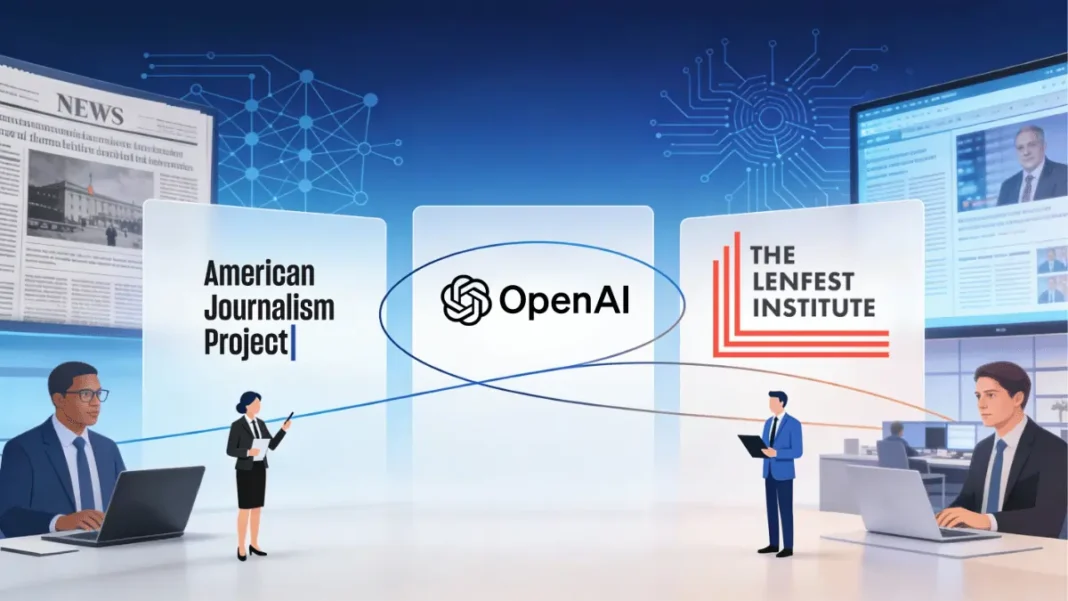
Summary: OpenAI launched the OpenAI Academy for News Organizations on December 17, 2025, partnering with the American Journalism Project and The Lenfest Institute to provide AI training, tools, and resources specifically designed for journalists and publishers. This free learning hub aims to help news organizations ethically integrate AI technologies while maintaining editorial standards, building on OpenAI’s previous $10 million collaboration with newsrooms. The Academy offers training programs, tool access, and peer learning opportunities to address the journalism industry’s sustainability challenges through AI innovation.
OpenAI unveiled the OpenAI Academy for News Organizations on December 17, 2025, a dedicated learning hub designed to train journalists and publishers on effectively using artificial intelligence. Developed through partnerships with the American Journalism Project and The Lenfest Institute for Journalism, this initiative aims to democratize AI access for news organizations of all sizes while addressing the industry’s ongoing sustainability crisis.
QUICK ANSWER: OpenAI Academy for News Organizations is a new free training platform launched in partnership with the American Journalism Project and The Lenfest Institute, providing journalists and publishers with AI education, tools, and best practices to enhance newsroom operations and business sustainability.
What Is OpenAI Academy for News Organizations?
Core Mission and Purpose
The OpenAI Academy for News Organizations serves as a centralized platform where news institutions can access OpenAI’s resources, expertise, and AI technologies. Unlike consumer-focused AI tools, this Academy specifically addresses journalism workflows from investigative research and data analysis to audience engagement and archive utilization.
The initiative recognizes that local and independent news organizations face disproportionate challenges accessing cutting-edge technology. By providing structured training and direct tool access, OpenAI aims to level the playing field between large media conglomerates and smaller newsrooms struggling with limited technology budgets.
Partnership Structure
Three organizations power this Academy:
- OpenAI provides the AI technology, infrastructure, and technical expertise
- American Journalism Project contributes journalism-specific curriculum design and industry connections
- The Lenfest Institute for Journalism offers implementation frameworks based on its previous AI fellowship programs
This partnership model ensures the Academy balances technological capability with journalistic ethics and practical newsroom needs.
Who’s Behind This Initiative?
American Journalism Project’s Role
The American Journalism Project (AJP) focuses on building sustainable business models for local news organizations. Their involvement ensures the Academy’s curriculum addresses real revenue challenges and operational inefficiencies facing newsrooms today. AJP brings experience supporting independent journalism ventures and understanding which AI applications deliver measurable business impact versus theoretical benefits.
The Lenfest Institute Connection
The Lenfest Institute for Journalism has pioneered AI experimentation in news organizations since 2024. Their $10 million AI Collaborative and Fellowship program launched with OpenAI and Microsoft in October 2024 tested AI implementations across major metro newsrooms including The Philadelphia Inquirer, Chicago Public Media, The Minnesota Star Tribune, Newsday, and The Seattle Times.
Jim Friedlich, Lenfest’s executive director and CEO, emphasized that the Academy represents an expansion of lessons learned from those initial fellowships. The Institute contributes proven frameworks for ethical AI adoption, risk mitigation strategies, and success metrics refined through 14 months of newsroom experimentation.
OpenAI’s Journalism Commitment
Tom Rubin, OpenAI’s chief of Intellectual Property and Content, previously stated that “while nothing will replace the central role of reporters, AI technology can help in the research, investigation, distribution and monetization of important journalism“. The Academy formalizes this philosophy into actionable training programs.
OpenAI has already expanded its Academy concept globally, launching initiatives in India in August 2024 and scaling online resource hubs in March 2024. The journalism-specific branch represents the company’s recognition that news organizations require specialized AI education distinct from general enterprise or educational applications.

What Training and Resources Are Included?
AI Literacy Programs
The Academy offers foundational education demystifying AI concepts for journalists without technical backgrounds. Training modules cover:
- Machine learning fundamentals and how language models process information
- Natural language processing (NLP) applications in content analysis
- Prompt engineering techniques for research and drafting workflows
- AI output verification and fact-checking methodologies
This literacy component ensures journalists understand AI capabilities and limitations before implementing tools in live production environments.
Hands-On Tool Access
Participants receive access to OpenAI’s enterprise-grade technologies, potentially including:
- ChatGPT Advanced Voice features for interview transcription and analysis
- GPT-4o for document synthesis and research assistance
- Custom GPT configurations tailored to specific beats or newsroom standards
- API access for integrating AI into existing content management systems
Microsoft’s partnership in the previous Lenfest program provided $2.5 million in software credits, suggesting the Academy likely includes Azure-based AI services and infrastructure support for larger implementation projects.
Best Practice Documentation
The Academy compiles case studies and implementation guides from the 2024-2025 Lenfest AI Fellowship cohort. These resources document what worked and what failed when newsrooms applied AI to:
- Public data analysis and investigative database building
- Visual archive digitization and searchability improvements
- Audience engagement personalization
- New AI-powered news products and revenue streams
Participating organizations agreed to share results publicly, creating a knowledge base that benefits the broader journalism industry.
How This Differs from Previous OpenAI Journalism Programs
The $10 Million Lenfest-OpenAI-Microsoft Collaboration
In October 2024, OpenAI and Microsoft each contributed $5 million ($2.5 million cash plus $2.5 million in credits) to fund the Lenfest Institute AI Collaborative and Fellowship. That two-year pilot program supported eight large independent metro newsrooms through intensive AI experimentation with dedicated fellows and consultancy support from FT Strategies and Nota.
The program expanded in June 2025 to include ProPublica and four additional publishers. Fellows worked directly on projects like building AI tools for investigative reporting, archive monetization, and audience development.
Evolution from Fellowship to Academy
The new Academy scales beyond the fellowship’s limited cohort model. While fellowships provided deep, consultancy-style support to select large newsrooms, the Academy offers broader access through self-directed learning modules, peer communities, and distributed resources.
This shift mirrors the broader OpenAI Academy strategy: moving from pilot programs to scalable education infrastructure. The journalism Academy benefits from 14 months of real-world testing data that the earlier fellowship cohorts generated.
KEY DIFFERENCE: The Lenfest AI Fellowship provided $10 million in direct funding and enterprise credits to 13 large metro newsrooms for intensive AI projects. The new Academy offers scalable training and resources accessible to news organizations of all sizes without the competitive application process.
Who Can Apply and Eligibility Requirements?
OpenAI has not yet released formal eligibility criteria or application processes for the Academy. Based on the announcement’s emphasis on democratizing AI access and partnering with organizations focused on local news sustainability, the Academy likely prioritizes:
Probable eligible organizations:
- Independent local news outlets
- Digital-native journalism startups
- Regional newspaper chains
- Nonprofit newsrooms
- Investigative journalism centers
- Journalism schools and training programs
Potential requirements:
- Active news publishing operation (not individual freelancers)
- Editorial independence and ethical journalism standards
- Commitment to transparency about AI usage
- Willingness to share learnings with the broader journalism community
The Academy announcement emphasizes making AI resources more accessible to smaller organizations that lack enterprise technology budgets, suggesting fewer barriers than the competitive Lenfest Fellowship application process.
Real-World Applications: AI in Newsrooms Today
Investigative Reporting Enhancement
The Lenfest Fellowship participants tested AI for analyzing large public datasets, think campaign finance records, court documents, or government spending databases. AI excels at pattern recognition across thousands of records that would take human journalists months to review manually.
Example workflow: A reporter uploads 10,000 city contractor payment records to a custom GPT trained on procurement regulations. The AI flags unusual payment patterns, contract award timing anomalies, and vendors with multiple subsidiaries creating investigative leads the reporter then verifies through traditional source work.
Archive and Data Analysis
News organizations possess decades of published content and visual archives that remain largely unsearchable. AI-powered digitization and indexing turns these archives into revenue-generating assets through licensing, educational products, and enhanced reader engagement.
Example workflow: The Seattle Times used AI to analyze 100 years of photograph archives, automatically generating captions, identifying locations, and tagging subjects. This made historical content discoverable for modern readers and created new subscription packages focused on local history enthusiasts.
Audience Engagement Tools
AI personalizes content discovery and newsletter curation based on individual reader behavior patterns. Chicago Public Media experimented with AI-generated podcast summaries and automated social media post variations optimized for different platforms.
Limitation: Newsrooms must balance personalization benefits against filter bubble risks and editorial judgment about what readers “need to know” versus what algorithms predict they’ll click.
Potential Benefits for Publishers
Revenue Innovation Opportunities
AI enables new product development that smaller newsrooms previously couldn’t afford:
- Automated local data dashboards (crime stats, school performance, housing prices)
- Personalized newsletter products without expanding editorial staff
- Archive monetization through searchable historical databases
- AI-assisted sponsored content creation that maintains editorial voice
The Lenfest Institute emphasizes that AI business solutions must “uphold the highest ethical standards while strengthening future prospects”, balancing innovation with journalism integrity.
Operational Efficiency Gains
AI handles repetitive tasks that don’t require editorial judgment:
- Transcribing hours of council meetings or interviews
- Generating first drafts of earnings reports or sports recaps for human editing
- Social media post scheduling and performance analysis
- SEO optimization recommendations for published stories
This efficiency doesn’t eliminate journalism jobs but redirects human effort toward high-value investigative and explanatory work.
Competitive Technology Access
The Academy provides small newsrooms access to enterprise-grade AI technologies that typically require six-figure annual budgets. This levels the playing field against large media companies already deploying AI at scale, ensuring independent journalism remains technologically competitive.
Ethical Considerations and Limitations
Editorial Independence Safeguards
OpenAI’s partnership with journalism organizations raises questions about editorial influence and content licensing deals. The Academy must establish clear boundaries between AI tool provision and editorial decision-making.
Critical safeguard: News organizations retain full editorial control over AI implementation decisions and published content. OpenAI provides technology and training not content guidance or editorial direction.
Transparency Requirements
Teresa Hutson, Microsoft’s corporate vice president for technology and fundamental rights, emphasized that Lenfest fellows must “provide examples of how AI can build a better future for the business of news”. This implies transparency obligations where participating newsrooms disclose:
- Which AI tools they use and for what purposes
- How they verify AI-generated content before publication
- Clear labeling when AI assists in content creation
- Data usage and reader privacy protections
AI Attribution Standards
The journalism industry lacks consensus on AI attribution standards. Questions remain:
- Does AI-assisted research require disclosure if human journalists verify everything?
- How should newsrooms label AI-generated summaries or translations?
- What constitutes sufficient human editorial oversight for AI-drafted content?
The Academy curriculum must address these evolving ethical debates and help participating organizations develop transparent policies.
Known limitation: OpenAI’s models occasionally generate false information (“hallucinations”). Journalists must verify all AI output through traditional source checking. AI accelerates research but doesn’t replace verification.
- Democratizes enterprise AI access for small newsrooms lacking technology budgets
- Built on proven frameworks from $10M Lenfest fellowship with 14 months of real-world testing
- Industry-specific training addressing journalism workflows versus generic AI education
- Peer learning opportunities through case studies from metro newsroom implementations
- Partnership credibility with respected journalism organizations (AJP, Lenfest) balances tech provider influence
- Business sustainability focus addressing revenue challenges and operational efficiency
- Ethical framework emphasis including transparency standards and editorial independence safeguards
- Very early stage with no published eligibility criteria, application process, or curriculum details
- Potential geographic limitations if US-focused initially, excluding international newsrooms
- Unclear sustainability model for the Academy itself beyond pilot phase
- Risk of AI over-reliance if newsrooms adopt tools without sufficient human oversight training
- Content licensing concerns given OpenAI’s separate publisher agreements and data usage questions
- Technology lock-in risk if newsrooms become dependent on proprietary OpenAI tools
- Unproven at scale since previous fellowship supported only 13 hand-selected large newsrooms
How to Get Started with OpenAI Academy
Since the Academy announcement is just hours old, application details haven’t been published. Interested news organizations should:
- Monitor OpenAI’s official channels: Watch openai.com/news and the American Journalism Project and Lenfest Institute websites for application announcements
- Review Lenfest AI Fellowship case studies: Study the $10 million fellowship program results to understand AI applications that worked for similar newsrooms
- Assess organizational readiness: Evaluate your newsroom’s current AI literacy, technical infrastructure, and capacity to implement new workflows
- Develop AI use case proposals: Identify specific newsroom challenges where AI might help data analysis bottlenecks, archive underutilization, audience engagement gaps
- Connect with journalism AI communities: Join existing programs like LSE’s JournalismAI Academy or NCTJ’s AI training to build foundational knowledge before applying
Frequently Asked Questions (FAQs)
Is OpenAI Academy for News Organizations free?
The announcement doesn’t specify pricing, but the emphasis on democratizing access and partnerships with nonprofit journalism organizations suggests free or subsidized access modeled on OpenAI’s other Academy programs. The previous Lenfest fellowship provided free training plus direct funding.
Can individual freelance journalists apply?
Based on the “news organizations” framing, the Academy likely targets established newsrooms rather than individual journalists. Freelancers should explore OpenAI’s general Academy programs or journalism-specific training from LSE’s JournalismAI and NCTJ.
What AI models and tools does the Academy provide access to?
Specific tools haven’t been announced. The previous Lenfest collaboration included OpenAI API access and Microsoft Azure credits, suggesting participants receive enterprise-grade ChatGPT, GPT-4o, and potentially specialized journalism tools developed during the fellowship pilot.
How does this differ from general AI training for journalists?
The Academy focuses specifically on business sustainability and revenue innovation for news organizations, unlike general AI literacy programs. It includes direct tool access, newsroom-specific case studies, and peer learning from publishers solving similar challenges.
Does participating require content licensing deals with OpenAI?
The announcement makes no mention of content licensing requirements. OpenAI has separate content partnerships with publishers like The Atlantic, Vox Media, and News Corp, but those appear distinct from Academy participation. However, applicants should clarify intellectual property terms before sharing proprietary content or data.
What happens if AI-generated content contains errors?
News organizations maintain full editorial responsibility for published content regardless of AI involvement. The Academy training emphasizes verification workflows and human oversight requirements. Participating newsrooms must develop internal standards for fact-checking AI output before publication.
Will the Academy help with AI ethics policies?
Based on the Lenfest Institute’s previous emphasis on “ethical uses of AI” and “highest ethical standards”, the Academy curriculum likely includes ethics frameworks, transparency guidelines, and bias detection protocols developed during the fellowship pilot.
Can international news organizations apply?
The Academy’s global scope remains unclear. OpenAI operates country-specific Academies in India and general online hubs, suggesting potential geographic expansion beyond US-based American Journalism Project and Lenfest Institute partners.

Featured Snippet Boxes
Program Definition
OpenAI Academy for News Organizations is a free learning hub launched December 17, 2025, through partnerships with the American Journalism Project and The Lenfest Institute. It provides journalists and publishers AI training, enterprise tool access, and best practices for sustainable news business innovation.
Partnership Overview
Three organizations power the Academy: OpenAI provides AI technology and expertise, the American Journalism Project contributes journalism curriculum design, and The Lenfest Institute offers implementation frameworks from its $10 million AI fellowship program with OpenAI and Microsoft.
Eligibility (Provisional)
Formal eligibility criteria haven’t been released yet. The Academy likely targets independent news organizations, local newsrooms, investigative journalism centers, and journalism schools rather than individual freelancers, based on its mission to democratize AI access for under-resourced publishers.
Core Training Components
The Academy offers AI literacy education for non-technical journalists, hands-on access to OpenAI’s enterprise tools, and documented best practices from 2024-2025 newsroom AI implementations including investigative reporting, archive analysis, and audience engagement applications.
Ethical Safeguards
Participating newsrooms maintain full editorial independence and content control. The Academy emphasizes transparency requirements including AI usage disclosure, output verification protocols, and clear reader attribution when AI assists content creation or research.
Business Benefits
AI enables news organizations to develop new revenue products like automated local data dashboards, personalized newsletters, searchable archives, and operational efficiency gains through automated transcription and routine content generation.

