

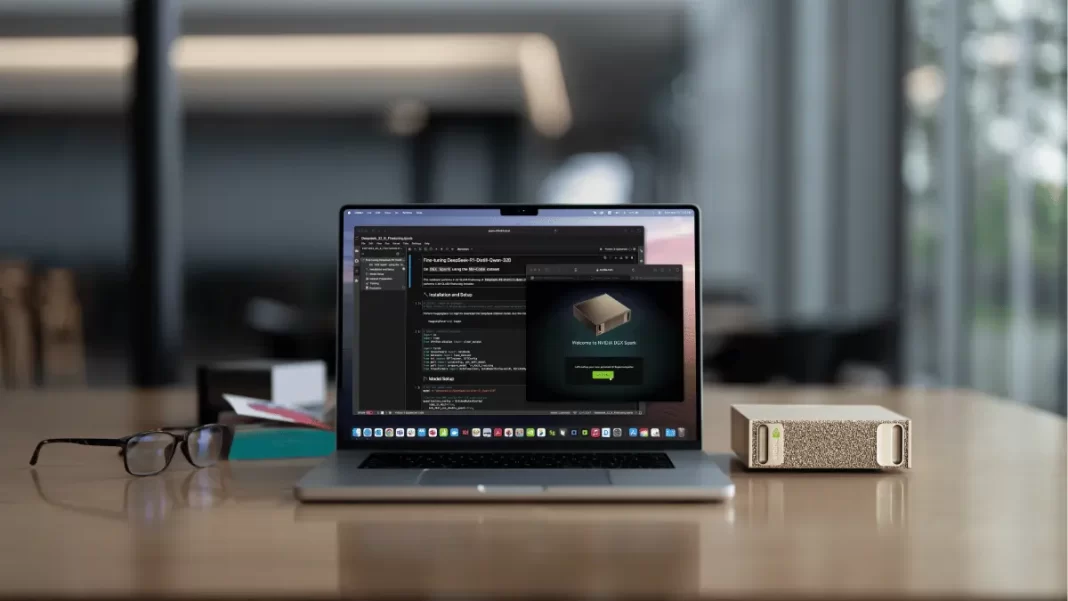
What is DGX Spark
A desk-friendly AI computer powered by NVIDIA’s GB10 Grace Blackwell Superchip with 128GB unified memory and about 1 PFLOP FP4 AI performance. It’s built for local prototyping, fine-tuning, and inference of modern models, then handing off to cloud or cluster when you need scale.
Price and availability: Listed at about $3,999 in early retail postings, with shipments starting mid-October 2025 depending on region and partners.
Headline specs: GB10 Superchip, 20-core Arm CPU, 128GB unified memory, up to 4TB NVMe, ConnectX-7, Wi-Fi 7, 150×150×50.5 mm, ~1.2 kg.
Table of Contents
Pros and Cons
Pros
- Big unified memory for very large models on a desk-friendly box
- Full NVIDIA AI stack and NIM, easy handoff to cloud
- Quiet footprint, standard power, small chassis
Cons
- FP4 headline can be misunderstood vs FP8/FP16 needs
- Not a replacement for multi-GPU training rigs
- Early demand may outpace supply at launch

Understanding DGX Spark: Capabilities and Limitations
DGX Spark is positioned as “the world’s smallest AI supercomputer,” a compact box that mirrors NVIDIA’s datacenter stack on your desk. The point is speed of iteration, not replacing a full rack or a cloud pod. You get coherence between CPU and GPU over NVLink-C2C, a modern AI software stack, and enough unified memory to work with very large models locally for inference or fine-tuning.
It isn’t a magic replacement for serious training. A petaflop at FP4 is impressive for on-desk development, but end-to-end training of frontier-scale models still belongs in multi-GPU servers or the cloud. Plenty of devs will prototype locally, validate, then scale to bigger iron. NVIDIA’s own docs steer you toward that hybrid flow.
Why unified 128GB memory matters
Large, coherent memory changes the shape of what you can do without sharding or elaborate offload tricks. With 128GB unified memory, Spark is marketed to run models “up to 200B parameters” locally for development work, which opens the door to testing long-context prompts, running high-parameter inference, or applying low-rank fine-tuning methods without juggling as much memory mapping.
FP4 performance, precision, and that “1 PFLOP”
The “1 PFLOP” figure is FP4 with sparsity. That’s ideal for certain inference and fine-tuning paths, but you’ll still lean on higher-precision modes for stability in some training steps. Treat the petaflop line as a ceiling for targeted workloads, not a blanket promise for every operation.
Workloads that fit well
- Rapid prototyping of assistants and RAG systems
- Fine-tuning and inference for large models to validate ideas
- Robotics sims and local policy testing before deployment
- On-prem work that can’t leave the lab for policy reasons
NVIDIA frames Spark exactly this way: build locally, deploy to DGX Cloud or a hyperscaler when ready.
DGX Spark specs and design
Compute: GB10 Grace Blackwell Superchip with fifth-gen Tensor Cores and an Arm CPU with 20 total cores.
Memory: 128GB coherent unified memory.
Networking: ConnectX-7 SmartNIC, 10GbE, Wi-Fi 7, Bluetooth 5.x.
Storage: Up to 4TB NVMe.
I/O and size: 1× HDMI 2.1a, USB-C ports, 150×150×50.5 mm, ~1.2 kg. Fits in a small bag.
Small note on power and acoustics: early listings show a 240W supply class and a console-like physical footprint, which should be desk-friendly for most offices.
Setup and software
Spark ships with DGX OS and the NVIDIA AI stack preloaded, plus access to NIM microservices. Most common frameworks and toolkits are ready to go. The big workflow benefit is that you can keep your code and dependency choices consistent across laptop-to-Spark-to-cloud.
Example dev flow:
- Prototype prompts, tools, and data loaders locally on Spark.
- Run fast-feedback LoRA fine-tunes and sanity checks.
- When the job needs throughput, push the same container to your cloud of choice. NVIDIA’s docs and partner tutorials show that handoff.
Can you really work with 200B-parameter models?
Short answer: for inference and certain fine-tuning approaches, yes in a development sense. The 200B figure assumes FP4 and careful memory use. It does not mean training a 200B model from scratch on a single Spark box. Pair two Sparks via ConnectX-7 and you can target even larger inference footprints, but token throughput and latency will reflect the hardware’s limits. Use this to validate ideas before scaling up.
Community reports echo the same caution: treat Spark as a dev and validation platform, not a production training rig.
DGX Spark vs DGX Station vs a DIY RTX PC vs cloud
At a glance
| Option | Memory model | Peak AI perf (headline) | Best for |
|---|---|---|---|
| DGX Spark | 128GB unified | ~1 PFLOP FP4 | Local prototyping, fine-tuning, inference, policy-limited work |
| DGX Station | ~784GB unified | ~20 PFLOPS FP4 | Team-level desktop training and heavy inference without a rack |
| DIY high-end RTX PC | 24–64GB VRAM per GPU | High FP16/FP8, strong gaming drivers | Vision work, mixed creator + AI, cheaper parts over time |
| Cloud GPUs | Scales to many GPUs | Depends on instance | Burst training, big experiments, fast iteration with budget |
Figures for Station come from NVIDIA’s March announcement and may vary by partner SKU.
Cost and time trade-offs
- Spark is a fixed, lower up-front cost with predictable power and space.
- DIY PCs are flexible and upgradeable, but VRAM ceilings can be a blocker for 100B-class models.
- Cloud is unmatched for big training runs and short bursts, but costs spike if you leave instances running.
- Station sits in between: big memory, serious performance, higher price bracket.
Who should pick what
- Solo devs, labs, and classrooms that need privacy and quick iteration: Spark.
- Teams doing frequent heavy runs without a rack room: Station.
- Vision-heavy creator workflows and gaming on the side: DIY RTX PC.
- Training runs that must finish by Friday: cloud GPUs.
Comparison Table DGX Spark vs DGX Station vs DIY RTX PC vs Cloud
| Feature | DGX Spark | DGX Station | DIY RTX PC | Cloud GPUs |
|---|---|---|---|---|
| CPU/GPU | GB10 Superchip | GB300 Superchip | Consumer/Pro GPUs | Varies |
| Unified memory | 128GB | ~784GB | 24–64GB VRAM per GPU | Varies |
| Perf headline | ~1 PFLOP FP4 | ~20 PFLOPS FP4 | High FP16/FP8 | Scales |
| Best for | Prototype, tune, inference | Heavier local training | Mixed creator + AI | Burst training at scale |
| Footprint | 150×150×50.5 mm | Desktop tower | Mid/full tower | None on-prem |
Mini case study: startup path
A three-person startup uses Spark to prototype a multilingual support agent on a 70B base with LoRA, tests prompt strategies locally, then ships the container to a cloud A100/Blackwell instance for a 24-hour fine-tune and batch inference. Local iteration cuts the “idea to test” loop from days to hours, and the cloud handles the one-off heavy lift. This is the pattern NVIDIA is encouraging with Spark.
Pricing and availability
Early retail shows $3,999.99 for Founder’s Edition-class units in the U.S., with partner systems to follow. NVIDIA’s marketplace lists Spark as sold out at times, and press materials confirm shipment timing with partner OEMs. Expect rolling availability by region through partners like ASUS, Dell, HP, and Lenovo.
Frequently Asked Questions (FAQs)
Is DGX Spark good for training from scratch?
Not for large models. Use it for prototyping and fine-tuning, then scale to bigger systems.
Can it really handle 200B models?
For inference and certain tuning flows with FP4 and smart memory use, yes in a dev context. Not a blanket promise for raw training.
What makes it different from a gaming PC with an RTX card?
Memory and coherence. Spark’s 128GB unified memory and NVLink-C2C change how large models fit and run locally.
How big is it?
About 150×150×50.5 mm, roughly 1.2 kg. Very small.
How much does it cost?
Early U.S. retail shows about $3,999.99. Regional prices may vary.
What about the DGX Station?
Station uses GB300 and far larger unified memory, aimed at heavier work. It also costs far more.
The Bottom Line and Checklist
DGX Spark is the most practical way to prototype with very large models on a desk. It won’t replace a server or cloud, but it will speed your build-measure-learn loop while keeping data local.
Before you buy
- You need local privacy or offline iteration
- Your workloads are fine-tunes and inference, not massive pretraining
- You can hand off to cloud when jobs outgrow the box

Featured Snippet Boxes
What is NVIDIA DGX Spark?
A palm-size AI computer with a GB10 Grace Blackwell Superchip, 128GB unified memory, and roughly 1 PFLOP FP4 performance for local prototyping, fine-tuning, and inference.
How much does DGX Spark cost?
Early U.S. retail shows about $3,999.99 for the base unit. Regional pricing may vary with partners and storage options.
Can DGX Spark handle 200B models?
Yes for inference and select fine-tuning paths using FP4 and unified memory. It’s not intended for full training from scratch.
DGX Spark vs DGX Station
Spark focuses on desk-side dev with 128GB memory, while Station targets heavier work with far larger unified memory and higher FP4 performance.

