

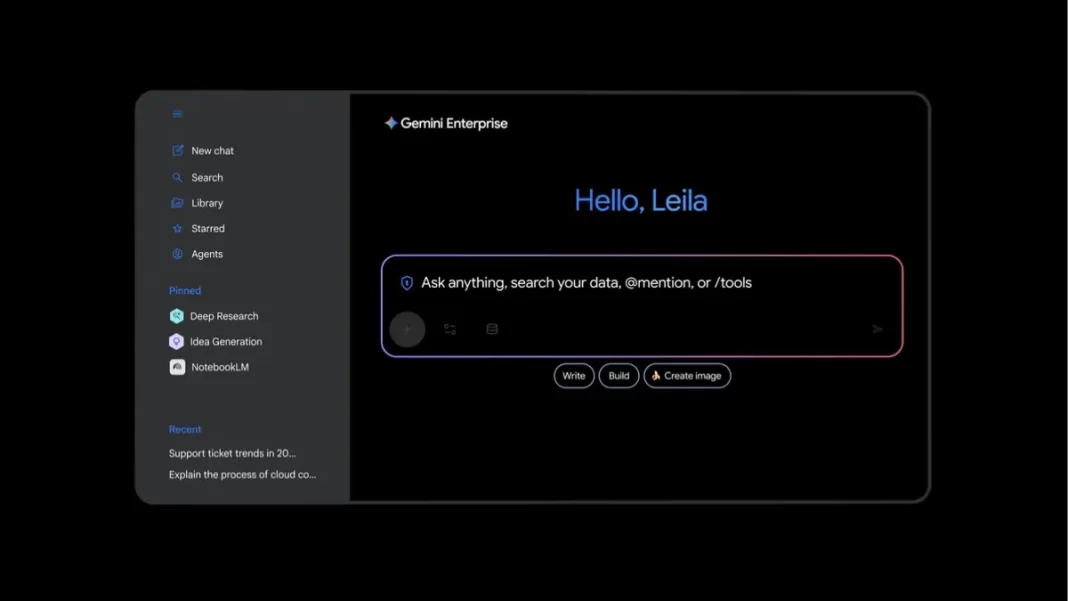
Most teams test AI in pockets one tool for notes, another for search, a third for docs. Work gets scattered. Gemini Enterprise tries to fix that: it pulls your tools, data, and people into one AI hub so anyone can build or use agents that actually finish work, not just draft text. Below are four ways it helps today, with pricing, security notes, and when it beats alternatives.
Gemini Enterprise is Google’s agentic AI platform for work. It adds prebuilt agents (like Deep Research), a no-code builder, and connectors to Workspace, Microsoft 365, Salesforce, and SAP. Pricing starts at $21 for Business and $30 for Enterprise editions (annual). It’s built for whole-workflow automation with enterprise-grade governance.
What is Gemini Enterprise?
It’s a platform, not just a chatbot. Users chat to search/analyze info and trigger agents that can chain steps, pull company context, and hand back results inside the apps you already use. Think “front door for AI at work.”
Table of Contents
How it differs from a chatbot
Unlike a single model in a window, Gemini Enterprise bundles: prebuilt Google agents (Deep Research, NotebookLM, Coding), a no-code workbench for custom agents, and governance to deploy them safely across teams.
Editions and pricing at a glance
- Gemini Business: small teams; starts at $21/seat/month (annual)
- Gemini Enterprise (Standard/Plus): larger orgs; starts at $30/seat/month (annual); adds higher quotas, advanced security, governance, and optional Frontline add-on.

The 4 ways it helps today
1) Give every team an AI specialist
Prebuilt agents handle heavy lifting from day one: Deep Research to explore sources and synthesize, NotebookLM for document grounded analysis, and Coding Agents for dev workflows. Teams can also build no-code agents to match their processes. Marketing can spin up campaign ideas on brand assets in minutes instead of days.
2) Connect the dots across business data
Gemini taps your docs, sheets, email, drive, plus Microsoft 365, Salesforce, SAP, and BigQuery. That context helps agents answer with specifics product SKUs, contract terms, last quarter’s numbers without copy paste.
3) Automate workflows, not just tasks
The platform can orchestrate multi-step processes across apps. Example: Macquarie Bank’s help center search directs 38% more users to self-service and cut false-positive security alerts by 40% using Google Cloud AI; that’s the kind of end-to-end lift the platform targets.
4) Use powerful AI in tools you already use
Gemini meets users where they work. In Google Workspace, early highlights include Meet with real-time speech translation and Google Vids to turn a presentation into a narrated video. The point: keep flow, reduce app-switching.
Real-world examples (what changed)
- Banco BV: automates hours of analytics grunt work for relationship managers.
- Harvey (legal): faster contract analysis/compliance via deep context.
- Macquarie Bank: +38% self-service, −40% false positives (above).
These examples show agents doing multi-step, domain-aware work not just drafting text.
Pricing & editions: which one fits?
- Business ($21): small teams or departmental pilots that want quick value, pooled storage (25 GiB/seat), connectors, and prebuilt agents. Seat cap tops out at 300.
- Enterprise Standard/Plus ($30): unlimited seats, higher quotas, advanced governance (VPC-SC, CMEK), data residency, and Code Assist Standard included. Frontline add-on available. Storage up to 75 GiB/seat. Best for org-wide rollouts.
Note on pricing context: Today’s press coverage and Google’s product page consistently list $30 for Enterprise editions and $21 for Business on annual plans.
Security, data use, and compliance
- Data use: For paid Business and Enterprise (Standard/Plus), your prompts/outputs aren’t used to train Google’s models. (Starter/free after trial has different terms.)
- Admin & history: Conversation history retention is admin-controlled in Workspace Admin; Gemini app can be turned on/off by admins.
- Residency/sovereignty: Enterprise editions support data residency boundaries (EU/US multi-regions) and governance features.
Gemini Enterprise vs Microsoft Copilot vs ChatGPT Team
Price & fit (quick view)
| Platform | List price (USD) | Seat min | Strengths | Typical fit |
|---|---|---|---|---|
| Gemini Enterprise (Std/Plus) | $30/seat/mo (annual) | 1+ | Agentic platform, prebuilt + no-code agents, Workspace & M365 connectors, governance (VPC-SC, CMEK) | Org-wide automation + governance first |
| Gemini Business | $21/seat/mo (annual) | 1–300 | Quick value for teams; connectors; prebuilt agents | Team pilots, SMB |
| Microsoft Copilot for M365 | $30/seat/mo (annual) | varies | Deep Office integration; Copilot Studio for custom | M365-centric orgs |
| ChatGPT Team | $25–30/seat/mo | 2+ | General AI, workspace, no training on your team data | Small teams, knowledge work |
When Gemini Enterprise makes more sense:
- You need data-aware agents that move across Workspace and M365/CRM/ERP.
- You require governance (CMEK, VPC-SC) and residency.
- You want a no-code builder to let business teams create safe, reusable agents.
Rollout: a practical 30-day pilot plan
Admin basics: In Admin Console, toggle Gemini app for pilot users; confirm conversation history settings and app-level controls.
Pilot steps:
- Week 1: Choose two “boring but valuable” workflows (e.g., RFP response, monthly performance report). Baseline minutes spent, error rates.
- Week 2: Use a prebuilt agent (Deep Research) + a simple no-code agent. Connect Drive/Docs + one CRM/BI source.
- Week 3: Expand to one cross-app orchestration (e.g., summarize CRM notes → draft emails → set tasks).
- Week 4: Measure savings (minutes saved, handoffs cut, accuracy), push best agent to 50–100 users, collect feedback.
Track: time saved, output quality, revision count, cycle time, and % work completed end-to-end in the platform.
The Bottom Line
Gemini Enterprise is an agentic platform to unify data, apps, and teams. It ships with prebuilt agents, a no-code builder, and enterprise-grade governance. Pricing starts at $30/seat/mo for Enterprise and $21 for Business (annual). If you need cross-app, data-aware workflows with compliance and admin control, it’s worth a serious pilot.
Frequently Asked Questions (FAQs)
Gemini Business vs Enterprise what’s the difference?
Business targets small teams and pilots; Enterprise adds unlimited seats, higher quotas, advanced security (e.g., CMEK, VPC-SC), and data residency options.
Is it available globally?
Enterprise supports EU/US multi-regions and standard Google Cloud geographies; check your country and residency needs in product docs.
Which languages are supported?
Workspace with Gemini supports major languages across Docs, Chat, and Meet features; coverage varies by feature.
What prebuilt agents are included?
Google-made agents like Deep Research, NotebookLM, and Coding Agents are available, plus a marketplace for partner agents.
Can non-technical teams build agents?
Yes there’s a no-code workbench for business users to build and share agents.
How does it compare to Microsoft Copilot?
Copilot is $30 and tightly integrated with Microsoft apps; Gemini Enterprise emphasizes cross-stack agents, connectors, and Google’s governance features. Choose based on stack and governance needs.
Is ChatGPT Enterprise comparable?
ChatGPT Team is $25–30/seat; Enterprise is custom-priced. Gemini Enterprise differs by shipping agent orchestration and deep Google ecosystem ties.

Featured Snippet Boxes
What is Gemini Enterprise?
Google’s enterprise AI platform that lets employees chat with data and run agents to automate multi-step work across Workspace, Microsoft 365, CRM/ERP, and more with prebuilt agents, a no-code builder, and governance.
How much does Gemini Enterprise cost?
Annual plans start at $30 per seat per month for Enterprise Standard/Plus. Gemini Business for small teams starts at $21 per seat per month.
Does Google train on my enterprise data?
For paid Business and Enterprise editions, Google says prompts and outputs aren’t used to train its models. Admins retain control over retention and history.
What are the four big benefits?
1) Prebuilt/custom AI specialists; (2) unified context from your tools/data; (3) workflow orchestration; (4) native use inside Workspace tools like Meet and Vids.

