

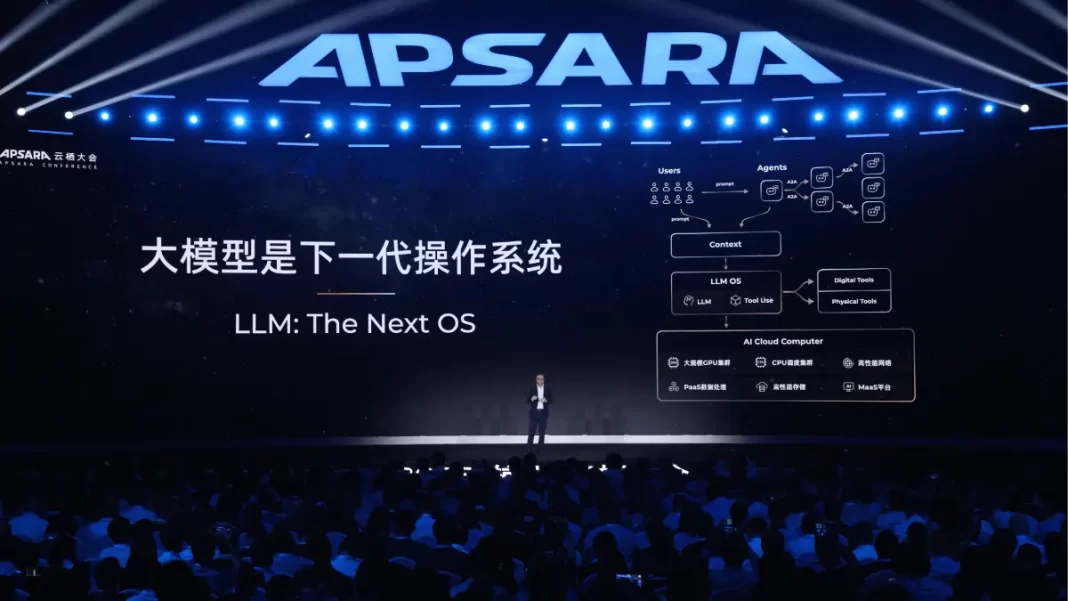
Alibaba Cloud’s 2025 roadmap centers on bigger models (Qwen3-Max), real-time multimodal (Qwen3-Omni), agent tools (Model Studio ADK/ADP, AgentBay, Lingyang AgentOne), and infra tuned for agents (Vector Bucket, 800 Gbps HPN8.0, CTDR, 15k pods/min). It’s a full-stack push aimed at faster builds and cheaper scale.
What changed and why it matters
Alibaba Cloud used Apsara 2025 to present a single, end-to-end story: models → agent tooling → infra. That coherence is what many buyers want less glue code, more out-of-the-box acceleration. For engineering teams, the pitch is speed (benchmarks), simplicity (ADK/ADP), and scale (networking, storage, autoscaling).
Table of Contents

The models: Qwen3-Max, Qwen3-Omni, Qwen3-VL, Wan2.5
Qwen3-Max (1T parameters). Reported at 69.6 on SWE-Bench Verified, it’s framed as a coding/agent workhorse. Parameter count isn’t everything, but SWE-Bench is a good proxy for “fix actual software.” If your backlog includes bug-bashing or refactors, it’s worth a trial against your current model.
Qwen3-Omni. A live, multimodal model that handles text, images, audio, and video with real time speech. Think “assistant in your car or glasses” rather than a web chat. This matters if your use case needs streaming, low latency responses.
Qwen3-VL. A vision language model positioned as a “visual agent,” with spatial understanding that helps in robotics-ish tasks and design to code workflows. If you turn Figma frames into front ends or parse diagrams, this is relevant.
Wan2.5 (preview). Video generation gets to ~10 seconds with native audio enough for reels, ads, or quick concepts. It’s not movie length yet, but paired with templates it can speed content experiments.
Building agents: ADK vs ADP, AgentBay, Lingyang AgentOne
Model Studio ADK (high-code) gives engineers primitives to express business logic as agent policies. Use it when you have devs who can wire tools, memory, and workflows. Model Studio ADP (low-code) lets product folks or analysts assemble lightweight agents with less code. Use it to prototype and validate value fast.
AgentBay adds a self-evolving engine, custom containers, and built-in safety/compliance. If your org wants “agents as internal workers,” this reduces devops toil. Lingyang AgentOne targets enterprises connecting agents to existing systems across the sales/marketing/service loop.
Why it’s useful: Many teams stall at “great demo, fragile production.” The ADK/ADP + AgentBay + AgentOne stack is Alibaba Cloud’s answer to productionizing agents with guardrails.
The infrastructure: built for “agentic AI”
- Vector Bucket in OSS. Store raw + vector data together, with standard APIs. If you’ve struggled with patchwork vector DBs and object stores, this reduces complexity for RAG pipelines.
- HPN8.0 networking (800 Gbps). Doubles prior gen throughput important for distributed training, RL, and high fanout inference. For cost control, higher throughput can mean better utilization.
- CTDR with agentic response. Five Qwen powered agents automate threat triage and actions; the post cites a 59%→74% bump in automated investigation success and ~70% automated responses. That’s the first time we’ve seen a concrete “agentic SecOps” claim in a vendor roadmap.
- ACS autoscaling. Up to 15,000 pods/min plus sandbox isolation so a bad agent doesn’t spill risk. If your traffic spikes are bursty, this is the line item to test.
- PolarDB + CXL. -72.3% latency, 16× memory for combined data+AI workloads; Lakebase architecture with Iceberg/Hudi/Lance support for multimodal data management.
- PAI accelerations. MoE training +300%, DiT -28.1% sample time, and big inference TPS/latency wins useful if you own fine-tunes or custom video models.
Costs, coverage, availability
Alibaba Cloud announced international expansion with first data centers in Brazil, France, Netherlands and more regions queued (Mexico, Japan, South Korea, Malaysia, Dubai). For multinational rollouts, this reduces latency/compliance concerns. For creative teams, Model Studio lists Wan video SKUs and pricing handy for quick pilots.
Compared with your alternatives (executive snapshot)
Analysts frame Alibaba Cloud’s direction as “AI-native” i.e., designing cloud around AI, not layering AI on top. Media coverage leans on the 1T-parameter headline and coding scores; our take is the agent stack + infra pairing is the practical differentiator.
| Buyer question | Alibaba Cloud answer (2025) | Why it matters |
|---|---|---|
| Can we ship useful agents fast? | ADK (code) + ADP (low code) + AgentBay + AgentOne | Prototyping to production path in one ecosystem. |
| Will it scale without glue? | HPN8.0, Vector Bucket, 15k pods/min, sandbox | Lower integration tax; safer multi agent ops. |
| Is the model any good? | Qwen3-Max SWE-Bench 69.6; Omni live multimodal | Coding and real time UX covered. |
| Global rollouts? | New DCs in BR/FR/NL; more planned | Latency, data locality options. |
Comparison Snapshot (Pros/Cons)
Pros
- Cohesive agent story (ADK/ADP + AgentBay + AgentOne).
- Strong coding benchmark signals (SWE-Bench).
- Infra built for agent scale (HPN8.0, Vector Bucket, 15k pods/min).
Cons
- Vendor reported numbers need workload validation.
- Regional availability rolling out (confirm DCs, compliance).
- Migration off existing stacks may require refactors.
Try it this week – mini HowTo
- Create an Alibaba Cloud account → Model Studio. Start in ADP to assemble a simple RAG/DeepResearch agent.
- Add knowledge. Store docs in OSS; test Vector Bucket for embeddings + raw assets in one place.
- Pilot Wan. Generate a 6-10s product teaser; log time/cost with the Wan model SKUs.
- Harden. Move to ADK for tool use; deploy in AgentBay with compliance toggles; consider sandbox for isolation.
- Observe. Track query latency, tool success rate, and per session cost; iterate prompts/tools.
Risks & considerations
- Benchmarks are moving targets. Treat SWE-Bench or leaderboards as directional; always A/B on your workloads.
- Region/regulatory fit. Confirm data residency and compliance per workload.
- Vendor sprawl. End to end stacks reduce glue, but raise lock in risk; keep portable patterns (MCP, OpenAPI, export paths).
Featured Snippet Boxes
What is Alibaba Cloud’s AI roadmap for 2025?
A full-stack push: new Qwen3-Max (1T), Qwen3-Omni and Qwen3-VL models; Wan2.5 video; agent tooling via Model Studio ADK/ADP, AgentBay, Lingyang AgentOne; and infra tuned for agents Vector Bucket, HPN8.0 (800 Gbps), CTDR agentic SecOps, ACS autoscaling, PolarDB+CXL.
How good is Qwen3-Max at coding?
Alibaba cites 69.6 on SWE-Bench Verified, a benchmark for fixing real software issues placing it among strong coding models. Validate on your repos before committing.
What’s Wan2.5?
A preview of Alibaba’s video generation suite that pushes to ~10-second clips with native audio and better multimodal alignment useful for marketing tests and concept videos.
ADK vs ADP what’s the difference?
ADK is high-code for engineers building complex, tool-using agents. ADP is low-code for faster prototypes and lightweight workers. Teams often start in ADP, then graduate to ADK.
What infra upgrades matter most for enterprises?
Vector Bucket simplifies RAG storage; HPN8.0 boosts throughput; CTDR’s agentic response automates SecOps tasks; ACS scales to 15k pods/min with sandbox isolation; PolarDB+CXL cuts latency ~72% for AI/data workloads.

Frequently Asked Questions (FAQs)
Is Qwen3-Max open weight or closed?
Most enterprise-class checkpoints are served via API; several Qwen family models are open-sourced. Check licensing per model card.
How do I try Qwen or Wan quickly?
Use Model Studio; look at Wan SKUs and quotas; start with short clips and measure cost/latency.
What is Vector Bucket vs a vector database?
Vector Bucket sits in OSS to co-store raw+vector data, accessed via standard APIs reducing moving parts in RAG systems.
What does HPN8.0 (800 Gbps) actually help?
Higher throughput helps distributed training and inference, improving utilization and stability under heavy agent traffic.
Does Alibaba Cloud have global footprint growth?
Yes new data centers in Brazil, France, Netherlands (and more planned), broadening regional options.
Are the SecOps agent claims verified?
Alibaba cites internal success metrics (investigation 59%→74%); treat as vendor-reported and validate in your SOC.

