

Quick Brief
- TERAFAB is a $20B to $25B joint venture by Tesla, SpaceX, and xAI targeting 1 trillion watts of compute per year
- Most compute will go to space because the entire US electricity grid generates only 0.5 terawatts on average
- The Austin facility integrates chip design, fabrication, testing, and packaging under one roof, targeting 2nm process technology
- Humanoid robot production could eventually reach 1 to 10 billion units annually, creating AI chip demand no existing foundry can satisfy
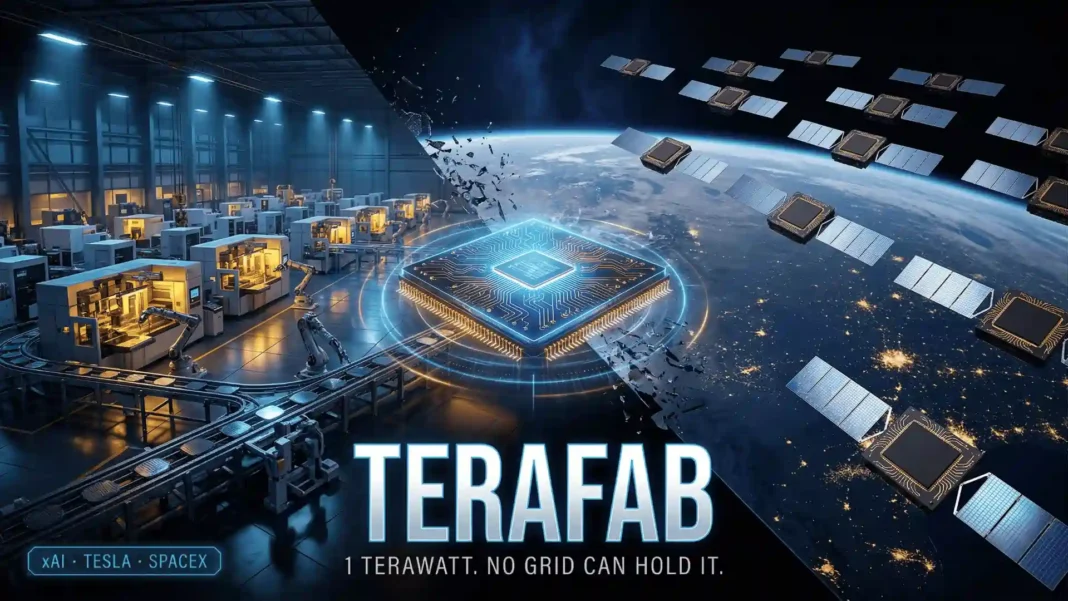
Elon Musk announced TERAFAB on March 21 to 22, 2026, describing it as “the next phase in our journey toward becoming a galactic civilization.” The project does not just aim to build chips faster. It targets a scale of compute so large that Earth’s entire power infrastructure is a physical barrier to achieving it.
Why Earth Cannot Power This Vision
The core constraint driving TERAFAB’s space strategy is concrete and arithmetically inescapable: total US electricity generation averages approximately 0.5 terawatts. Building one terawatt of compute infrastructure on the ground would require more electrical power than the entire United States currently produces, making terrestrial deployment physically impossible at that scale.
Global AI compute capacity today sits at approximately 20 gigawatts per year across all facilities worldwide. TERAFAB’s one-terawatt target is 50 times that figure, a scale that surpasses every semiconductor fab on the planet combined, which currently accounts for roughly 2% of TERAFAB’s annual compute goal.
What TERAFAB Actually Builds
The facility sits at the North Campus of Giga Texas near Austin and integrates lithography mask creation, chip fabrication, testing, and redesign into a single campus. This closed-loop structure is designed to dramatically accelerate improvement cycles compared to today’s fragmented global supply chain. Massive construction is already active at the site as of March 2026.
TERAFAB produces two distinct chip categories:
- Edge inference chips for Tesla’s Cybercab autonomous vehicles, Full Self-Driving systems, and Optimus humanoid robots
- Space computing chips built to withstand high-energy particle bombardment and engineered to run at elevated temperatures, reducing the mass of thermal radiators on orbiting platforms
The factory targets 2nm process technology and one million wafer starts per month. TSMC took 40 years to build its current global network; TERAFAB’s output target at a single site aims to dwarf it.
The Space Compute Architecture
A prototype mini-satellite specification calls for 100 kilowatts of compute output per unit, with future iterations scaling into the megawatt range. Reaching one terawatt of orbital compute would require launching roughly ten million tons of material to orbit each year, based on an efficiency of 100 kilowatts per ton.
Starship V3 can deliver approximately 100 tons to orbit per payload. The forthcoming V4 version would double that to 200 tons. SpaceX has completed more than 500 successful booster landings and reduced launch costs from over $65,000 per kilogram during the Space Shuttle era to an estimated $1,000 to $2,000 per kilogram today.
Musk’s stated target is $100 to $200 per kilogram with Starship optimization, a threshold he projects would make space-based AI deployment cheaper than ground-based alternatives within two to three years. Long-term concepts include lunar-based manufacturing and electromagnetic mass drivers to move materials off the Moon’s surface and into orbit at lower cost than Earth launches.
The Civilization-Scale Framing
Musk framed TERAFAB explicitly as a step toward becoming “a galactic civilization.” The practical mechanism is space-based solar arrays feeding orbital AI clusters at scales no terrestrial grid can match.
Humanoid robot production, which Musk projects could eventually reach one to ten billion units annually compared to roughly 100 million vehicles produced worldwide each year, depends entirely on the edge inference chips TERAFAB will produce. The compute demand from that robot fleet alone would exceed what any existing supply chain can provide, a supply constraint Musk projects will materialize within three to four years even with dual sourcing from TSMC and Samsung.
Tesla’s D3 (Dojo 3) chips are already deployed in SpaceX’s AI satellites, confirming a deep cross-company integration that predates the formal TERAFAB announcement.
Financial Scale and Execution Risks
The joint venture is valued at $20 billion to $25 billion. Tesla, SpaceX, and xAI each contribute distinct assets: Tesla’s manufacturing discipline and silicon design for automotive AI, SpaceX’s launch infrastructure, and xAI’s large-model compute demand as a primary customer.
The execution risks are significant. Musk himself described the talent challenge as “Herculean,” acknowledging a severe industry-wide shortage of semiconductor engineering and manufacturing workers. Achieving 2nm yields at one-million wafer starts per month requires solving lithography and materials science challenges that have strained even the most experienced foundries.
Considerations
TERAFAB’s one-terawatt target has no confirmed production timeline. The project depends on Starship cost reductions not yet achieved at commercial scale, and orbital deployment at ten million tons per year is contingent on launch cadence improvements spanning years. One analyst has noted that building TERAFAB “could be harder than sending rockets to Mars.” The $20B to $25B initial investment covers the ground facility only, not the space infrastructure.
TERAFAB vs. Current Global Compute Infrastructure
| Dimension | Global AI Chip Output Today | TERAFAB Target |
|---|---|---|
| Annual compute capacity | ~20 gigawatts | 1 terawatt (1,000 GW) |
| Share of TERAFAB target | ~2% | 100% |
| Process node (leading fabs) | 3nm to 5nm | 2nm |
| Wafer starts per month | Distributed across dozens of fabs | 1 million at single site |
| Primary power source | Earth grid | Space-based solar arrays |
| Location of compute | Ground-based data centers | Predominantly orbital |
| Launch cost (current) | Not applicable | $1,000 to $2,000/kg, target $100 to $200/kg |

Frequently Asked Questions (FAQs)
What is TERAFAB and who is building it?
TERAFAB is a joint chip manufacturing venture announced in March 2026 by Tesla, SpaceX, and xAI. Located at Giga Texas’ North Campus in Austin, it targets one terawatt of AI compute output per year. The project integrates chip design, fabrication, and packaging under one roof using 2nm process technology.
Why does TERAFAB need to put AI compute in space?
The US electricity grid generates approximately 0.5 terawatts on average. Deploying one terawatt of compute on Earth would require more power than the entire country currently produces. Space-based solar arrays orbiting Earth generate power continuously without those grid constraints, making orbital deployment the only viable path to this scale.
How much does TERAFAB cost?
The joint venture is valued at $20 billion to $25 billion. This covers the ground-based Austin facility. Space deployment infrastructure, including orbital satellites and the expanded Starship launch cadence required to reach terawatt scale, represents additional capital beyond this figure.
What chips will TERAFAB produce?
Two categories: edge inference chips for Tesla’s Cybercab, Full Self-Driving systems, and Optimus robots, and space computing chips engineered to withstand high-energy particle bombardment and elevated temperatures for orbital data centers serving xAI and SpaceX workloads. Both target 2nm process technology.
How does TERAFAB compare to TSMC?
TSMC built its global network over 40 years. TERAFAB’s one-million wafer starts per month at a single site targets output exceeding that entire network. Current global AI chip output across all fabs is approximately 20 gigawatts per year, and all fabs combined represent roughly 2% of TERAFAB’s annual goal.
What are the biggest risks facing TERAFAB?
Execution is the primary risk. Musk called the talent challenge “Herculean,” given the global shortage of semiconductor engineers. Achieving 2nm yields at volume also requires solving lithography and materials challenges that have pushed the limits of experienced foundries. No confirmed production timeline has been disclosed.
What is the Starship connection to TERAFAB?
Starship is the critical delivery mechanism for space-based AI infrastructure. V3 delivers roughly 100 tons to orbit per payload; V4 would double that. Launch costs need to fall from the current $1,000 to $2,000 per kilogram to Musk’s target of $100 to $200 per kilogram before space-based AI compute becomes economically competitive with ground-based alternatives.
Why can’t existing foundries like TSMC simply expand to meet demand?
Musk stated that even TSMC and Samsung’s maximum comfortable expansion rate falls far short of what TERAFAB requires. Tesla projects a hard ceiling on chip supply will materialize within three to four years for its Cybercab, FSD, and Optimus programs. Vertical integration is presented as the only path around that constraint.

