

Essential Points
- OpenAI’s Responses API now includes a shell tool running inside a hosted container, supporting Python, Node.js, Go, Java, and Ruby natively
- Agent skills package reusable multi-step workflows as versioned folder bundles loaded deterministically into model context before each run
- Server-side context compaction fires automatically when token count crosses a set threshold, letting agents run extended tasks without context window collapse
- The egress proxy enforces domain allowlists and injects secrets only at approved destinations, keeping credentials out of model-visible context entirely
OpenAI shifted its developer platform from text generation to genuine task execution on March 11, 2026, and the gap between a language model and a working agent just narrowed sharply. The Responses API now ships with a hosted container, a shell tool, reusable skills, and native context compaction, giving developers a production-ready agent runtime without building execution infrastructure from scratch. This analysis covers exactly how each component works, where the architecture holds up, and what it means for developers building real-world AI workflows.
What the Shell Tool Actually Does
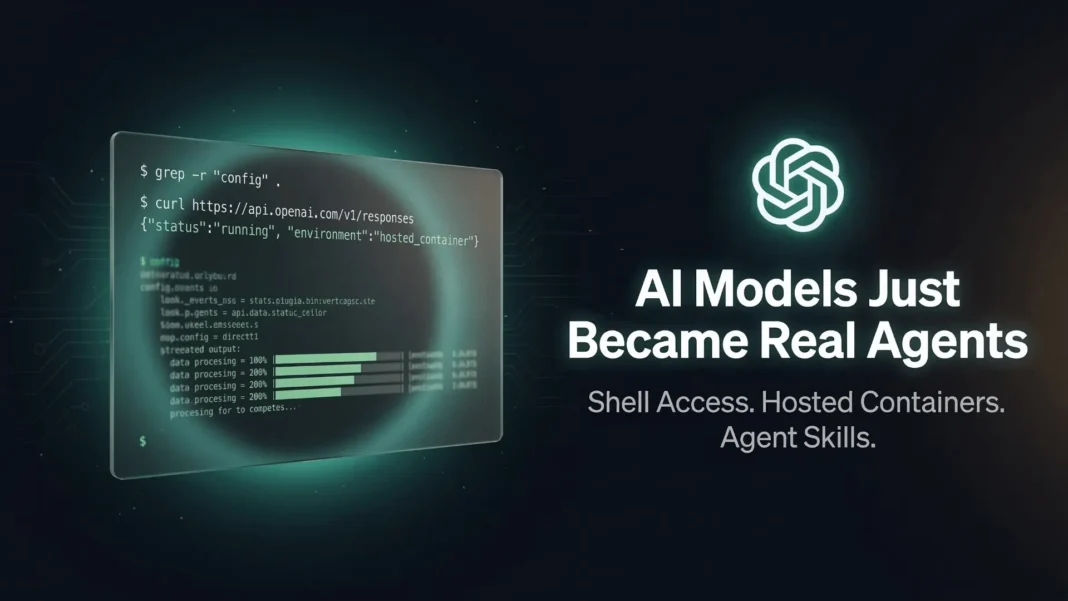
The shell tool gives the model access to a full Unix terminal inside an OpenAI-hosted container. The model proposes commands like grep, curl, or awk; the Responses API executes them in an isolated environment and streams output back to the model in near real time. This is fundamentally different from the existing Code Interpreter, which only runs Python.
The container provisions a fresh environment per agent session using container_auto. The container includes a persistent file system for inputs and outputs, so agents can generate reports, save intermediate datasets, and produce downloadable artifacts across multi-step runs. Developers running Go, Java, or Node.js workloads no longer need to stand up separate services.

How the Responses API Orchestrates the Agent Loop
When a prompt arrives, the Responses API assembles full model context: user input, conversation state, and tool instructions. The model then decides its next action. If it selects shell execution, it returns one or more commands; the API forwards those to the container runtime, streams output, and feeds results back into the next request.
The loop continues until the model returns a completion with no further shell commands. The model can propose multiple shell commands in a single step, and the API executes them concurrently in separate container sessions, multiplexing the output streams back as structured tool results. This parallelization cuts execution time on tasks like multi-file search combined with live API fetches.
Output caps prevent context flood. The model sets a per-command character limit, and the API returns bounded output that preserves the beginning and end while marking omitted content. This keeps the agent reasoning over relevant results rather than drowning in raw terminal logs.
Agent Skills: Reusable Workflows Without Rediscovery
One of the structural weaknesses in earlier agent designs was workflow rediscovery. Every run, the agent re-planned, re-issued commands, and re-learned conventions, producing inconsistent results and burning unnecessary execution cycles.
Agent skills solve this directly. A skill is a versioned folder bundle containing a SKILL.md file with metadata and instructions, plus optional supporting resources like API specs or UI assets. Before each run, the Responses API loads the skill deterministically: it fetches metadata, copies the bundle into the container, unpacks it, and updates model context with the skill’s path. The model then explores and executes skill scripts through the same shell tool it already uses, with no architectural changes required.
Developers manage skills through a dedicated API, uploading and versioning bundles that can be retrieved by skill ID. A skill built once can be reused across dozens of agent runs without prompt re-engineering.
Context Compaction for Long-Running Tasks
Multi-step agent tasks fill context windows fast. Tool calls, reasoning summaries, file reads, and API responses compound with every iteration. Without compaction, agents either hit hard token limits or developers must build custom summarization logic on the client side.
OpenAI’s native compaction trains models to analyze prior conversation state and produce a compaction item: an encrypted, token-efficient representation of key context. After compaction fires, the next context window contains only this compaction item plus high-value portions of the earlier window. Codex relies on this mechanism to sustain long coding sessions and iterative tool execution without quality degradation.
Server-side compaction runs automatically. Developers set a compact_threshold in the Responses API request; the server monitors token count and triggers compaction when the threshold is crossed, returning the encrypted item in the same stream without requiring a separate call. A standalone /compact endpoint also exists for developers who want manual control over compaction timing.
Network Access Under a Sidecar Egress Proxy
Unrestricted container internet access creates real risk: credential leaks, unintended touches to sensitive third-party systems, and data exfiltration are all possible without control layers.
OpenAI addresses this with a sidecar egress proxy. All outbound traffic from hosted containers flows through a centralized policy layer that enforces domain allowlists and keeps traffic observable. Credentials never appear in model-visible context. Instead, OpenAI uses domain-scoped secret injection at egress: the model and container see only placeholders, while raw secret values are applied only for approved destinations at the network boundary. Developers building workflows that call external APIs, fetch live data, or install packages retain full functionality within a clearly bounded security perimeter.
How the Five Primitives Combine
| Primitive | Role in Agent Runtime |
|---|---|
| Responses API | Orchestration, agent loop management, multi-turn continuation |
| Shell Tool | Executable actions via Unix commands inside the container |
| Hosted Container | Persistent runtime context, file system access, and artifact storage |
| Agent Skills | Reusable, versioned workflow logic loaded before each run |
| Context Compaction | Encrypted context compression for extended multi-step sessions |
A single prompt can now expand into a full end-to-end workflow: discover the right skill, fetch live data, stage it in the container file system, query it via SQLite, and produce a durable artifact. OpenAI demonstrated this with a live spreadsheet generation workflow in their engineering post.
Structured Data in Containers: SQLite Over Prompt Pasting
A common anti-pattern OpenAI explicitly calls out is pasting entire datasets into prompt context. As inputs grow, this inflates cost and degrades model navigation of the data.
The recommended pattern stages resources in the container file system and lets the model query them using SQL. Rather than copying a full sales spreadsheet into the prompt, a developer describes the table schema and lets the model issue targeted SELECT statements for exactly the rows it needs. This approach scales to large datasets without proportional context cost.
Limitations and Considerations
The Responses API shell tool is not available through the Chat Completions API, meaning developers on older integrations must migrate to the Responses API to access these capabilities. Shell execution with container_auto requires model GPT-5.2 or later, so earlier model versions cannot propose shell commands in the hosted environment. Server-side compaction is ZDR-friendly only when store=false is set on Responses create requests, which adds an integration step for zero-data-retention deployments.
What This Means for Developers Building in 2026
The architecture resolves four practical problems that previously blocked production agent deployment: intermediate file storage, large table handling, secure network access, and context management across long runs. Developers no longer need to build custom execution harnesses, summarization pipelines, or egress proxies.
The OpenAI team notes that Codex itself was built and improved using these same primitives, with one Codex instance investigating compaction errors encountered by another. This self-referential development cycle signals that OpenAI considers this infrastructure mature enough for production-grade internal use.
For developers building data pipelines, code automation tools, or research agents in 2026, the Responses API computer environment is the most complete hosted agent runtime OpenAI has shipped to date. The combination of shell access, persistent file storage, reusable skills, and automatic compaction eliminates the majority of infrastructure overhead that previously separated prototypes from reliable production agents.
Frequently Asked Questions (FAQs)
What is the OpenAI Responses API computer environment?
It is a hosted runtime that combines the Responses API, a shell tool, a managed container, agent skills, and context compaction. Together, these components let AI models execute real commands, manage files, query databases, and call external APIs inside an isolated environment managed by OpenAI.
How does the OpenAI shell tool differ from Code Interpreter?
Code Interpreter only runs Python in a sandboxed environment. The shell tool provides a full Unix terminal inside a hosted container, supporting Python, Node.js, Java, Go, and Ruby, along with standard Unix utilities like grep, curl, and awk.
Which OpenAI models support shell tool execution?
GPT-5.2 and later models are trained to propose shell commands in the hosted container environment through the Responses API. Earlier models and the Chat Completions API do not support this capability.
What are agent skills in the Responses API?
Agent skills are versioned folder bundles containing a SKILL.md instruction file plus optional API specs and scripts. They package reusable multi-step workflows so agents do not rediscover procedures on every run. The Responses API loads them deterministically before each session begins.
How does context compaction work for long-running agents?
When token count crosses a configured threshold, the Responses API triggers a compaction pass that produces an encrypted, token-efficient summary of prior context. The agent continues from this compaction item without losing the key state needed for coherent task completion.
Is the hosted container internet access unrestricted?
No. All outbound traffic flows through a sidecar egress proxy enforcing domain allowlists. Credentials are injected only at approved destinations as domain-scoped secrets, never appearing in model-visible context. This balances agent capability with a measurable security boundary.
Can I use the Responses API shell tool with a local shell environment?
Yes. OpenAI supports both hosted execution through the Responses API container and local shell execution where developers host and run the shell runtime themselves. Local execution gives more control but requires developers to manage isolation and security independently.
Where can I find examples for building workflows with the Responses API?
OpenAI published a detailed engineering blog post and a developer cookbook covering end-to-end examples, including how to package a skill, configure container_auto, set compaction thresholds, and execute multi-step agent workflows through the Responses API.

