

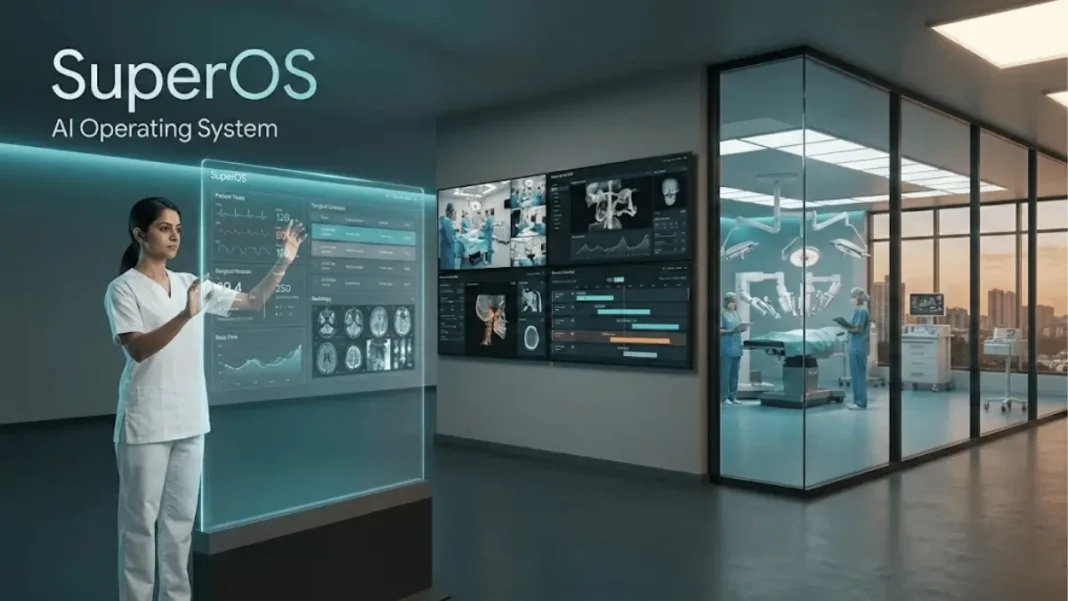
Quick Brief
- SuperOS manages complete hospital operations from consultations to discharge at Superhealth’s Bengaluru facility since February 2026
- AI-driven workflows enable radiologists to complete reports 30% faster by flagging anomalies instantly
- System coordinates operating room schedules, surgeon availability, and equipment allocation with dynamic real-time adjustments
- Built entirely in India, addressing the country’s shortage of 6,000 radiologists serving 1.4 billion people
Most AI healthcare tools today generate notes, optimize billing, or overlay dashboards. SuperOS runs the entire hospital. Developed by Superhealth and deployed at its flagship Bengaluru facility in February 2026, this agentic AI operating system manages outpatient consultations, diagnostics, surgeries, inpatient care, inventory management, and discharge processes through interconnected AI-driven workflows. Unlike ambient scribes or administrative assistants, SuperOS integrates clinical data, hospital infrastructure, and staff coordination into a unified system that assigns tasks to both AI agents and human teams in real time.
What Makes SuperOS an Operating System, Not Software
SuperOS functions as infrastructure rather than an application layer. Founder and CEO Varun Dubey describes it as a system running hospital functions “from clinical decisions to operations, from labs to discharge, from OT assignments to auto prescriptions“. The distinction matters: traditional healthcare AI tools augment existing workflows, while SuperOS orchestrates them end-to-end.
The system controls physical hospital resources and clinical decision pathways simultaneously. It adjusts appointment durations based on visit types, coordinates medicine delivery to consultation rooms, and dynamically reschedules operating theaters when procedures exceed expected timelines. This operational control extends beyond software recommendations into actual resource allocation and process execution.

Clinical Workflow Integration Across Departments
Outpatient Department Automation
SuperOS functions as ambient AI co-pilot across 15 Indian languages during consultations, surfacing prior patient records and suggesting clinical considerations based on medical history. Physicians receive AI-drafted prescriptions for review and approval rather than manually entering orders. The system simultaneously coordinates lab sample collection and medication dispensing directly within consultation rooms, eliminating patient movement between departments.
Appointment scheduling adapts in real time based on consultation complexity. A routine follow-up receives shorter time allocation than a new patient diagnostic visit, optimizing throughput without compromising care quality.
Radiology and Pathology Workflows
Superhealth eliminated traditional PACS servers at its Bengaluru facility, replacing them with cloud-based imaging infrastructure managed by SuperOS. Images transfer instantly between modalities and review stations, while the AI performs 3D volumetric analysis across imaging types including intracranial hemorrhage mapping, fracture detection, implant positioning verification, and pneumothorax identification.
Surgical and Inpatient Coordination
Operating room management requires synchronizing surgeon availability, anesthesia team schedules, equipment allocation, and room assignments. SuperOS coordinates these variables continuously, monitoring procedure timelines and adjusting downstream schedules when delays occur. Discharge summaries generate instantly after procedures, requiring only physician approval rather than manual documentation.
Patient monitoring uses individualized alert thresholds based on clinical history rather than fixed parameters. A post-surgical cardiac patient receives different monitoring sensitivity than a maternity admission, reducing alert fatigue while maintaining safety.
Real-World Deployment Context
SuperOS operates in production at Superhealth’s flagship hospital in Salapuria Towers, Koramangala, Bengaluru not in sandbox or demo mode. The facility represents India’s first zero wait-time hospital model, where SuperOS eliminates bottlenecks from admission through discharge. The proprietary Magic Discharge™ feature, powered by SuperOS automation, reduces end-of-treatment waiting time through instant documentation and billing finalization.
Varun Dubey, who brings experience from Apollo and Narayana Health, emphasizes that Superhealth’s full-stack approach designing, building, and operating hospitals while developing the technology stack enables system-level integration impossible for external software vendors. The company controls both the clinical environment and the operating system, allowing iterative refinement based on actual operational data.
Technical Architecture and Data Management
SuperOS processes clinical data, infrastructure status, and staff coordination through a unified backend. The system converts physician voice notes into digital prescriptions across seven Indian languages with over 95% accuracy, enabling completely paperless workflows. All data remains stored within India, complying with Indian data protection regulations for healthcare information.
Beta features under development include automated drug-drug interaction checking and AI-based post-surgical wound assessment through remote image analysis. These capabilities extend SuperOS beyond operational coordination into clinical decision support.
Industry Context and Competitive Landscape
Major US hospital systems deploy AI for specific functions rather than comprehensive orchestration. UCSF Health uses ambient AI for documentation and sepsis detection across 13 hospitals, while Providence optimizes operating room scheduling and uses chatbots to reduce administrative inquiries by 30%. HCA Healthcare pilots generative AI for clinical documentation in emergency departments. Epic Systems, the dominant US EHR platform, offers automation through customizable workflows, SmartTools, and AI-enhanced clinical decision support, but relies on healthcare organizations to configure and implement these capabilities.
SuperOS differentiates through end-to-end operational control rather than feature-specific optimization. Where Epic automation requires configuration by healthcare IT teams, SuperOS functions as a pre-integrated operating system designed specifically for hospital workflows.
Implications for Healthcare Delivery in India
India’s healthcare infrastructure faces structural constraints: severe specialist shortages, operating theater inefficiencies, discharge bottlenecks, and clinical audit gaps. SuperOS addresses these through AI-augmented workflows that extend specialist capacity and eliminate administrative delays. A hospital administrator can view real-time resource allocation, identify bottlenecks before they cascade, and redistribute tasks between human staff and AI agents dynamically.
Superhealth plans to expand SuperOS across its broader hospital network targeting 100 facilities by 2030, representing 5,000 beds and over 50,000 healthcare jobs. The zero-commission model eliminates incentive-driven treatment recommendations, while zero wait-time operations reduce patient frustration and improve throughput.
Implementation Considerations
SuperOS demonstrates operational viability in a controlled environment, one hospital designed around its capabilities. Scaling to legacy facilities with established workflows, varied IT infrastructure, and different patient populations introduces complexity. The system’s effectiveness depends on data quality, staff adoption, and continuous refinement based on clinical outcomes rather than just operational metrics.
Healthcare AI faces inherent risks: algorithmic bias in clinical suggestions, over-reliance on automated alerts leading to missed edge cases, and system failures creating critical care delays. SuperOS mitigates these through physician-in-the-loop design AI drafts prescriptions and flags anomalies, but humans retain final approval authority. This hybrid approach balances efficiency gains with clinical safety requirements.

Frequently Asked Questions (FAQs)
What is SuperOS?
SuperOS is an agentic AI operating system developed by Superhealth that manages complete hospital operations including outpatient care, diagnostics, surgeries, inpatient management, and discharge processes. It runs in production at Superhealth’s Bengaluru facility since February 2026.
How does SuperOS differ from other healthcare AI systems?
SuperOS functions as infrastructure that orchestrates entire hospital workflows rather than augmenting specific tasks like documentation or billing. It assigns tasks to both AI agents and human teams in real time, coordinating clinical decisions with operational resource allocation.
Where is SuperOS currently deployed?
SuperOS operates at Superhealth’s flagship hospital in Salapuria Towers, Koramangala, Bengaluru a live production environment, not a demonstration facility. Superhealth plans expansion across a 100-hospital network by 2030.
What clinical functions does SuperOS manage?
SuperOS handles outpatient consultations with ambient AI across 15 Indian languages, radiology and pathology workflows with 3D volumetric analysis, operating room scheduling with dynamic adjustments, inpatient monitoring with individualized alerts, and instant discharge summary generation.
How does SuperOS improve radiology efficiency?
SuperOS enables radiologists to complete reports 30% faster by performing 3D volumetric analysis and flagging anomalies in seconds, addressing India’s shortage of 6,000 radiologists serving 1.4 billion people.
Is SuperOS data secure and compliant?
All SuperOS data is stored within India, complying with Indian data protection regulations including the Digital Personal Data Protection Act. The system maintains comprehensive audit trails and follows stringent healthcare data governance protocols for patient information security.
Who developed SuperOS?
Superhealth developed SuperOS in-house under founder and CEO Varun Dubey, leveraging the company’s full-stack approach of designing, building, and operating hospitals while developing the technology infrastructure.
Can SuperOS integrate with existing hospital systems?
SuperOS currently functions as a unified operating system in purpose-built Superhealth facilities. Integration with legacy hospital IT infrastructure would require adaptation, as the system was designed for end-to-end control rather than modular deployment.

