

Quick Brief
- The Launch: Supabase released Agent Skills for Postgres Best Practices on January 21, 2026 an open-source framework with 8 performance-focused rule categories
- The Impact: Targets the 4 million+ developers and 100,000+ customers building on Supabase, addressing optimization gaps in AI-generated PostgreSQL queries
- The Context: Follows Supabase’s $100M Series E at $5B valuation (October 2025), positioning the company to capture the AI-native database infrastructure market
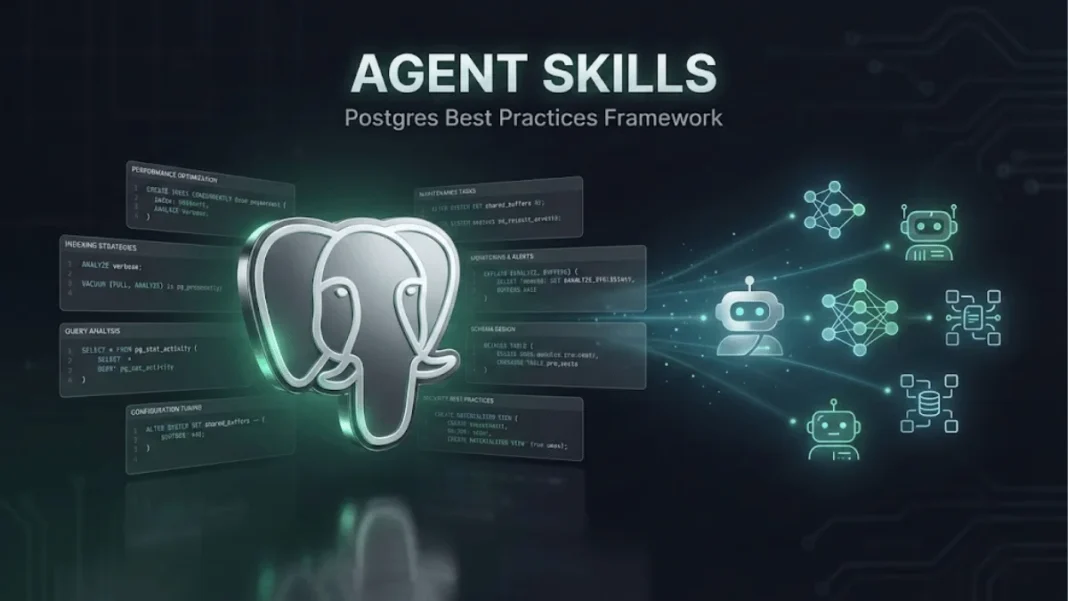
Supabase announced the release of Agent Skills for Postgres Best Practices on January 21, 2026, delivering a standardized framework to train AI coding agents in writing optimized PostgreSQL code. The open-source initiative addresses a critical infrastructure gap: while AI agents now generate database queries at scale, most lack embedded knowledge of performance optimization and Postgres-specific best practices.
The Agent Skills Architecture
The framework organizes Postgres optimization guidelines across eight prioritized categories spanning query performance, connection management, schema design, concurrency and locking, security and RLS, data access patterns, monitoring and diagnostics, and advanced features. Each category contains impact-weighted rules ranging from Priority 1 (CRITICAL) to Priority 8 (LOW), designed for machine parsing to enable AI agents to evaluate multiple optimization paths during code generation. The system integrates directly into agent workflows through the Model Context Protocol (MCP) server and execute_sql tool interface.
Supabase designed the ruleset to function as master prompts covering schema design, query tuning, migrations, and native search implementations. The framework supports both structured query optimization and vector search capabilities, critical for AI applications requiring embedding storage and retrieval.

Infrastructure Impact on AI Development Workflows
The release targets a fundamental shift in database development: autonomous agents that design schemas, execute migrations, and benchmark performance without human intervention. The framework reduces cognitive overhead developers face when context-switching between documentation, GitHub issues, and database consoles. AdwaitX analysis shows this approach embeds decades of PostgreSQL optimization knowledge directly into agent execution layers.
Industry adoption signals validate the approach. LinkedIn responses to the January 21 announcement describe the framework as “moving hard-won DB knowledge out of docs and into the agent’s execution layer,” with developers reporting immediate performance improvements. The framework’s GitHub repository (supabase/agent-skills) provides machine-readable performance optimization guidelines compatible with major AI agent platforms.
Technical Specifications
| Component | Specification | Use Case |
|---|---|---|
| Rule Categories | 8 prioritized sets (Critical to Low) | Query optimization, indexing, migrations |
| Integration Method | MCP server / execute_sql tool | Real-time agent code validation |
| Database Support | PostgreSQL with pgvector | AI embedding storage and retrieval |
| Security Model | Row Level Security (RLS) scoped roles | Agent-specific database permissions |
| Performance Tools | Explain plan analysis, connection pooling | Query diagnostics, resource management |
The framework supports Supabase’s Edge Functions infrastructure, enabling serverless agent deployment with auto-scaling capabilities. Developers can deploy agents globally across Supabase’s CDN for distributed AI applications.
Market Position and Enterprise Adoption
Supabase’s $5 billion pre-money valuation reflects investor confidence in AI-native database infrastructure. The company’s October 2025 Series E funding round raised $100M, co-led by Accel and Peak XV. The investment will finance Multigres, an enterprise-scale platform co-developed with Vitess co-creator Sugu Sougoumarane positioning Supabase to compete directly with cloud database giants in the AI application layer.
With over 4 million developers and more than 100,000 customers building on the platform, Supabase has raised over $500M in total funding. The Agent Skills framework complements Supabase’s existing AI Assistant, integrated into the platform’s dashboard for schema design, query writing, and RLS policy management.
Postgres Agent Ecosystem Development
Multiple frameworks now leverage Postgres for AI agent infrastructure. The cloudraftio/stonebraker project implements automated schema analysis, query optimization, and performance testing using LLMs. The agenticsorg/edge-agents repository provides serverless agent patterns on Supabase infrastructure, featuring real-time communication channels and database-triggered workflows. Composio’s Supabase MCP integration enables OpenAI Agent Builder to call Postgres functions directly, embedding business logic execution within agent decision loops.
Production Implementation Roadmap
Organizations adopting the Agent Skills framework should implement scoped database schemas with dedicated AI agent roles. Supabase recommends using role-based access patterns where agents operate exclusively within designated schemas, preventing access to system tables. The framework’s Priority 1 (CRITICAL) rules address query performance and connection management, requiring immediate attention during implementation.
Security analysis remains critical. AI agents require continuous monitoring of RLS policies to identify access gaps and unusual query patterns. Production deployments should implement connection pool management and caching strategies to prevent agent-generated query loads from degrading application performance, as outlined in Priority 2 (CRITICAL) connection management rules.
Frequently Asked Questions (FAQs)
What are Supabase Agent Skills for Postgres?
Open-source performance optimization guidelines across 8 priority-ranked categories, designed for AI coding agents to generate efficient PostgreSQL code.
How do AI agents integrate with Postgres databases?
Through Model Context Protocol (MCP) servers and execute_sql tools, enabling schema operations, query execution, and real-time validation.
Which AI platforms support Supabase Agent Skills?
Major agent frameworks including OpenAI Agent Builder, Composio MCP, Claude Code, and custom implementations via Supabase Edge Functions.
What performance improvements do agent skills provide?
Priority-ranked optimizations including query performance tuning, connection management, schema design, concurrency control, and monitoring diagnostics.

