

Quick Brief
- The Shift: Retailers confront a $3–5 trillion global agentic commerce market by 2030, with U.S. B2C retail alone reaching $1 trillion as AI agents replace browser-based shopping.
- SAP’s Response: The enterprise software giant launched storefront Model Context Protocol (MCP) server, Retail Intelligence in Business Data Cloud, and Digital Service Agent at NRF 2026.
- The Readiness Gap: 71% of merchants report AI merchandising tools have shown limited to no business impact, while 61% admit their organizations lack AI scaling infrastructure.
- Why Now: Consumer adoption of AI-powered product discovery tools accelerates as generative AI shifts shopping from search engines to agent-driven recommendations.
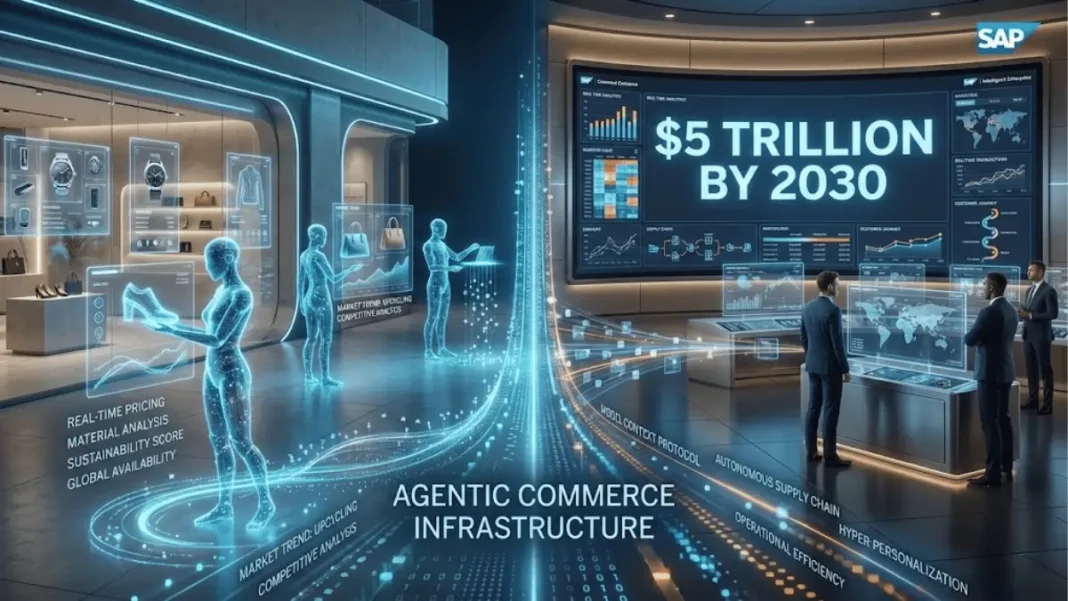
SAP SE announced a suite of AI-native retail solutions at the National Retail Federation’s 2026 Big Show in New York, positioning infrastructure for what McKinsey calls a “seismic shift” in commerce. The deployment responds to projections that agentic commerce shopping powered by autonomous AI agents will orchestrate up to $5 trillion in global transaction volume by 2030, fundamentally restructuring how consumers discover and purchase products.
SAP’s Three-Layer AI Retail Architecture
SAP introduced integrated systems designed to make digital storefronts machine-readable for large language models (LLMs). The storefront Model Context Protocol (MCP) server enables AI agents to parse product catalogs, inventory data, and pricing structures without human-optimized web interfaces. This protocol addresses a critical infrastructure gap: retailers have spent decades optimizing for search engine algorithms, but AI agents require structured, semantic data formats.
The Retail Intelligence solution within SAP Business Data Cloud aggregates data from SAP S/4HANA Cloud and third-party systems to deliver demand forecasting, inventory optimization, and omnichannel coordination. SAP reports the system uses AI-generated simulations to improve forecast accuracy and reduce manual planning effort. The company plans to release an Order Reliability Agent in Q2 2026 to support fulfillment consistency.
SAP Customer Experience deployed a Digital Service Agent that integrates with its existing Shopping Agent, creating unified conversational AI that handles product discovery, transaction execution, and post-sales support. This end-to-end automation reflects the shift from discrete shopping steps to continuous, intent-driven flows.

Financial Stakes and Market Transformation
McKinsey’s analysis, published in October 2025, projects the U.S. B2C retail market will generate $1 trillion in agentic commerce revenue by 2030, with global estimates ranging from $3 trillion to $5 trillion. The consultancy describes agentic commerce as a system where AI anticipates consumer needs, evaluates options across platforms, negotiates pricing, and executes purchases through multistep reasoning models.
This transformation moves faster than previous digital shifts because AI agents operate on existing commerce infrastructure rather than requiring new technical rails. Becca Coggins, McKinsey senior partner and global leader for retail practices, emphasized that autonomous agents now perform the searching, filtering, and comparing traditionally done by human shoppers. AdwaitX analysis indicates this disrupts brand visibility models built on search engine optimization and paid advertising.
The financial impact extends across the retail value chain. Payment processors, logistics providers, and marketplace platforms must adapt to AI-to-AI transactions rather than human-initiated purchases. Early technical frameworks gaining adoption include Model Context Protocol (MCP), Agent-to-Agent Protocol (A2A), and Agent Payments Protocol (AP2).
Infrastructure Readiness Deficit
Despite market projections, most retailers lack operational infrastructure for agentic commerce. A McKinsey survey published in January 2026 found 71% of merchants report AI merchandising tools have delivered limited to no measurable business impact. The firm attributes this to fragmented systems, unstructured data, and inconsistent adoption rather than technology limitations.
Sixty-one percent of survey respondents stated their organizations are not prepared or only slightly prepared to scale AI across merchandising operations. Andre Bechtold, president for SAP Industries & Experience, emphasized at NRF that retailers face a “disconnected technology” problem where isolated AI pilots fail to translate into resilient growth.
Thomas Saueressig, member of SAP’s Executive Board, noted in a Handelsblatt article that companies rarely achieve cost reductions or revenue increases through AI when implementations run as isolated projects rather than embedded business processes. Industry analysts project AI agents will first transform planning-oriented and repeatable purchase decisions such as outfit coordination, room design, seasonal refreshes, and weekly grocery shopping.
Implementation Requirements
SAP prescribes three technical steps for agentic commerce readiness. First, retailers must restructure product data into machine-readable formats that AI agents can parse without rendering visual web pages. Second, companies need to add semantic summaries that enable LLM reasoning about product attributes and use cases. Third, catalogs should tag products by problems solved rather than solely by specifications.
Julie Towns, vice president of product marketing at Pinterest, projects agentic AI will first transform planning-oriented and repeatable purchase decisions. Tasks such as outfit coordination, room design, seasonal refreshes, and weekly grocery shopping represent initial high-volume adoption categories. Adam Skinner, managing director of unified retail media at Epsilon, anticipates rapid shifts in transaction mechanics and automated deal-finding, moving competition from human attention to agent-to-agent negotiation.
| Critical Infrastructure Component | Function | SAP Solution |
|---|---|---|
| Machine-Readable Storefront | Enables AI agent product parsing | MCP Server in Commerce Cloud |
| Demand & Inventory Intelligence | AI-driven forecasting and simulation | Retail Intelligence in Business Data Cloud |
| Unified Customer Journey Agent | Discovery to post-sales support | Digital Service Agent + Shopping Agent |
| Omnichannel Promotion Pricing | Real-time pricing integration | S/4HANA Cloud Public Edition |
Regulatory and Trust Architecture
McKinsey identifies trust as a primary barrier to agentic commerce scaling. Autonomous AI agents making purchase decisions require transparency in recommendation logic, pricing accuracy, and return policy enforcement. Tom Burke, CEO of AtData, notes that early agent adoption will concentrate on high-friction, low-risk tasks such as price comparison, credibility verification, and review validation.
The consulting firm emphasizes that early-mover retailers will capture disproportionate advantage by creating agent-ready websites, composable commerce architectures, and transparent APIs. Companies delaying infrastructure adaptation risk losing visibility as AI agents become primary gatekeepers of product discovery.
Bechtold stated during his NRF session with Gymshark that boards and investors now prioritize measurable outcomes over innovation pilots. He framed the challenge as whether AI and data systems embed across supply chain, finance, merchandising, and customer engagement operations in ways executives can trust.

Frequently Asked Questions (FAQs)
What is agentic commerce?
Agentic commerce uses autonomous AI agents to discover, compare, negotiate, and purchase products on behalf of consumers through multistep reasoning models, replacing traditional browser-based shopping.
How much will agentic commerce be worth by 2030?
McKinsey projects $1 trillion in U.S. B2C retail and $3–5 trillion globally by 2030, comparable to the combined impact of web and mobile commerce revolutions.
What did SAP announce at NRF 2026?
SAP deployed storefront Model Context Protocol server, Retail Intelligence in Business Data Cloud, Digital Service Agent, and plans Q2 2026 release of Order Reliability Agent.
How should retailers prepare for AI shopping agents?
Retailers must restructure product data for machine readability, add semantic summaries for LLM reasoning, and tag products by problems solved rather than attributes alone.
What is the Model Context Protocol for retail?
MCP is a technical standard enabling AI agents to parse digital storefronts, product catalogs, and inventory systems without human-optimized web interfaces.

