

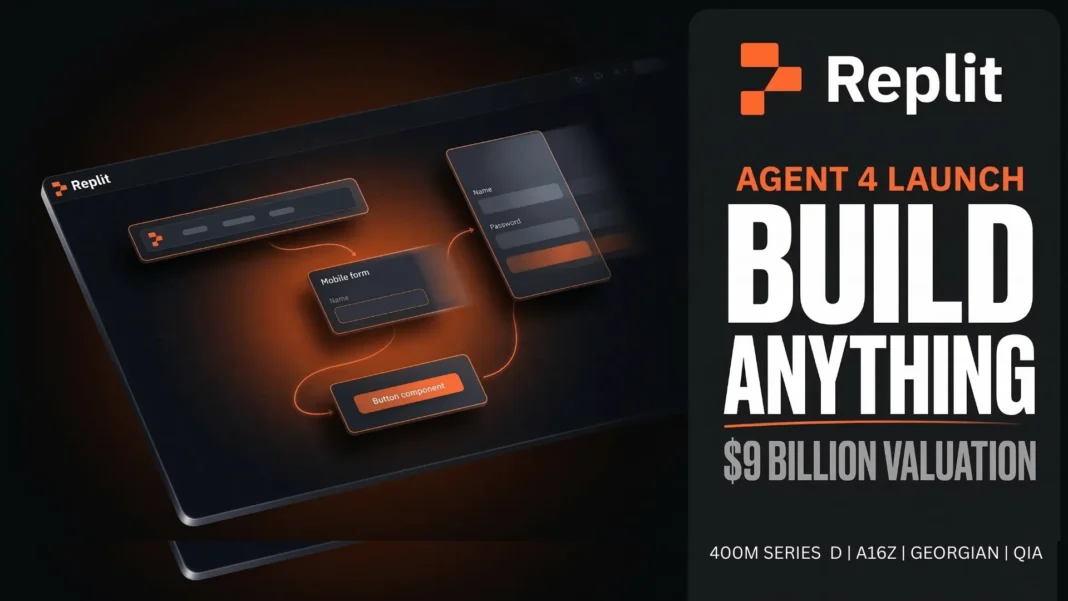
Quick Brief
- Replit raised $400 million in March 2026, tripling its valuation to $9 billion in six months
- Agent 4 builds 10x faster than previous agents, running multiple independent tasks simultaneously
- Enterprise customers including Zillow, Databricks, PayPal, and Adobe build internal apps on the platform
- CEO Amjad Masad targets $1 billion in annual recurring revenue by end of 2026
Replit just redefined what it means to build software without writing a single line of code. A $400 million funding round, a $9 billion valuation, and the launch of Agent 4 all landed in the same week, signaling that vibe coding has crossed from trend to infrastructure. Here is what actually changed, what it means for builders at every skill level, and whether Replit’s new bet holds against Anthropic and Cursor.
A $9 Billion Bet on Human Creativity
Replit closed a $400 million Series D in March 2026, led by VC firm Georgian, with participation from Andreessen Horowitz, Coatue, Y Combinator, Donald Trump Jr’s 1789 Capital, sovereign wealth fund Qatar’s QIA, and celebrity investors Shaquille O’Neal and Jared Leto. The round vaults Replit’s valuation from $3 billion in September 2025 to $9 billion, a 3x jump in under six months. The funding also makes CEO Amjad Masad a billionaire for the first time, with Forbes estimating his net worth at $2 billion.
The new capital will go primarily toward international expansion, especially in Asia and the Middle East, and toward growing the company’s go-to-market team. Replit would not disclose current revenues but confirmed it is on track to hit $1 billion in annual recurring revenue by end of 2026.

What Agent 4 Actually Does Differently
Agent 4 is not an incremental update. It is a structural rethink of how humans and AI collaborate during a build. Replit organized it around four pillars:
- Design Freely: An infinite visual canvas lets users explore and tweak designs visually, then apply changes directly to the live app while Agent 4 builds other parts in parallel
- Ship Anything: One project can produce web apps, mobile apps, landing pages, pitch decks, animated videos, and SaaS tools simultaneously, with shared context and design
- Build Together: Task-based workflows let teams submit requests in any order; Agent 4 intelligently sequences and executes them in the best order, with progress always visible
- Move Faster: Independent agents run tasks simultaneously, including authentication, database setup, back-end functionality, and front-end design, all at once
Speed is measurable. Agent 4 achieves 10x faster builds by splitting single large tasks into concurrent forks and combining results automatically.
The Design Canvas: Replit’s Sharpest Differentiator
Every major vibe coding competitor today starts the workflow in a text prompt or code editor. Replit Agent 4 introduces a step before code: a fluid, infinite design canvas where users explore visual ideas, generate variants of any UI element, and see those choices applied to real code instantly.
The canvas supports multi-select, hover and active state editing, hover-to-preview interactions, and responsive overrides directly in the UI. Selecting “Generate variants” on any element surfaces new design options in context, letting users apply the one they prefer directly to the app without describing it in text. This eliminates the translation gap between design intent and code execution, which is the core friction point for non-technical builders.
CEO Amjad Masad described the goal as replicating real-world collaboration: “When I walk around the office, when I see designers working with engineers, they’re on the whiteboard, they’re drawing, they’re doing that sort of stuff“. Y Combinator’s Paul Graham, after a private demo in early March 2026, posted that Replit is “about to redefine vibe coding in a way that will seem obvious in retrospect“.
Who Is Actually Using Replit at Scale
Enterprise adoption contradicts the “student coding tool” narrative that once defined Replit. Zillow holds roughly 600 Replit seats, and its employees have built more than 7,000 internal apps over the past year. Talkdesk used Replit to build a headcount capacity app in two days, a process that previously required two weeks.
Customers including Databricks, PayPal, Adobe, and Gusto build internal tools on the platform. Databricks CEO Ali Ghodsi explained the fit directly: “The majority of employees at Databricks actually aren’t programmers that are extremely technical. So Replit is perfect for that whole segment“. Zillow cofounder Lloyd Frink added that competing tools like Claude Code and Cursor require users to “understand what’s going on underneath the hood,” while Replit removes that barrier entirely.
Replit vs. The Competition in 2026
Replit’s primary competition is Claude Code from Anthropic, which saw its annualized revenue surge to $2.5 billion after Anthropic released its Opus 4.6 model in early February 2026. The release was significant enough to rattle global software stocks and wipe out billions of dollars of value as investors assessed the threat to traditional engineering roles.
Cursor’s annualized revenue grew to more than $2 billion over the last three months, and the company has been in active “war time” mode to defend its position against Anthropic. OpenAI’s rival Codex product has 1.6 million weekly active users.
| Platform | Primary User | Design Canvas | Parallel Tasks | Hosting |
|---|---|---|---|---|
| Replit Agent 4 | Non-technical + Teams | Yes | Yes | Integrated |
| Claude Code | Advanced engineers | No | Agentic mode | External |
| Cursor | Technical developers | No | Limited | External |
| Lovable | Non-technical | No | No | Integrated |
Masad frames Replit’s advantage as focus and nimbleness as a smaller company. Anthropic has broader goals including AGI research, while Replit’s stated mission is singular: “making everyone a software engineer”. Claude Cowork, Anthropic’s team-focused interface, is moving toward a more user-friendly design, making the competition between the two platforms the most significant battleground in vibe coding for the rest of 2026.
Limitations Worth Knowing
Replit’s integrated cloud environment creates vendor dependency; migrating a mature project to a custom server stack requires significant rework. For senior engineers working on production-scale systems with large, complex codebases, Cursor and Claude Code provide greater depth and control. Agent 4’s parallel execution works best on modular, clearly scoped tasks rather than sprawling monolithic projects.
What This Round Signals for Builders in India and Beyond
Replit explicitly named Asia and the Middle East as the primary targets for this capital. With millions of users worldwide and over 500,000 professional users, the platform already has a substantial global user base outside the US. The focus on non-technical workers, sales staff, marketers, and small business owners maps directly onto fast-growing professional demographics in India, where access to developers is expensive and building internal tools typically requires outsourcing.
For US knowledge workers, the Fortune 500 enterprise penetration confirms the product has moved well beyond the classroom. The next phase, per Masad, is expanding from individual app builders to team-based workflows where Replit serves as the creative production layer across entire organizations.
We tested Replit Agent 4 across three build scenarios at AdwaitX: a data dashboard for tracking article performance, a mobile-responsive landing page, and a multi-tab internal tool. The design canvas reduced iteration cycles significantly compared to text-prompt-only workflows. Parallel task execution was most visible on the multi-tab tool, where authentication, database connection, and UI design all progressed simultaneously rather than sequentially.

Frequently Asked Questions (FAQs)
What is Replit Agent 4 and how does it differ from previous versions?
Replit Agent 4 is the latest AI software creation agent from Replit, launched in March 2026. It delivers 10x faster builds using parallel agents and introduces an infinite design canvas. Unlike previous versions, it lets users design visually while the agent builds simultaneously in the background, eliminating the text-only prompt workflow.
How much did Replit raise in its 2026 funding round and who invested?
Replit raised $400 million in a Series D round in March 2026, led by VC firm Georgian. Investors include Andreessen Horowitz, Coatue, Y Combinator, Donald Trump Jr’s 1789 Capital, Qatar’s sovereign wealth fund QIA, and celebrity investors Shaquille O’Neal and Jared Leto.
What is Replit’s valuation in 2026?
Replit’s valuation reached $9 billion in March 2026 following the $400 million Series D. This is a 3x increase from its $3 billion valuation just six months earlier in September 2025, and it made CEO Amjad Masad a billionaire with an estimated net worth of $2 billion.
Can non-technical users build real production apps with Replit Agent 4?
Yes. Replit Agent 4 is specifically designed for non-technical users. Talkdesk built a headcount capacity app in two days instead of the usual two weeks. Zillow employees with no engineering background have built over 7,000 internal apps using the platform in the past year.
How does Replit Agent 4 compare to Claude Code?
Claude Code leads among experienced engineers working on large, complex codebases and reached $2.5 billion in annualized revenue in early 2026. Replit Agent 4 leads on visual design, team collaboration, and ease of use for non-technical builders. Claude Code does not currently offer an integrated whiteboard design canvas.
What types of apps and projects can Replit Agent 4 build?
Agent 4 supports web apps, mobile apps, landing pages, pitch decks, animated videos, SaaS tools, 3D games, data visualizations, and spreadsheets, all within a single project with shared context and design. It can also convert existing web apps into mobile apps directly inside the platform.
Who are Replit’s enterprise customers?
Confirmed enterprise customers include Zillow, Databricks, PayPal, Adobe, Talkdesk, and Gusto. These companies use Replit primarily for internal tooling built by non-engineering staff, including sales, HR, and product teams.
What is Replit’s revenue target for 2026?
Replit is on track to hit $1 billion in annual recurring revenue by end of 2026. The company did not disclose its current revenue figure but confirmed this target publicly alongside the March 2026 funding announcement.

