


Quick Brief
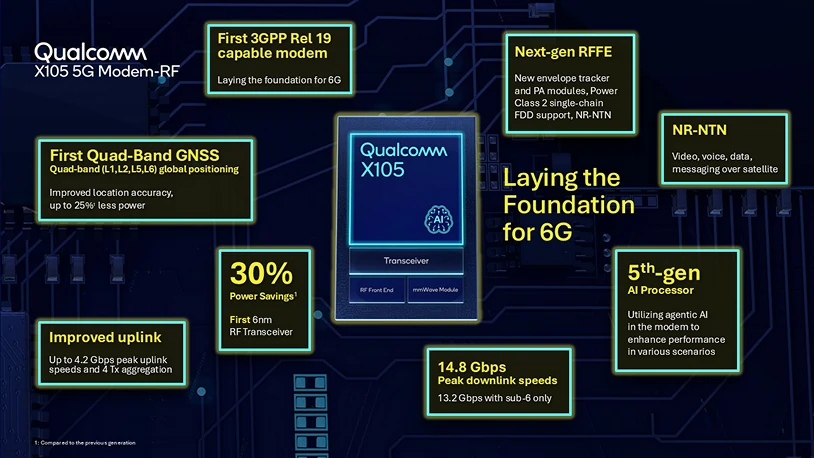
- Qualcomm X105 achieves 14.8 Gbps peak download and 4.2 Gbps peak upload speeds, surpassing the X85
- World’s first modem compatible with 5G Advanced Release 19, a direct step on the path to 6G
- New 6nm RF transceiver cuts power consumption by 30% and reduces PCB footprint by 15% versus the X85
- NR-NTN satellite support enables voice, video, and data connectivity where no cell tower is reachable
Qualcomm skipped a generation number, jumping from the X85 straight to the X105, and the reason is deliberate. This modem does not just improve on its predecessor; it resets expectations for what 5G hardware is capable of in 2026. The X105 arrives at MWC 2026 as the first modem compatible with 3GPP Release 19, the specification that serves as a direct step on the path to 6G standardization.
What Makes the X105 Qualcomm’s Biggest Modem Leap in Years

The X105 5G Modem-RF system was unveiled at Mobile World Congress 2026 on March 1 and is sampling with manufacturing partners now. It directly succeeds the X85 modem, which powered cellular connectivity in the Snapdragon 8 Elite chipsets used in flagship phones. The jump to X105 reflects a fundamental architectural change, not an incremental refresh.
Peak download speed reaches 14.8 Gbps, and upload speeds top out at 4.2 Gbps. This upload improvement directly addresses a persistent gap that affected creators and remote workers uploading large files over mobile connections. The modem is built for what Qualcomm describes as the “agentic AI era”.
The X105 targets smartphones, PCs, XR headsets, automotive systems, fixed wireless access routers, robotics platforms, and industrial IoT devices. One hardware platform covering this range signals Qualcomm’s intent to standardize 5G Advanced connectivity across every connected category.

5 Core Technologies Inside the Qualcomm X105
1. 5th-Generation 5G AI Processor with Agentic AI
The X105 integrates Qualcomm’s fifth-generation 5G AI Processor, which uses agentic AI to classify and optimize data traffic in real time. It detects what you are doing, whether gaming, video calling, or scrolling, and adjusts link parameters without user input. Qualcomm also confirmed developer APIs for “predictive intelligence,” allowing apps to tap directly into this optimization layer.
2. First 6nm RF Transceiver
No prior commercial modem has shipped with a 6nm RF transceiver. This node reduction delivers 30% lower power consumption and a 15% smaller PCB footprint compared to the X85. For compact devices like XR glasses and wearables, this efficiency directly translates into longer battery life and slimmer device designs.
3. Integrated Satellite Connectivity via NR-NTN
The X105 supports New Radio Non-Terrestrial Network (NR-NTN) connectivity for 5G over satellite. This goes beyond SOS messaging. Users in off-grid environments can make voice calls, stream video, and send data over satellite links when no cell tower is reachable. This makes satellite a genuinely viable connectivity alternative for end users in remote regions across both the US and India.
4. NB-IoT Fallback for Coverage Gaps
The X105 adds support for Narrowband Internet of Things (NB-IoT), a cellular technology that works on existing LTE infrastructure. This serves as a fallback when physical obstructions block standard signals, such as in elevators, underground parking garages, or dense urban structures. NB-IoT is optimized for messaging and basic communication rather than data or voice, keeping power consumption low.
5. Turbo DSDA for Multi-SIM Performance
Dual SIM, Dual Active (DSDA) with Turbo enhancements delivers significantly faster throughput when operating across two active SIM cards simultaneously. This directly benefits users in India, where dual-SIM usage for separating personal and work numbers is widespread, and where switching between carriers is routine.
How the X105 Compares to the X85
| Specification | Qualcomm X85 | Qualcomm X105 |
|---|---|---|
| Peak Download Speed | Lower | 14.8 Gbps |
| Peak Upload Speed | Lower | 4.2 Gbps |
| 3GPP Release Support | Pre-Release 19 | Release 19 |
| RF Transceiver Node | Previous generation | 6nm (first ever) |
| Power vs. X85 | Baseline | 30% lower |
| PCB Footprint vs. X85 | Baseline | 15% smaller |
| Satellite Support | Not confirmed | Voice, video, data via NR-NTN |
| NB-IoT Fallback | Not confirmed | Yes, for coverage gaps |
| AI Processor Generation | Previous gen | 5th Gen with agentic AI |
Release 19 and Why It Matters for 6G
3GPP Release 19 is a major 5G Advanced specification milestone and a direct step on the path to 6G. Being the first modem compatible with this release means the X105 can participate in next-generation network trials and handle the signaling protocols that future infrastructure will require. For consumers, devices built on X105-based chipsets are architecturally prepared for the transition ahead rather than facing early obsolescence.
Which Devices Will Use the X105
Qualcomm has not officially confirmed which chipsets will integrate the X105, and no OEM has formally announced a device using this modem as of March 2026. Android Central noted at MWC 2026 that the X85 powered the Snapdragon 8 Elite, and it is possible that the X105 could appear in an upcoming Snapdragon 8 Elite successor chipset powering future flagships. Commercial device availability depends on sampling completion and OEM integration timelines, with Qualcomm currently in the partner sampling phase.
Agentic AI in a Modem: What This Actually Does
Agentic AI in the context of a modem means the chip makes autonomous decisions about how to allocate network resources without waiting for app-level instructions. If you start a video call, the modem can preemptively reduce latency and increase link stability before your app registers congestion. Qualcomm also confirmed third-party developer APIs tied to this “predictive intelligence” layer, meaning future apps may actively leverage modem-level foresight for better user experiences.
This is distinct from prior AI-enhanced modems, which reacted to conditions after they occurred rather than anticipating them. The agentic framing indicates a shift in how Qualcomm positions the modem as an active participant in device intelligence rather than passive hardware.
Limitations and Considerations
The X105 platform is in sampling phase as of March 2026 and is not yet in any shipping consumer product. Real-world performance for satellite connectivity and agentic AI optimization in dense urban environments remains untested at scale. NB-IoT fallback is designed for basic messaging only and does not support full data or voice over that channel.
 Qualcomm’s Agentic RAN Management Service: The Architecture Shift Telcos Can No Longer Ignore
Frequently Asked Questions (FAQs)
What is the Qualcomm X105 5G modem?
The Qualcomm X105 5G Modem-RF is the world’s first modem compatible with 3GPP Release 19, announced at MWC 2026. It supports 5G Advanced with 14.8 Gbps peak download speeds, integrated NR-NTN satellite connectivity, NB-IoT fallback, and a 5th-generation agentic AI processor for real-time network optimization.
How fast is the Qualcomm X105 modem?
The X105 achieves peak download speeds of 14.8 Gbps and peak upload speeds of 4.2 Gbps, both representing a significant improvement over its predecessor, the X85.
What is 3GPP Release 19 and why does it matter?
3GPP Release 19 is a key 5G Advanced specification and a direct step toward 6G standardization. The X105 is the first commercial modem compatible with this release, meaning it is architecturally prepared for next-generation network evolution.
Does the Qualcomm X105 support satellite connectivity?
Yes. The X105 supports NR-NTN (New Radio Non-Terrestrial Network) for 5G over satellite, enabling voice calls, video streaming, and data transmission where traditional cell service is unavailable. It also includes NB-IoT fallback for messaging in signal-obstructed environments such as elevators and parking garages.
What is the difference between NR-NTN and NB-IoT in the X105?
NR-NTN provides full 5G over satellite connectivity including voice, video, and data when no cell tower is reachable. NB-IoT is a low-power fallback that operates on existing LTE infrastructure and is designed for basic messaging when physical obstructions block conventional signals.
How does the X105 improve power efficiency over the X85?
The X105 uses a new 6nm RF transceiver, the first of its kind in any commercial modem, delivering 30% lower power consumption and a 15% smaller PCB footprint compared to the X85 generation.
When will X105-based devices reach the market?
Qualcomm confirmed partner sampling is underway as of March 2026. No commercial device launch date has been announced. Availability depends on OEM integration timelines following the completion of the sampling phase.
What is agentic AI in the context of the X105 modem?
Agentic AI means the X105 autonomously optimizes network resource allocation in real time, anticipating needs rather than reacting to them. Qualcomm has also confirmed developer APIs for “predictive intelligence,” enabling third-party apps to leverage this modem-level optimization layer.

