

Quick Brief
- Qualcomm and T-Mobile extended their strategic collaboration at MWC Barcelona 2026, targeting commercial 6G deployment starting in 2029
- The partnership spans three defined pillars: advanced connectivity, wide-area sensing, and energy-efficient high-performance compute
- Qualcomm’s X105 5G Modem-RF is the world’s first Release 19-ready modem, consuming 30% less power than the X85 it replaces
- A 30-plus company Global 6G Coalition has committed to finalizing standards by 2028 and commercial deployment by 2029
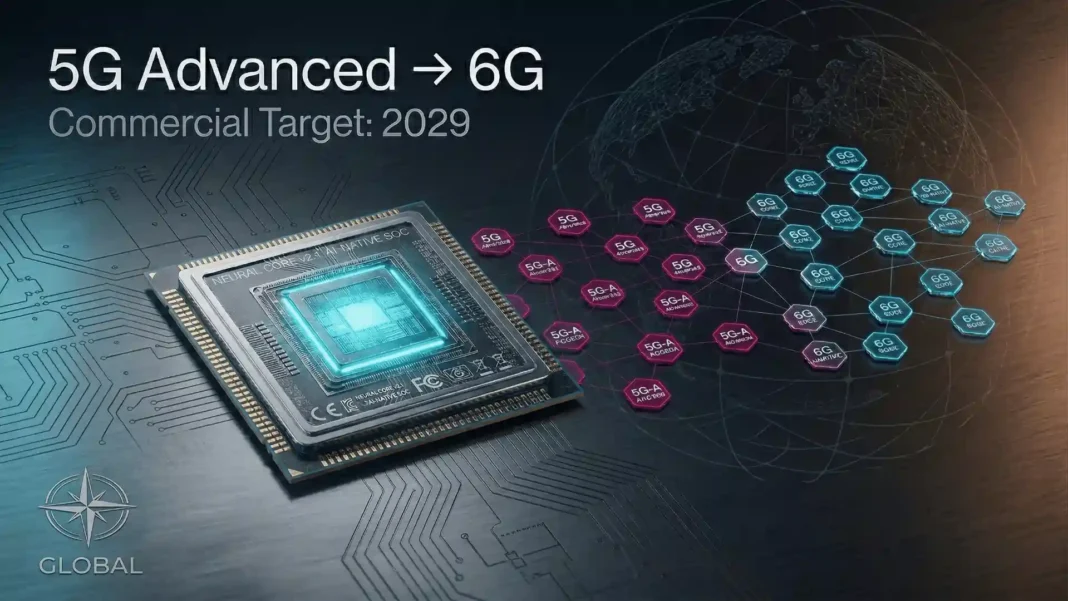
The wireless standard powering your phone in 2029 is being designed right now, and the companies building it just made their most specific public commitment yet. Qualcomm Technologies and T-Mobile announced an expanded strategic collaboration at MWC Barcelona 2026 to accelerate the transition from 5G Advanced to 6G, backed by a structured roadmap with defined milestones. The partnership is part of a broader Global 6G Coalition of more than 30 companies, with standards targeted for finalization by 2028 and commercial deployments beginning in 2029.
Why This Qualcomm T-Mobile 6G Partnership Is Different
This collaboration traces back to 2019, when Qualcomm and T-Mobile jointly made the first 5G data call. The 2026 extension builds on that foundation with three defined technical pillars: advanced connectivity, wide-area sensing, and energy-efficient high-performance compute. That structure signals a meaningful shift from prior 6G announcements, which largely stayed at the concept level.
T-Mobile’s role in the coalition is the most extensive among partners. John Saw, T-Mobile’s President of Technology and CTO, stated: “Our expanded collaboration with Qualcomm Technologies allows us to help shape the technologies of 6G from the outset.” T-Mobile will validate 6G technologies in live network environments through pre-commercial trials, not just laboratory settings.

What the Three Pillars Mean for Users
Advanced Connectivity targets wider coverage, higher capacity, and stronger uplink performance to support surging data from mobile users, sensors, and edge AI applications. Technologies in active development include wider bandwidths, Giga-MIMO radios, and advanced waveforms designed to improve energy efficiency alongside raw speed.
Wide-Area Sensing is the capability that sets 6G apart from every prior generation. 6G radio signals will detect and map objects in the physical environment in real time, a capability Qualcomm calls “wide-area sensing,” enabling applications from drone tracking to digital factory twins without dedicated sensor hardware. This is built into the 6G air interface itself, not added as a separate overlay.
Energy-Efficient High-Performance Compute addresses the infrastructure layer, where a virtualized network environment will host both RAN and AI workloads. Compute tasks will be dynamically distributed based on real-time network conditions, enabling autonomous network management and lower operational overhead for carriers.
Qualcomm X105 Modem: The Hardware Foundation
Qualcomm unveiled the X105 5G Modem-RF at MWC Barcelona 2026 as the world’s first 3GPP Release 19-ready chip. Release 19 is the 3GPP specification milestone that Qualcomm positions as the direct on-ramp to 6G development and testing. Nitin Dhiman, Director of Product Marketing at Qualcomm, described it as “our latest and greatest benchmark-defining modem for 5G Advanced and leading the path to 6G, 6G development and testing, in particular.”
The X105 brings three concrete hardware improvements over its predecessor, the X85. Power consumption dropped 30%, the physical footprint shrank 15%, and the chip now supports all four major satellite navigation constellations simultaneously: GPS, GLONASS, Galileo, and BeiDou. The X105 also integrates 5G NR-NTN directly into the modem die, enabling satellite video calls without additional antenna hardware. Commercial devices using the X105 are expected in the second half of 2026.
The Global 6G Coalition: Who Is Involved
More than 30 companies signed onto Qualcomm’s Global 6G Coalition at MWC Barcelona 2026. Confirmed named partners include T-Mobile and LG Electronics, with T-Mobile focused on network deployment and LG joining for vehicle connectivity applications. Qualcomm has not publicly disclosed the full roster of coalition members.
The coalition’s stated timeline is specific: finalize 6G standards by 2028 and reach commercial deployment by 2029. This four-year runway is structured to allow both chipmakers and carriers to align infrastructure investments before commercial launch, a lesson drawn from the fragmented early rollout of 5G.
Qualcomm’s AI Integration History in Modems
Qualcomm’s integration of AI into modem hardware is not new to 2026. The company first embedded AI into a modem in 2022 with the X70. The X105 extends that work with on-modem AI applied to antenna beam management and Wi-Fi-to-cellular handoff optimization. This on-chip approach keeps AI processing local to the modem, reducing latency compared to cloud-delegated signal management.
Qualcomm’s pitch for 6G centers on making AI-native design structural at the network level, not just at the device level. That means carriers like T-Mobile would use AI to manage radio resources, predict congestion, and self-optimize network configurations without manual intervention.
Limitations and Considerations
The 2029 commercial target is a coalition commitment, not a regulatory guarantee. 6G spectrum allocation remains unresolved in most markets, and the 802.11-equivalent 6G radio standard will not be finalized until 2028. Devices using the X105 ship on pre-standard silicon that may require firmware updates as the specification evolves. Many applications the coalition describes, including real-time environmental sensing at network scale, do not yet exist in any commercial form.
T-Mobile and Qualcomm: 5G Advanced Progress to Date
The current collaboration builds on a documented 2025 milestone. Working with Nokia, Qualcomm and T-Mobile set record-breaking 5G Advanced downlink speeds using 6-carrier aggregation on the Qualcomm X85 Modem-RF in a live customer network. That validated infrastructure is the baseline from which 6G pre-commercial trials will begin.
T-Mobile’s involvement in 3GPP standards work from the outset of the 6G cycle reflects a strategy to avoid the late-entry deployment delays that affected some 5G markets. Pre-commercial trials under the new collaboration will cover all three pillars: connectivity, integrated sensing, and high-performance compute.
Qualcomm T-Mobile vs. Competing 6G Approaches
| Dimension | Qualcomm + T-Mobile | Ericsson / Nokia-led | Huawei 6G |
|---|---|---|---|
| Commercial target | 2029 | ~2030 projected | 2030+ (regulatory constraints) |
| AI integration | Structural, modem-native since 2022 | Network layer overlay | Native (limited US/India access) |
| Sensing capability | Wide-area, integrated into air interface | Selective integration | Broad sensing scope |
| Coalition size | 30+ companies | Standards-body driven | Separate track |
| US deployment lead | T-Mobile nationwide | Operator-dependent | Restricted in US and India |
Frequently Asked Questions (FAQs)
When will 6G be commercially available?
Qualcomm’s Global 6G Coalition, which includes T-Mobile and more than 30 other companies, has set a commercial deployment target beginning in 2029. Standards finalization is targeted for 2028. Initial availability will likely be limited to select US markets, with broader global rollout extending into the early 2030s.
What is the Qualcomm X105 modem?
The X105 is Qualcomm’s fifth-generation 5G modem and the world’s first chip ready for 3GPP Release 19, the specification milestone that bridges 5G Advanced with 6G development. It uses 30% less power than the X85, has a 15% smaller footprint, and supports all four major satellite navigation systems simultaneously. Commercial devices are expected in the second half of 2026.
What makes 6G different from 5G Advanced?
6G is designed as an AI-native platform with three integrated capabilities: advanced connectivity, wide-area sensing, and distributed high-performance compute. Wide-area sensing is the most distinctive addition, allowing 6G radio signals to detect and map physical objects in real time without dedicated sensor hardware. 5G Advanced improves speed and capacity within the existing 5G architecture.
What is T-Mobile’s role in the 6G coalition?
T-Mobile is the primary network partner for pre-commercial trials, responsible for validating 6G technologies in live network environments rather than controlled lab conditions. T-Mobile’s CTO John Saw confirmed the carrier is participating in shaping 6G specifications from the outset of the standards process, not just as a deployment partner.
What is wide-area sensing in 6G?
Wide-area sensing uses 6G radio signals to detect and map physical objects in real time, integrated directly into the 6G air interface. Qualcomm and its coalition partners cite applications including drone tracking, digital factory monitoring, and smart infrastructure. These applications are currently theoretical and have no commercial deployment as of March 2026.
What is 3GPP Release 19 and why does it matter?
3GPP Release 19 is the standards milestone that Qualcomm identifies as the technical bridge between 5G Advanced and 6G development. The X105 is the first commercial modem chip designed to meet Release 19 specifications. Devices built on it will be positioned to support early 6G testing and eventual 6G network compatibility as the standard matures.
When did Qualcomm first integrate AI into a modem?
Qualcomm first integrated AI into a modem in 2022 with the X70. The X105 continues that work with on-chip AI applied to antenna beam management and Wi-Fi-to-cellular handoff, keeping AI inference local to the modem to reduce latency.

