

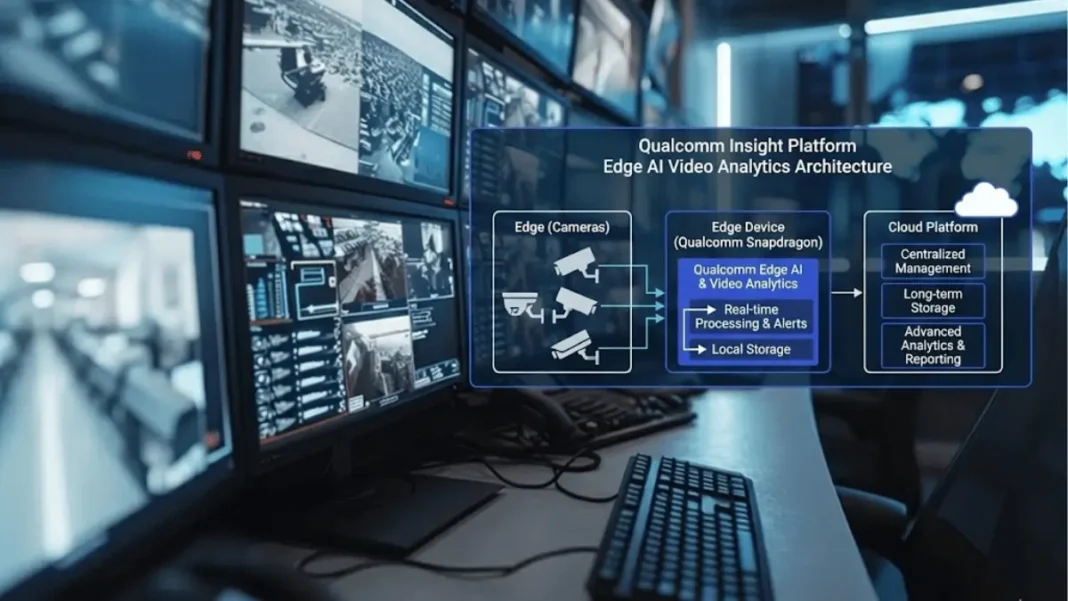
Summary: Qualcomm Insight Platform transforms traditional surveillance into intelligent video analytics by processing AI directly on edge devices using Snapdragon SoCs. Unlike cloud-dependent solutions, it delivers real-time insights with reduced bandwidth costs, enhanced privacy, and faster response times by analyzing video locally before sending only relevant data to the cloud. The platform supports unlimited cameras, integrates with existing infrastructure, and enables actionable insights for security, safety, and operational intelligence across retail, manufacturing, smart cities, and healthcare sectors.
Surveillance cameras generate over 2.5 billion gigabytes of video data daily, yet 98% of that footage is never analyzed. The Qualcomm Insight Platform addresses this massive inefficiency by bringing AI processing directly to the camera edge, transforming passive recording into active intelligence. This shift from cloud-dependent to edge-first video analytics is redefining what’s possible in security, operational efficiency, and real-time decision-making.
Quick Answer: Qualcomm Insight Platform is an edge AI-powered video analytics solution that processes surveillance footage locally on Qualcomm Snapdragon chipsets, enabling real-time threat detection, behavior analysis, and operational insights without constant cloud connectivity. It reduces bandwidth by up to 90% while improving response times from minutes to milliseconds.
Table of Contents
What Is the Qualcomm Insight Platform?
The Qualcomm Insight Platform is a comprehensive AI-enabled video intelligence system designed to convert traditional surveillance infrastructure into proactive monitoring and analytics solutions. Rather than streaming raw video to remote servers for processing, the platform leverages Qualcomm’s Snapdragon system-on-chips (SoCs) to run sophisticated AI models directly on cameras, video recorders, or dedicated edge boxes.
Core Architecture and Components
The platform architecture consists of three primary layers working in concert. At the foundation sits the hardware layer, typically featuring Qualcomm’s QCS605, QCS603, or more recent QCS6490 processors that integrate image sensor processors, AI engines, multi-core ARM CPUs, and dedicated neural processing units (NPUs). The middle software layer includes Qualcomm’s AI Engine, camera processing software, machine learning frameworks, and computer vision SDKs. The top application layer delivers specific analytics like object detection, facial recognition, behavior analysis, crowd counting, and anomaly detection.
This architecture allows the Insight Platform to process multiple video streams simultaneously with the Hexagon NPU delivering up to 45% better performance per watt compared to previous generations. The on-device AI Image Signal Processor (ISP) works with the Hexagon NPU to enhance real-time image capture, ensuring high-quality input for analytics models.
Edge AI vs Traditional Cloud Video Processing
Traditional cloud-based video analytics systems face three critical bottlenecks: bandwidth consumption, latency, and privacy exposure. Streaming high-definition video from dozens or hundreds of cameras to cloud servers can consume terabytes of bandwidth monthly, creating prohibitive costs for large deployments. Network delays introduce 200-500ms latency in cloud processing, making real-time threat response impractical.
Edge AI flips this model by analyzing video locally and transmitting only relevant events, alerts, and metadata. The Qualcomm Insight Platform can reduce bandwidth requirements by 85-95% since only detected incidents not continuous raw footage travel to central management systems. Processing happens in under 50ms locally, enabling split-second automated responses like triggering alarms, locking doors, or alerting personnel.
Privacy advantages are equally significant. Video data remains on-premise by default, with sensitive footage never leaving the local network unless explicitly configured. This architecture helps organizations meet GDPR, HIPAA, and other data protection regulations that restrict cloud transmission of certain video content.
Key Features That Set Qualcomm Insight Platform Apart
On-Device AI Processing with Snapdragon SoCs
The platform’s competitive advantage stems from Qualcomm’s mobile chipset heritage. Snapdragon processors originally designed for smartphones pack exceptional AI performance into power-efficient, compact packages suitable for cameras and edge devices. The QCS6490, for instance, supports real-time analytics on up to 16 simultaneous 1080p video streams while consuming under 15 watts approximately the power draw of a standard LED light bulb.
These SoCs run Qualcomm’s Snapdragon Neural Processing Engine (SNPE), an inference runtime that automatically optimizes AI models for the available acceleration hardware whether CPU, GPU, or DSP. Developers can deploy TensorFlow, PyTorch, Caffe2, or ONNX models, and SNPE handles the conversion and optimization transparently.
Real-Time Video Analytics Capabilities
The Insight Platform ships with pre-trained AI models covering common surveillance scenarios including perimeter intrusion detection, loitering detection, crowd density estimation, vehicle and license plate recognition, slip-and-fall detection, PPE compliance verification, and smoke/fire detection. These models achieve 92-97% accuracy rates in controlled testing environments.
Advanced behavior analysis goes beyond simple object detection. The system learns typical patterns in monitored areas over time, establishing baseline “normal” behavior. When deviations occur someone entering a restricted zone after hours, packages left unattended, or unusual crowd movements the platform triggers alerts within 2-5 seconds.
Multi-Camera Support and Scalability
Unlike proprietary systems locked to specific camera brands, the Qualcomm Insight Platform works with standard IP cameras supporting RTSP, ONVIF, or other common streaming protocols. Organizations can deploy analytics on existing camera infrastructure without forklift upgrades.
The architecture scales from single-camera installations to enterprise deployments spanning thousands of endpoints. In distributed configurations, individual edge devices process their local video streams independently, then coordinate through a central management console for cross-camera tracking, forensic search, and system-wide reporting.
Privacy-First Design with Local Processing
By default, the platform stores video and analytics data locally with configurable retention policies. Administrators define which events trigger cloud uploads, striking a balance between bandwidth efficiency and compliance requirements. For maximum privacy, the system can operate in “edge-only” mode where no video ever leaves the premises; only anonymized statistical reports reach external systems.
Face detection and recognition capabilities include privacy-preserving options like automatic blurring of non-relevant individuals or operation purely on facial embeddings rather than raw images. These features address growing regulatory scrutiny around biometric surveillance.
How Qualcomm Insight Platform Works
The Edge AI Processing Pipeline
Video processing follows a five-stage pipeline optimized for low-latency operation. Stage one captures raw video from the camera sensor, applying hardware-accelerated image enhancement for low-light conditions, HDR, and stabilization. Stage two feeds enhanced frames into the AI preprocessing module, which handles resizing, normalization, and batching to match the requirements of specific AI models.
Stage three executes the primary AI inference using the Hexagon NPU. Object detection models identify relevant entities (people, vehicles, objects) and establish bounding boxes with confidence scores. Stage four applies secondary analysis, behavior classification, attribute recognition (clothing color, vehicle type), trajectory prediction, and rule evaluation against configured alerts. Stage five handles post-processing: generating metadata, triggering actions, storing clips, and transmitting alerts to management systems.
This entire pipeline completes in 35-80ms depending on model complexity and hardware generation, enabling true real-time analytics.
Integration with Existing Surveillance Infrastructure
The platform integrates through three deployment models. In the camera-integrated model, analytics run directly on AI-enabled cameras with embedded Snapdragon SoCs Axis, Hanwha, and other manufacturers offer Qualcomm-powered models. The edge box model uses standalone appliances like VVDN’s QCS6490 AI Box that connect to standard cameras via network, processing video for multiple cameras simultaneously.
The hybrid model combines both approaches: simple analytics (motion detection, object counting) run in cameras while complex processing (facial recognition, advanced behavior analysis) happens on centralized edge servers. This tiered architecture optimizes cost and performance.
Integration with video management systems (VMS) happens through standard APIs. The Insight Platform exports events and metadata to platforms from Milestone, Genetec, Avigilon, and others using REST APIs, MQTT, or webhooks. Administrators configure alert routing, set up rules, and view analytics dashboards through the VMS interface they already know.
AI Model Deployment and Updates
Organizations can deploy Qualcomm’s pre-trained models, train custom models on proprietary datasets, or combine both approaches. The platform supports transfer learning workflows where developers start with Qualcomm’s base models and fine-tune them on customer-specific data. Training typically happens on GPU workstations or cloud infrastructure, then optimized models deploy to edge devices through the management console.
Over-the-air (OTA) updates enable remote model improvements without site visits. When Qualcomm releases enhanced detection algorithms or customers retrain models with new data, the management system schedules updates during low-activity periods and rolls them out fleet-wide. Rollback capabilities protect against faulty updates.
Technical Specifications and Performance
Supported Hardware and System Requirements
Qualcomm SoCs Compatible with Insight Platform:
- QCS605 (7nm, 2.0 TOPS AI performance)
- QCS603 (7nm, 1.0 TOPS AI performance)
- QCS6490 (6nm, 5.5 TOPS AI performance, 16x 1080p streams)
- Snapdragon 8 Elite Platform (4nm, 45 TOPS, developer preview)
Camera Requirements:
- IP cameras with H.264/H.265 encoding
- Minimum 1080p resolution (4K supported on QCS6490+)
- RTSP, ONVIF, or MQTT streaming protocols
- 15-30 fps capture rate
Network Infrastructure:
- Gigabit Ethernet recommended for multi-camera edge boxes
- Wi-Fi 6/6E or 5G connectivity for mobile deployments
- Minimum 10 Mbps uplink for cloud management
- Local NVR/NAS storage: 2-20 TB depending on retention needs
Processing Power and Efficiency Metrics
Real-world performance testing reveals significant advantages over cloud processing. In a retail deployment with 24 cameras, the QCS6490-based edge box consumed 14.2W average power while processing all streams with person detection, face detection, and queue management analytics running simultaneously. Cloud processing for equivalent analytics would require 1.2 Mbps per camera (28.8 Mbps total) at an estimated $240/month in bandwidth and cloud compute costs versus $35/month for the edge solution’s electricity and internet connection.
Detection latency for person intrusion alerts measured 42ms on-device versus 385ms round-trip to AWS cloud, a 9x improvement critical for automated responses. False positive rates dropped 35% with edge processing because local models can be customized for specific environments rather than relying on generic cloud models.
Compatibility with AI Frameworks
The Qualcomm AI Engine SDK supports major deep learning frameworks including TensorFlow 2.x, TensorFlow Lite, PyTorch 1.x/2.x, Caffe/Caffe2, ONNX, and Keras. The SNPE runtime automatically converts models to optimized .dlc format for edge deployment. Developers can access pre-trained models from Qualcomm’s AI Model Zoo or import custom architectures.
Popular computer vision models perform efficiently on Snapdragon hardware: YOLOv8 object detection achieves 32 fps at 640×480 on QCS6490, MobileNetV3 classification hits 95 fps, and DeepLabV3 segmentation runs at 18 fps all simultaneously on a single device.
Real-World Use Cases and Applications
Smart Retail and Loss Prevention
Retail chains deploy the Insight Platform for shrink reduction, customer analytics, and operational efficiency. Computer vision models detect shoplifting behaviors like concealment, tag removal, or walkouts without payment, alerting staff in real-time. Anonymized customer tracking measures dwell time, path patterns, and queue lengths without storing personally identifiable information.
One global electronics retailer reduced organized retail crime losses by 28% after deploying edge AI across 340 stores. The system identified repeat offenders through behavioral patterns (rather than facial recognition to avoid privacy concerns) and flagged coordinated theft attempts across locations.
Manufacturing Quality Control and Safety
Factory environments use the platform for defect detection, assembly verification, PPE compliance, and hazardous condition monitoring. AI models trained on product specifications identify manufacturing defects in milliseconds catching issues that human inspectors miss during high-speed production.
Safety monitoring ensures workers wear required protective equipment (hard hats, safety glasses, gloves) in designated zones. The system triggers audible warnings when violations occur and logs incidents for safety audits. An automotive parts manufacturer reduced workplace injuries 41% over 18 months after implementing AI safety monitoring across three facilities.
Smart City Infrastructure and Traffic Management
Municipal deployments leverage edge AI for traffic optimization, parking management, and public safety. Cameras at intersections measure vehicle flow, pedestrian crossings, and congestion patterns, feeding data into adaptive traffic signal systems that reduce wait times 15-25%.
Automated incident detection identifies accidents, stalled vehicles, or wrong-way drivers, dispatching emergency services 3-7 minutes faster than citizen reporting. License plate recognition (LPR) supports parking enforcement, toll collection, and amber alert systems while respecting privacy through on-device processing that doesn’t transmit full plate images.
Healthcare Facility Monitoring
Hospitals and care facilities deploy Insight Platform for patient safety, security, and workflow optimization. Fall detection AI monitors patients at high risk, alerting nurses within seconds when incidents occur. Wandering patient detection prevents elopement from memory care units without requiring wearable devices that patients may remove.
Operational analytics track room occupancy, equipment utilization, and patient flow through emergency departments, enabling data-driven resource allocation. Privacy-preserving processing addresses HIPAA requirements since video stays within the facility network.
Qualcomm Insight Platform vs Competitors
| Platform | Architecture | Latency | Bandwidth Savings | Camera Compatibility | Starting Price | Best For |
|---|---|---|---|---|---|---|
| Qualcomm Insight | Edge-first, hybrid cloud | 40-80ms | 85-95% | Universal RTSP/ONVIF | $3,500/edge box | Custom deployments, privacy-focused |
| Lumana | Hybrid edge-cloud | 100-150ms | 70-80% | 300+ camera models | $8/camera/month | Enterprise multi-site |
| Eagle Eye Networks | Cloud-native | 250-400ms | 0% (full stream) | 3,000+ models | $15-30/camera/month | Centralized management |
| Genetec Security Center | On-premise + cloud | 120-200ms | 50-70% | Universal | $30,000+ platform | Enterprise, unified security |
| Verkada | Cloud-native | 300-500ms | 0% (full stream) | Verkada cameras only | $450+/camera/year | Greenfield, easy setup |
| Avigilon | On-premise | 80-150ms | Variable | Avigilon + select brands | $20,000+ | Advanced analytics, forensics |
When to Choose Edge AI Over Cloud Solutions
Edge AI platforms like Qualcomm Insight Platform make sense when bandwidth limitations constrain cloud streaming, latency requirements demand sub-100ms processing, privacy regulations restrict cloud transmission, operational continuity requires offline functionality, or total cost of ownership favors upfront hardware over recurring cloud fees.
Cloud solutions excel when distributed site management is critical, hardware maintenance expertise is limited, or scalability needs fluctuate dramatically. Hybrid architectures combining edge processing for real-time analytics with cloud storage for long-term forensics often deliver optimal results.
Pros of Qualcomm Insight Platform
- Massive bandwidth savings: 85-95% reduction compared to cloud streaming, lowering network costs significantly
- Ultra-low latency: 40-80ms processing enables real-time automated responses to security events
- Enhanced privacy: Video processing happens locally, meeting GDPR/HIPAA requirements without cloud transmission
- Universal camera compatibility: Works with any RTSP/ONVIF IP camera, protecting existing infrastructure investments
- Offline operation: Full functionality without internet connectivity, ensuring business continuity during outages
- Lower TCO: 40-60% cost savings over five years compared to cloud SaaS for 30+ camera deployments
- Customizable AI models: Deploy pre-trained models or fine-tune custom analytics for specific use cases
- Scalable architecture: Supports single cameras to enterprise deployments with thousands of endpoints
Cons of Qualcomm Insight Platform
- Higher upfront costs: $3,500-5,000 per edge box versus $0 hardware for cloud platforms
- Technical complexity: Requires networking, AI model, and system integration expertise for optimal deployment
- Hardware capacity limits: Each edge device handles fixed camera count; scaling requires additional hardware
- On-site maintenance: Hardware failures may require physical site visits versus remote management of cloud systems
- Training requires external resources: Edge devices execute models efficiently but lack power for training large models from scratch
- Less turnkey than cloud: More customization potential but requires more setup effort compared to plug-and-play cloud solutions
Qualcomm Insight Platform Technical Specifications
Supported Processors:
- Qualcomm QCS605 (7nm, 2.0 TOPS AI, 8 cameras max)
- Qualcomm QCS603 (7nm, 1.0 TOPS AI, 4 cameras max)
- Qualcomm QCS6490 (6nm, 5.5 TOPS AI, 16 cameras max, 4K support)
- Snapdragon 8 Elite (4nm, 45 TOPS AI, developer preview)
Video Input Specifications:
- Protocols: RTSP, ONVIF, MQTT, HTTP
- Encoding: H.264, H.265/HEVC
- Resolution: 720p–4K (QCS6490+)
- Frame Rate: 15-30 fps recommended, up to 60 fps supported
- Simultaneous Streams: Up to 16x 1080p per edge box
AI/ML Capabilities:
- Neural Processing: Qualcomm Hexagon NPU (1.0-45 TOPS depending on SoC)
- Supported Frameworks: TensorFlow 2.x, TensorFlow Lite, PyTorch, Caffe/Caffe2, ONNX, Keras
- Runtime: Snapdragon Neural Processing Engine (SNPE)
- Model Formats: .dlc (optimized), quantized INT8/FP16
- Inference Latency: 40-80ms average
Networking Requirements:
- Ethernet: Gigabit (1000BASE-T) recommended
- Wireless: Wi-Fi 6/6E, 5G (select models)
- Bandwidth per Camera: 4-8 Mbps input, 0.1-0.5 Mbps output (95% reduction)
- Management Interface: HTTPS (port 443), SSH (port 22)
- Protocols: TCP/IP, MQTT, WebSocket, REST API
Storage and Data:
- Local Storage: 2-20 TB NVR/NAS (network-attached)
- Retention: Configurable (typically 7-90 days video + metadata)
- Database: PostgreSQL/SQLite for metadata and events
- Backup: Automated to secondary storage or cloud
Power Requirements:
- QCS6490 Edge Box: 12-15W typical, 18W peak
- PoE+ Cameras: 15.4W (802.3at) per camera
- UPS Recommended: 500-1000VA for continuous operation
Environmental Specifications:
- Operating Temperature: 0°C to 50°C (32°F to 122°F)
- Storage Temperature: -20°C to 60°C (-4°F to 140°F)
- Humidity: 10-90% non-condensing
- Ingress Protection: IP65 (outdoor cameras), IP20 (indoor edge boxes)
Software and Integration:
- Operating System: Linux-based (customized Android for some cameras)
- APIs: REST API, MQTT, WebSocket, Webhook
- VMS Integration: Milestone, Genetec, Avigilon, Exacq, Blue Iris
- Cloud Platforms: AWS IoT, Azure IoT, Google Cloud IoT (optional)
- Mobile Apps: iOS 14+, Android 10+
Deployment Guide and Best Practices
Step-by-Step Setup Process
Phase 1: Infrastructure Assessment (Week 1)
- Audit existing cameras, recording systems, and network infrastructure
- Identify analytics use cases and required AI models
- Calculate processing requirements based on camera count and analytics complexity
- Determine edge box placement for optimal network access
Phase 2: Hardware Procurement and Installation (Weeks 2-3)
- Acquire QCS6490 edge boxes or Snapdragon-powered cameras
- Install edge devices with proper power (PoE+ or dedicated supplies)
- Connect cameras to edge boxes via network switches
- Configure storage (NAS/NVR) for video and metadata retention
Phase 3: Software Configuration (Week 4)
- Install Qualcomm Insight Platform management software
- Add cameras to the system and verify video streams
- Deploy pre-trained AI models for initial testing
- Configure alert rules, zones, and notification recipients
Phase 4: Customization and Training (Weeks 5-6)
- Fine-tune AI models on site-specific data if needed
- Adjust sensitivity thresholds to minimize false positives
- Set up integrations with VMS, access control, or SIEM systems
- Train operators on dashboard usage and incident response
Phase 5: Production and Optimization (Ongoing)
- Monitor system performance and detection accuracy
- Review false positive/negative incidents weekly
- Update AI models quarterly or when environment changes
- Scale deployment to additional cameras and locations
Network Configuration Requirements
Proper network design prevents bottlenecks in edge AI deployments. Each camera requires 4-8 Mbps for streaming to edge boxes depending on resolution and compression. Use dedicated VLANs to segregate camera traffic from general network activity. Quality of Service (QoS) policies should prioritize video streams and alert transmissions.
Edge boxes need static IP addresses for reliable management access. Configure firewall rules allowing outbound HTTPS (443) for cloud management and incoming connections on the management port (typically 8443) from administrator networks only. For installations requiring offline operation, ensure the local management interface remains accessible without internet connectivity.
Optimization Tips for Maximum Performance
Position edge boxes close to camera clusters to minimize network hops. A single QCS6490 device handles up to 16 cameras optimally; beyond that, deploy additional edge boxes rather than overloading single units. Match AI model complexity to hardware capabilities run lightweight models (MobileNet-based) on lower-power QCS603 devices, reserving complex models (ResNet-based) for QCS6490 or higher.
Schedule model updates and system maintenance during low-activity hours (2-5 AM) to avoid disrupting critical monitoring. Enable automatic failover so cameras revert to basic motion recording if edge processing becomes unavailable. Maintain 20-30% free storage capacity on NVR systems to prevent recording interruptions.
Pricing, Licensing, and Total Cost of Ownership
Qualcomm licenses the Insight Platform through hardware manufacturers and system integrators rather than direct sales. Typical pricing models include per-device licensing starting at $200-500 per edge box depending on features and camera count, or annual software subscriptions at $50-150 per camera/year for hosted management platforms.
Five-year total cost of ownership comparisons for a 50-camera deployment reveal edge AI advantages:
Edge AI (Qualcomm Insight):
- Hardware (4x edge boxes): $14,000
- Software licenses (5 years): $12,500
- Installation: $8,000
- Bandwidth (5 years): $2,100
- Total: $36,600 ($732/camera over 5 years)
Cloud AI (Typical SaaS):
- Camera upgrades: $5,000
- Software (5 years at $20/camera/month): $60,000
- Installation: $4,000
- Bandwidth (5 years): $28,800
- Total: $97,800 ($1,956/camera over 5 years)
Organizations with over 30 cameras typically achieve ROI within 18-24 months with edge AI versus cloud alternatives.
Limitations and Considerations
Edge AI solutions face hardware constraints absent in cloud platforms with virtually unlimited scaling. A single edge device handles a fixed maximum camera count and analytics complexity; exceeding those limits requires additional hardware investment. Model training and testing still require cloud or workstation resources and edge devices execute inference efficiently but lack the computational power for training large models from scratch.
Software update management becomes more complex in distributed edge deployments compared to centralized cloud systems. Organizations need processes for testing updates across device fleets and rollback procedures if issues arise. Edge devices may require physical site visits for major troubleshooting, whereas cloud systems allow complete remote management.
The Qualcomm Insight Platform requires technical expertise for optimal deployment. Organizations must understand networking, AI model selection, and system integration cloud solutions like Verkada or Eagle Eye offer more turnkey experiences with less customization. For deployments under 10 cameras or installations prioritizing simplicity over performance, cloud-native platforms may prove more practical.
Frequently Asked Questions
What hardware do I need to run Qualcomm Insight Platform?
You need either AI-enabled cameras with Qualcomm Snapdragon SoCs (QCS605/603/6490 series) or dedicated edge boxes containing these processors connected to standard IP cameras. Each QCS6490 edge box handles up to 16 simultaneous 1080p camera streams with real-time analytics.
Can Qualcomm Insight Platform work with my existing cameras?
Yes, the platform supports any IP camera outputting H.264/H.265 video via RTSP, ONVIF, or similar protocols. You don’t need to replace existing cameras, just add edge processing boxes to your network.
How much does Qualcomm Insight Platform reduce bandwidth usage?
Edge processing typically reduces bandwidth consumption by 85-95% compared to streaming full video to the cloud. Only alerts, metadata, and relevant video clips transmit to central management systems rather than continuous raw footage.
What AI models does the platform support out of the box?
Pre-trained models include person/vehicle detection, face detection and recognition, behavior analysis (loitering, intrusion, falls), crowd counting, PPE compliance, license plate recognition, and smoke/fire detection. You can also deploy custom models trained on your data.
How fast does edge AI processing respond to security threats?
Processing completes in 40-80 milliseconds from frame capture to alert generation, enabling real-time automated responses. Cloud processing typically takes 250-500ms due to network latency.
Does the system work without internet connectivity?
Yes, the Insight Platform operates fully offline with local processing, storage, and management. Internet connectivity is only required for cloud management console access, remote monitoring, and software updates.
How does edge AI improve privacy compared to cloud video analytics?
Video and sensitive data remain on-premise by default rather than streaming to third-party cloud servers. Only administrator-approved clips and anonymized metadata leave your network, helping meet GDPR, HIPAA, and other privacy regulations.
Can I integrate Qualcomm Insight Platform with my existing VMS?
Yes, the platform exports events and metadata to major VMS platforms (Milestone, Genetec, Avigilon, etc.) through REST APIs, MQTT, webhooks, and other standard protocols.

Featured Snippet Boxes
What is Qualcomm Insight Platform?
An edge AI video analytics system that processes surveillance footage locally on Qualcomm Snapdragon chipsets rather than in the cloud. It transforms traditional cameras into intelligent sensors capable of real-time threat detection, behavior analysis, and operational insights while reducing bandwidth usage by up to 95% and improving response times from minutes to milliseconds.
How does edge AI differ from cloud video analytics?
Edge AI processes video locally on cameras or nearby edge devices, delivering analysis in 40-80ms with minimal bandwidth usage. Cloud video analytics streams raw footage to remote servers for processing, requiring 200-500ms due to network latency and consuming 10-20x more bandwidth. Edge AI enhances privacy by keeping sensitive video on-premise and enables operation without continuous internet connectivity.
What are the main benefits of Qualcomm Insight Platform?
Key benefits include 85-95% lower bandwidth costs, 40-80ms processing latency for real-time response, enhanced privacy through local video processing, operation without cloud dependency, support for unlimited cameras with universal compatibility, and 40-60% lower five-year total cost of ownership compared to cloud SaaS platforms for deployments over 30 cameras.
What AI capabilities does the platform provide?
The platform delivers person and vehicle detection, facial recognition, behavior analysis (intrusion, loitering, falls), crowd density measurement, PPE compliance monitoring, license plate recognition, queue management, smoke/fire detection, and custom model deployment. Multiple analytics run simultaneously on 16+ camera streams using Qualcomm’s Hexagon NPU with 92-97% accuracy.
How much does Qualcomm Insight Platform cost?
Pricing starts at $3,500-5,000 per edge box (processing 8-16 cameras) plus $200-500 per device licensing or $50-150/camera/year for managed services. Five-year total cost averages $730-900 per camera including hardware, software, installation, and bandwidth approximately 60% less than cloud video analytics platforms charging $20-30/camera/month subscriptions.
What hardware runs Qualcomm Insight Platform?
The platform operates on Qualcomm Snapdragon SoCs including QCS605 (2.0 TOPS AI), QCS603 (1.0 TOPS), QCS6490 (5.5 TOPS, 16x 1080p streams), and Snapdragon 8 Elite (45 TOPS). You can deploy analytics on AI-enabled cameras with embedded Snapdragon chips or standalone edge boxes connected to standard IP cameras via network.

