

Quick Brief
- Qualcomm launched the Agentic RAN Management Service within the Dragonwing RAN Automation Suite at MWC Barcelona 2026
- Three tier-1 operators released AI-native RAN architectures in the same 5-day window before MWC opened, signaling coordinated industry direction
- NTT DOCOMO confirmed February 24, 2026: AI inference in live vRAN runs on general-purpose CPUs using Qualcomm accelerators, removing the GPU cost barrier
- Qualcomm CEO Cristiano Amon confirmed pre-commercial 6G devices are targeted for 2028, with AI agents at the core
Qualcomm used MWC Barcelona 2026 to answer a question the telecom industry has circled for two years: when does AI in the RAN become production reality rather than vendor roadmap? The Agentic RAN Management Service, launched under the Dragonwing brand on March 2, 2026, is Qualcomm’s answer. It arrived at precisely the moment three tier-1 operators each independently published AI-native RAN architectures, and the convergence is not coincidental. This article breaks down what Qualcomm launched, what the operator ecosystem confirmed at MWC 2026, and why the architecture decisions being made now will shape network economics for the next decade.
What AI-Native RAN Actually Means in 2026
The phrase “AI-native RAN” has circulated for two years. At MWC 2026, it carries production-oriented specifics for the first time.
AI-native RAN means the radio access network is designed from the ground up to run AI inference workloads including predicting interference, optimizing antenna configurations, managing handovers, and detecting faults. The intelligence is embedded in the RAN architecture itself, not added as an external layer.
The critical unresolved debate before MWC 2026 was where that AI processing runs and on what hardware. Three operators answered it differently in the same week, each solving a distinct constraint and arriving at the same destination.
What Qualcomm Launched at MWC Barcelona 2026
Qualcomm launched the Agentic RAN Management Service as a new capability within the Qualcomm Dragonwing RAN Automation Suite at MWC 2026. The service introduces agentic and generative AI into live RAN operations, enabling autonomous network management where operators work at the intent level rather than the configuration level.
Qualcomm also announced new AI enhancements for its existing commercial Open RAN platforms, designed to improve uplink and downlink performance on networks already deployed in the field. This is operationally significant: operators do not need to wait for a new infrastructure generation to access AI-driven performance gains.
The Dragonwing RAN Automation Suite includes a Data Management Layer that provides RAN AI Services based on Hybrid Neural Network (HNN) and Deep Neural Network (DNN) technology. It also enables a vendor-neutral rApp marketplace, allowing operators to deploy third-party AI applications on Qualcomm’s RAN infrastructure without single-vendor dependency.
The Verizon Deployment: Dragonwing in a Live Commercial Network
Qualcomm’s Dragonwing platform is not a lab demonstration. Verizon deployed Qualcomm’s Dragonwing RAN Intelligent Controller in its live commercial network, integrating it with Samsung’s AI-powered Energy Saving Manager (AI-ESM) in a multi-vendor Open RAN deployment announced February 25, 2025.
The deployment achieved 15% average energy savings across the network, reaching up to 35% savings per sector during low-traffic periods. This was the first integration of its kind combining a Qualcomm Dragonwing RIC with Samsung’s AI application in a production US network.
This result matters for the MWC 2026 announcement because it provides independently verified performance data for Qualcomm’s Dragonwing platform before the agentic capabilities layer was added. Operators evaluating the new Agentic RAN Management Service have a live commercial baseline to reference.
Three Operators, Three Architectures, One Thesis
The biggest signal from MWC 2026 did not come from a keynote. Three operators released AI-native RAN white papers and demonstrations in a 5-day window before the show floor opened. Read together, they represent a coordinated industry position: the RAN is now a distributed AI compute platform.
NTT DOCOMO: AI Without GPU Capital Expenditure
DOCOMO’s demonstration, confirmed February 24, 2026, ran AI applications directly on general-purpose CPU resources inside a commercial vRAN network using HPE servers with Qualcomm accelerators, NEC vRAN software, and AWS infrastructure. No dedicated GPU hardware was required. AI processing ran in parallel with live network processing on COTS CPUs.
This challenges a widely held assumption that AI-in-RAN means AI-capex-in-RAN. For operators watching AI infrastructure costs compound across thousands of sites, DOCOMO’s result is the most operationally important proof point at MWC 2026.
SK Telecom ATHENA: Full Hardware and Software Separation
SK Telecom’s ATHENA white paper, released ahead of MWC, calls for complete hardware and software decoupling with a near-real-time RIC at the center of a 6G-native architecture. The framework uses xPU-based COTS servers to replace proprietary base stations and open interfaces to eliminate vendor lock-in.
At MWC 2026, SK Telecom demonstrated AI agents for network management, on-device AI-based antenna optimization, and integrated communication-sensing as a full-stack preview of autonomous operations outside the lab. The ATHENA position is also a commercial stance: complete hardware and software separation means no single vendor controls the AI layer as AI becomes the differentiating capability in the RAN.
SoftBank Consortium and AgentRAN: Intent-Driven Orchestration
A consortium of Northeastern University, SoftBank, Keysight, and zTouch Networks demonstrated AgentRAN at MWC 2026 at the Keysight booth, Hall 2, running March 2 through March 5. Announced February 26, 2026, AgentRAN introduces a hierarchy of AI agents powered by a Large Telecom Model (LTM) that translates high-level operator intents directly into real-time 5G and 6G network configurations.
This is intent-driven orchestration, not traditional scripted automation. Engineers define outcomes; AI agents execute configurations autonomously.
How the Industry Hardware Layer Was Pre-Positioned
Ericsson launched ten AI-ready radios with built-in neural network accelerators on February 16, 2026, ahead of MWC, timed precisely for this architecture conversation. These radios are designed to run the AI inference workloads that DOCOMO, SK Telecom, and the SoftBank consortium are now defining at the software and orchestration layer.
NEC also demonstrated Agentic AI-driven autonomous network operations in a verified multi-vendor environment at MWC 2026, with the demonstration running at the AWS booth rather than NEC’s own stand. This placement is deliberate: hyperscaler-anchored telco AI is the infrastructure story of MWC 2026. The cloud is no longer adjacent to the RAN. It is operating inside it.
The Pattern These Announcements Reveal
| Operator | Architecture Position | Hardware Stance | AI Layer |
|---|---|---|---|
| NTT DOCOMO | CPU-first, cost-flexible vRAN | COTS CPUs, no dedicated GPU | AI parallel to live RAN processing |
| SK Telecom | Full HW/SW separation + near-RT RIC | xPU-based COTS, vendor-agnostic | AI agents for antenna, management, sensing |
| SoftBank consortium | Intent-driven agentic orchestration | Hyperscaler-anchored (AWS) | LTM-powered AgentRAN, autonomous config |
The three operators are not copying each other. Each is solving a different constraint: capital expenditure, vendor independence, and operational agility. They are arriving at the same destination: a RAN that runs AI natively, continuously, and autonomously.
Qualcomm’s 6G Roadmap and What It Means for Operators
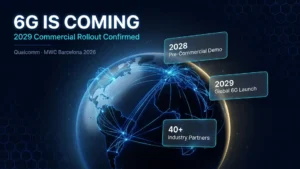
Qualcomm CEO Cristiano Amon confirmed at Snapdragon Summit 2025 that Qualcomm expects pre-commercial 6G devices to be ready by 2028, or possibly earlier. The 6G vision goes beyond connectivity, with Amon stating that 6G will interpret sensor data to understand and contextualize the environment and that AI agents will serve as the primary user interface on devices ranging from phones and smartwatches to earbuds and glasses.
The Agentic RAN Management Service launched at MWC 2026 is directly tied to this timeline. The AI workflows, agent policies, and operational data being built through Dragonwing deployments in 2026 form the infrastructure base that AI-native 6G networks will depend on from launch. Operators who adopt the platform now are not just solving a 5G management problem. They are building toward a 6G readiness position.
Qualcomm and other industry leaders also formalized a 6G trajectory commitment at MWC 2026 alongside live architecture demonstrations at the event.
Considerations
Qualcomm’s Agentic RAN Management Service was announced at MWC 2026 and the Qualcomm official press release was not publicly accessible for direct verification at time of writing. The core launch facts are confirmed via Qualcomm’s public press page and third-party reporting. Operator-level cost projections and autonomy-level timelines from Qualcomm’s roadmap require verification against the primary press release before use in decision-making. The NTT DOCOMO CPU-based AI deployment removes one cost barrier, but operators with highly heterogeneous legacy network environments may face integration complexity not captured in DOCOMO’s controlled deployment scenario.
Frequently Asked Questions (FAQs)
What is Qualcomm’s Agentic RAN Management Service?
It is a new capability within the Qualcomm Dragonwing RAN Automation Suite launched at MWC Barcelona 2026. It applies agentic and generative AI to live RAN operations, enabling operators to manage networks through intent-based instructions rather than manual configuration across individual cell sites.
What is the Qualcomm Dragonwing RAN Automation Suite?
It is Qualcomm’s infrastructure-facing platform for Open RAN networks. It includes a Data Management Layer with Hybrid Neural Network and Deep Neural Network services, a vendor-neutral rApp marketplace for third-party AI applications, and a RAN Intelligent Controller deployed in live commercial networks including Verizon’s US network.
Has Qualcomm’s Dragonwing platform been deployed in a live network?
Yes. Verizon deployed the Qualcomm Dragonwing RAN Intelligent Controller in its commercial US network in February 2025, integrating it with Samsung’s AI Energy Saving Manager. The deployment achieved 15% average energy savings and up to 35% per sector during low-traffic periods.
Does AI-in-RAN require expensive GPU infrastructure?
Not necessarily. NTT DOCOMO confirmed on February 24, 2026 that AI inference can run on general-purpose CPUs alongside live vRAN workloads, using HPE servers with Qualcomm accelerators and NEC vRAN software on AWS, with no dedicated GPU hardware required.
When is Qualcomm targeting pre-commercial 6G devices?
Qualcomm CEO Cristiano Amon stated at Snapdragon Summit 2025 that pre-commercial 6G devices are expected by 2028, or possibly earlier. The 6G architecture will center on AI agents as the primary user interface across phones, wearables, and connected devices.
What did SK Telecom demonstrate at MWC 2026?
SK Telecom demonstrated its ATHENA architecture at MWC 2026, featuring complete hardware and software separation, a near-real-time RIC, and AI agents handling antenna optimization, network management, and communication-sensing. The framework uses xPU-based COTS servers and fully open interfaces to eliminate vendor lock-in.
What is AgentRAN and who developed it?
AgentRAN is an intent-driven autonomous network orchestration system developed by a consortium of Northeastern University, SoftBank, Keysight, and zTouch Networks. It uses a Large Telecom Model (LTM) to translate high-level operator intents into real-time 5G and 6G network configurations. It was demonstrated live at MWC 2026, Keysight booth, Hall 2.

