

Quick Brief
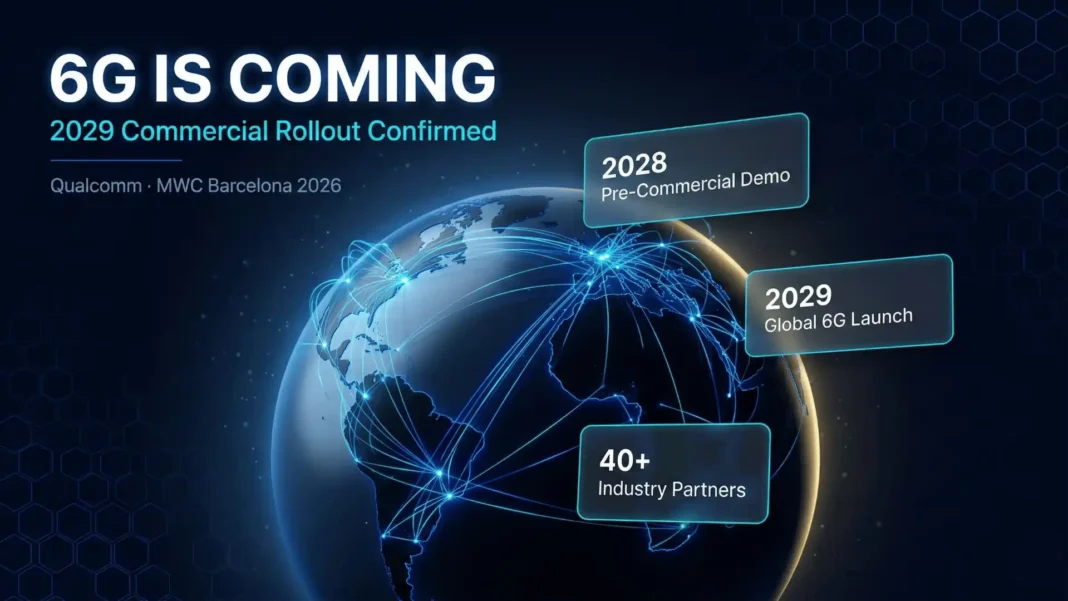
- Qualcomm and 40+ global partners announced a milestone-driven 6G roadmap at MWC Barcelona 2026, targeting commercial launch from 2029
- Primary coalition partners include Google, Microsoft, Amazon, Samsung, Ericsson, Nokia, T-Mobile, Reliance Jio, Meta, and 30+ others
- Pre-commercial 6G spec-compliant devices and networks are planned for demonstration by 2028
- 6G architecture is built on three pillars: AI-native devices, intelligent networks, and cloud infrastructure
6G is no longer a research concept. At MWC Barcelona 2026, Qualcomm formalized a coalition of more than 40 global industry leaders that puts a hard date on the world’s next wireless era. This piece breaks down what the coalition committed to, who is in it, and what the 2029 timeline means for consumers and enterprises in the US and India.
What the Qualcomm 6G Coalition Actually Committed To
Qualcomm Technologies announced a new strategic coalition at MWC Barcelona 2026 to accelerate the global development and deployment of 6G. The collaboration establishes a clear, milestone-driven roadmap focused on delivering commercial 6G systems starting from 2029 onwards.
The commitment covers five concrete milestones: timely development of essential 6G standards through active participation in bodies like 3GPP; early system validation through lab prototypes; demonstrations of 6G spec-compliant pre-commercial devices and networks by 2028; establishing a common industry benchmark for 6G readiness; and the initial rollout of global, interoperable commercial 6G systems starting in 2029.
This is not a soft pledge. It is a deadline-oriented industry alignment with named partners, shared technical targets, and public accountability established at the world’s largest mobile event.

Who Is In the Coalition: A Roster That Spans Every Sector
The primary coalition is one of the broadest in wireless history. Named global partners include Airtel, Amazon, Asus, BT Group, Cisco, Dell, e&, Ericsson, FPT Corporation, Fujitsu/1finity, Google, HP, HPE, HUMAIN, KDDI, KT, Lenovo, LG Electronics, LG Uplus, Meta, Microsoft, Motorola, NEC Corporation, Nokia, NTT DOCOMO, Reliance Jio, Samsung Electronics, Sharp, SK Telecom, Snap Inc., Stellantis, Swisscom, Tejas Networks, Telstra, TIM Group, T-Mobile, Viettel Group, VNG, and YTL.
A second group of partners also aligned with the effort includes Alibaba, Aramco, Chery Automobile, China Mobile, China Telecom, China Unicom, Deutsche Telekom, Geely Auto, GWM, Honor, Hyundai, Leap Motor, Li Auto, NIO, OPPO, SAIC Motor, Vivo, Xiaomi, and Xpeng. The presence of Stellantis, Hyundai, Xpeng, and multiple Chinese automakers confirms that 6G is being architected with connected and autonomous vehicle use cases as a primary design consideration from day one.
Ericsson and Qualcomm separately validated fundamental 6G radio innovations through collaborative lab prototypes, presenting agreed-upon study items for 3GPP 6G Release 20 at MWC 2026. Their joint work includes a 400 MHz component carrier at 30 kHz subcarrier spacing, exploring performance in the 6 to 8 GHz centimeter-wave range.
The 6G Architecture: Three Pillars That Define the Next Era
6G is being designed as an AI-native system built on three key pillars: connectivity, wide-area sensing, and high-performance compute. Each pillar integrates artificial intelligence at the foundation, not as an add-on layer.
Next-generation 6G networks will feature intelligent radios with integrated wide-area sensing capabilities, virtualized and cloud RAN with high-performance and energy-efficient compute, AI-based network autonomy, and edge and centralized data centers for entirely new AI workloads. For consumers, this translates to context-aware services, persistent agentic AI experiences, and real-time environment sensing built directly into the network.
6G systems will also enable new classes of services including low-altitude aerial and terrestrial traffic management, context-relevant data delivery, and data insights and analytics at scale. These are not distant possibilities. They are explicitly named use cases within the coalition’s official roadmap.
AI-Native Design: What It Means in Practice
Cristiano Amon, President and CEO of Qualcomm Incorporated, stated: “6G is more than the next step in wireless evolution. It is the foundation for an AI-native future that distributes intelligence across devices, the edge, and the cloud, and transforms network providers into AI-driven enterprises.”
The Ericsson and Qualcomm collaboration frames this shift precisely. As usage moves from app-based, user-initiated sessions to persistent, agentic AI experiences across multiple devices, uplink demand will rise significantly, making wide-area coverage for AI services increasingly essential. Ericsson’s ConsumerLab research quantifies this: by 2030, 40% of consumers are expected to use agentic AI services daily, one in four users will access AI across multiple devices, and 45% anticipate using AI outdoors.
Uplink data demand is projected to triple every five years, which is a direct driver behind 6G’s architectural focus on optimized uplink coverage and wide-area reliability. This is why Ericsson and Qualcomm are already prototyping AI and AR experiences with new device form factors and resilient infrastructure as part of their joint 6G work.
6G vs 5G: What Changes at the Infrastructure Level
| Dimension | 5G (Current) | 6G (Planned from 2029) |
|---|---|---|
| Core Design | Connectivity-first | AI-native from ground up |
| Spectrum Focus | Sub-6 GHz, mmWave | 6 to 8 GHz cmWave |
| Sensing Capability | Absent | Wide-area sensing integrated |
| Network Autonomy | Manual optimization | AI-driven self-management |
| Pre-commercial Demo | N/A | Planned 2028 |
| Commercial Rollout | Ongoing | 2029 targeted |
The 2028 to 2029 Window: What Happens Before Commercial Launch
The roadmap includes a critical pre-commercial phase in 2028 where spec-compliant devices and networks will be demonstrated publicly. Ericsson and Qualcomm are already executing on this through live MWC 2026 demonstrations of validated physical layer concepts aligned directly with 3GPP 6G Release 20 study items.
These demonstrations include a 400 MHz component carrier with 30 kHz subcarrier spacing, and exploration of the 6 to 8 GHz centimeter-wave range including improved cell-edge coverage with new device capabilities of four transmit-receive antennas. These are not concept videos. They are lab-validated prototype demonstrations of actual signal behavior in new spectrum bands.
Durga Malladi, EVP and GM at Qualcomm Technologies, stated: “By aligning early on key radio concepts and user-experience validation across devices and networks, we create a clearer path from lab to standard to commercial launch. That focus on usable performance, especially uplink and wide area reliability, will unlock the next wave of AI-driven devices and services.”
What This Means for India and US Consumers
For India, the coalition’s inclusion of Reliance Jio as a named primary partner is the single most significant data point. Jio’s presence indicates direct operator-level investment in 6G from India’s largest telecom network, setting the stage for domestic rollout alongside global commercial deployments starting 2029.
The secondary partner group also includes several major India-market device OEMs: Honor, OPPO, Vivo, and Xiaomi. India’s smartphone market, heavily weighted toward mid-range devices, stands to benefit from these OEMs building 6G capability into accessible price points, unlike the premium-first rollouts that characterized early 5G adoption.
For the US, T-Mobile is a named primary coalition partner. Airtel’s inclusion as a primary partner further bridges both the US and India markets given its multinational operator footprint. Both markets share a direct benefit from 6G’s AI-driven network autonomy, which will reduce latency variability and power real-time applications from agentic AI services to aerial traffic management.
Considerations and Limitations
The 2029 commercial target depends on 3GPP standards for Release 20 being finalized on schedule and regulatory bodies in each country clearing new spectrum bands, particularly the 6 to 8 GHz cmWave range. Standards delays have affected every prior wireless generation. Rural deployment in India and the US will follow urban centers by several years, consistent with the pattern seen in 4G and 5G rollouts.

Frequently Asked Questions (FAQs)
When will 6G launch commercially?
Qualcomm and its industry coalition have committed to launching interoperable commercial 6G systems starting from 2029 onwards. Pre-commercial, spec-compliant devices and networks will be demonstrated in 2028 as a formal coalition milestone announced at MWC Barcelona 2026.
What companies are part of Qualcomm’s 6G coalition?
The primary coalition includes 40+ named partners: Google, Microsoft, Amazon, Samsung, Ericsson, Nokia, T-Mobile, Reliance Jio, Meta, Airtel, Cisco, Dell, HP, HPE, NTT DOCOMO, SK Telecom, Snap Inc., Stellantis, and others. A second group includes Alibaba, China Mobile, Hyundai, Xiaomi, OPPO, and additional automotive and device OEMs.
What is AI-native 6G and why does it matter?
AI-native 6G means artificial intelligence is embedded at the network’s core architecture from design, not added as an overlay. This enables AI-based network autonomy, intelligent radios with integrated wide-area sensing, and edge and centralized data centers built specifically for new AI workloads.
How is 6G different from 5G?
6G introduces AI-native design across devices, networks, and cloud infrastructure. It adds integrated wide-area sensing capabilities, targets the 6 to 8 GHz centimeter-wave spectrum with new antenna configurations, and enables persistent agentic AI experiences that 5G’s architecture was not designed to support.
Will 6G be available in India by 2029?
Reliance Jio is a named primary coalition partner, indicating direct operator-level commitment to 6G in India. Device OEMs including Honor, OPPO, Vivo, and Xiaomi are aligned as secondary partners. Urban Indian markets are positioned for early deployment, with broader coverage expanding through the early 2030s.
What is 3GPP 6G Release 20?
3GPP Release 20 is the standards framework being developed for 6G. Ericsson and Qualcomm have already submitted aligned study items including a 400 MHz component carrier with 30 kHz subcarrier spacing, validated through live lab prototypes demonstrated at MWC Barcelona 2026.
What does the Ericsson and Qualcomm 6G prototype demonstrate?
Their joint prototype validates key 6G physical layer concepts including a 400 MHz component carrier at 30 kHz subcarrier spacing in the 6 to 8 GHz cmWave range, improved cell-edge coverage with four transmit-receive antenna devices, and AI and AR experiences with new device form factors and resilient infrastructure.
What is the agentic AI connection to 6G?
Ericsson’s ConsumerLab research projects that 40% of consumers will use agentic AI services daily by 2030, with uplink data demand tripling every five years. 6G is specifically architected to meet this demand through optimized uplink coverage, wide-area reliability, and device-network collaborative compute.

