

Quick Brief
- The Launch: OpenAI deployed Prism, a free scientific workspace powered by GPT-5.2, with unlimited collaborators and zero subscription fees.
- The Impact: Researchers gain integrated access to AI-assisted drafting, LaTeX editing, arXiv literature search, and real-time collaboration without fragmenting workflows across disconnected tools.
- The Context: ChatGPT processes 8.4 million weekly messages on hard science topics; OpenAI positions 2026 as the inflection year for AI in research, comparable to 2025’s transformation of software development.
- The Infrastructure: Built on Crixet, a cloud-based LaTeX platform OpenAI acquired, eliminating the need for local LaTeX installations or environment management.
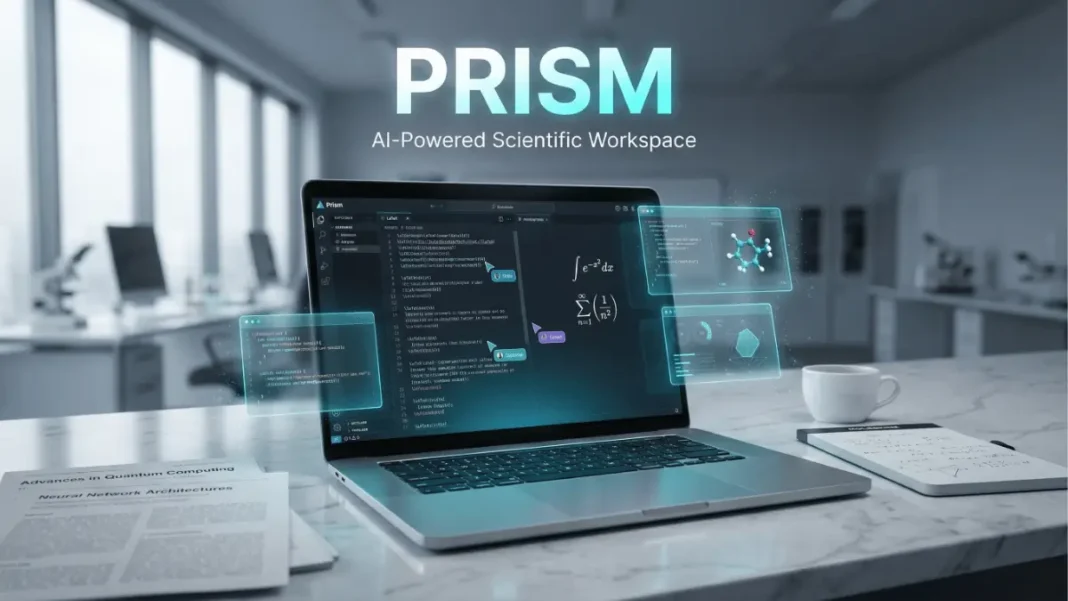
OpenAI launched Prism on January 27, 2026, a free AI-native workspace designed to consolidate scientific writing, collaboration, and publication preparation into a single cloud-based environment. Built on the acquired Crixet LaTeX platform and powered by GPT-5.2, Prism eliminates seat limits and offers unlimited projects to anyone with a ChatGPT personal account.
The Crixet Acquisition & Platform Architecture
OpenAI acquired Crixet, a cloud-based LaTeX editing platform, to establish the technical foundation for Prism. The acquisition provided a mature collaboration environment that OpenAI integrated with GPT-5.2, creating what the company describes as a productivity layer for scientific workflows.
LaTeX, a typesetting system used extensively in academia for formatting scientific documents, traditionally requires manual compilation, version control, and separate tools for citations, equations, and diagrams. Prism consolidates these functions into a single workspace where GPT-5.2 operates with full document context accessing paper structure, equations, references, and surrounding text simultaneously.
The platform supports unlimited collaborators with real-time editing, comment tracking, and automatic version synchronization. Cloud-based architecture removes barriers related to local LaTeX setup, enabling teams across institutions and geographies to collaborate without manual file merging or environment conflicts.
GPT-5.2 Integration: Capabilities & Scientific Reasoning
GPT-5.2 Thinking, OpenAI’s most advanced model for mathematical and scientific reasoning, operates directly within Prism’s workflow. The model demonstrates improved chain-of-thought consistency, lower hallucination rates, and stronger precision in mathematical problems compared to previous iterations.
Prism users can deploy GPT-5.2 for multiple research functions:
- Contextual drafting and revision: AI accesses surrounding text, citations, equations, and figures to generate or refine content
- Literature integration: Automated arXiv searches identify relevant research and generate bibliographies in manuscript context
- Equation manipulation: Convert whiteboard diagrams to LaTeX, refactor equations, and reason across mathematical elements
- Hypothesis testing: Explore ideas and test claims using the model’s extended reasoning capabilities
- Voice-based editing: Execute document changes through voice commands without interrupting workflow
According to Kevin Weil, OpenAI’s Vice President for Science, the company anticipates 2026 will mark a comparable shift for AI in research as 2025 did for software engineering, where AI coding assistants became standard infrastructure.
AdwaitX Analysis: Competitive Positioning & Market Disruption
Prism enters a market dominated by Overleaf (acquired by Digital Science in 2017) and traditional LaTeX distributions, but differentiates through zero-cost access and native AI integration. By eliminating subscription tiers and seat limits, OpenAI undercuts freemium models while positioning Prism as infrastructure rather than a premium product.
The platform directly competes with AI coding environments like Cursor and Windsurf, extending their workflow-integrated AI model to academic research. OpenAI’s 8.4 million weekly ChatGPT messages on hard science topics signal existing demand, though the company acknowledges uncertainty about what percentage originates from professional researchers versus students or enthusiasts.
The strategy mirrors GitHub Copilot’s disruption of software development: provide free baseline access to capture market share, then monetize advanced features through paid tiers. OpenAI confirmed more powerful AI capabilities will migrate to paid ChatGPT Business, Team, Enterprise, and Education plans over time.
Critical infrastructure advantages include:
- No installation friction: Cloud-based deployment removes LaTeX setup barriers that historically limited adoption among early-career researchers
- Collaboration at scale: Unlimited co-authors address multi-institutional research teams without licensing constraints
- Workflow consolidation: Eliminates context-switching between separate editors, PDFs, reference managers, and chat interfaces
Technical Specifications & Feature Comparison
| Feature | Prism (OpenAI) | Traditional LaTeX Workflow |
|---|---|---|
| AI Integration | GPT-5.2 Thinking with full document context | Separate ChatGPT/Claude sessions |
| Collaboration | Unlimited real-time co-authors | Manual version control via Git or email |
| Literature Search | Automated arXiv integration | Manual database searches + citation management |
| Pricing | Free (personal), paid tiers coming | Overleaf: $15-39/month for premium |
| LaTeX Environment | Cloud-based, zero setup | Local installation + package management |
| Diagram Tools | Whiteboard-to-LaTeX conversion | Manual TikZ coding |
| Access Model | Web-based, ChatGPT account required | Desktop apps or web editors |
Deployment Timeline & Enterprise Rollout
Prism became available January 27, 2026, to all ChatGPT personal account holders at prism.openai.com. Enterprise deployment for ChatGPT Business, Team, Enterprise, and Education plans will follow, though OpenAI has not specified exact timelines.
The company positions the launch as an “early step” in AI-accelerated science, following GPT-5’s demonstrated impact in mathematics frontiers, human immune-cell experiment analysis, and molecular biology experimental iteration. Advanced reasoning systems have already begun influencing specific research domains, but OpenAI emphasizes Prism addresses fragmentation in everyday research workflows rather than autonomous discovery.
OpenAI clarified Prism requires human guidance and is not designed to conduct independent research. The tool functions as a productivity multiplier for existing scientists rather than a replacement, similar to how AI coding assistants augment rather than eliminate software developers.
Regulatory & Academic Acceptance Challenges
Academic institutions maintain strict policies on AI-assisted research authorship, citation integrity, and plagiarism detection. Prism’s integration of AI-generated content into scientific manuscripts will face scrutiny from journal publishers requiring disclosure of AI usage in methodology sections.
Key adoption barriers include:
- Reproducibility standards: Scientific journals require transparent methodology; AI-assisted hypothesis generation or literature review may demand new disclosure frameworks
- Citation integrity: Automated bibliography generation must maintain accuracy to avoid retractions or corrections
- Institutional policies: Universities with restrictive AI policies may block adoption despite free access
- Data sovereignty: Research involving sensitive data (medical trials, defense applications) may require on-premise deployment unavailable in cloud-only models
OpenAI’s decision to build on an acquisition rather than develop LaTeX infrastructure internally accelerates time-to-market but inherits technical debt from Crixet’s codebase. User feedback on Reddit’s r/LaTeX community shows mixed reception, with concerns about AI quality in LaTeX generation and preference for established tools like Overleaf.
Frequently Asked Questions (FAQs)
What is OpenAI Prism?
Prism is a free, cloud-based workspace for scientific writing powered by GPT-5.2, offering unlimited projects, collaborators, and integrated LaTeX editing for ChatGPT users.
Does Prism cost money?
Prism is free for ChatGPT personal account holders; advanced AI features will be added to paid Business, Team, Enterprise, and Education plans later.
What is GPT-5.2 Thinking?
GPT-5.2 Thinking is OpenAI’s most advanced model for scientific and mathematical reasoning, with improved accuracy, lower hallucination rates, and stronger multi-step logic capabilities.
How does Prism differ from Overleaf?
Prism integrates GPT-5.2 directly into workflows with unlimited collaborators at zero cost, while Overleaf charges $15-39/month and requires separate AI tools.
Can Prism conduct research independently?
No. Prism requires human guidance and is designed to accelerate scientist workflows, not replace researchers or autonomously generate discoveries.

