

Essential Points
- GPT-5.2 Pro first conjectured the gluon amplitude formula; an internal OpenAI model then spent roughly 12 hours producing a formal proof
- Both the gluon (February 12, 2026) and graviton (March 4, 2026) results are published as arXiv preprints submitted for peer review
- Single-minus graviton amplitudes are nonzero only in the “half-collinear” regime, where particle momenta obey a precise alignment condition
- “Both GPT-5.2 Pro and a new OpenAI internal model played a significant role at all stages” of the graviton project, per the preprint
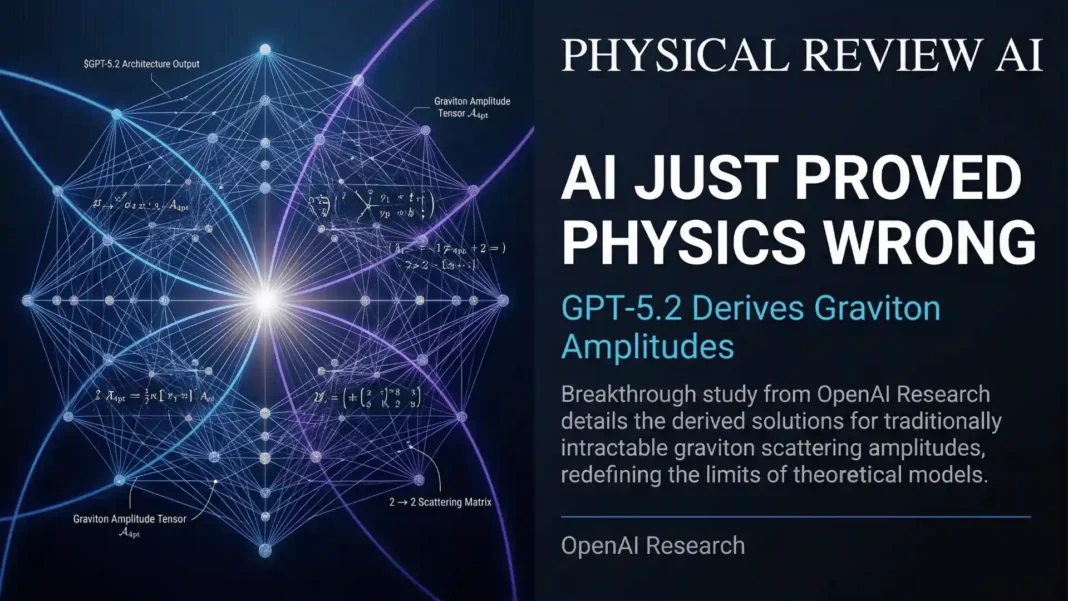
Physicists had treated an entire class of graviton interactions as zero for decades. Two preprints published in early 2026 show that conclusion was too strong. The work, produced with significant involvement from OpenAI’s GPT-5.2, extends a newly discovered gluon result directly to gravitons and opens a series of questions at the boundary of quantum gravity.
The Assumption That Collapsed
In quantum field theory, scattering amplitudes are the core quantities physicists use to calculate the probability that particles interact in a specific way. For a massless particle like a gluon or a graviton, helicity describes one of two possible spin orientations. A “single-minus” amplitude involves one particle with negative helicity and all remaining particles with positive helicity.
Standard textbook arguments hold that tree-level single-minus amplitudes must equal zero. “Tree level” means the calculation uses only the simplest Feynman diagrams, with no quantum loops included. This configuration has therefore been largely set aside in the literature for decades. The 2026 results show the argument holds only under generic kinematic conditions and breaks down in a specific, well-defined region of momentum space.
What the Half-Collinear Regime Actually Is
The key is a region called the half-collinear regime. Here, particle momenta obey a special alignment condition: all angle brackets between momenta satisfy the condition that they equal zero, which is compatible with nonzero square brackets in Klein space or for complexified momenta. Under generic kinematics, the standard power-counting argument for vanishing amplitudes applies. In the half-collinear regime, the choice of reference spinor that argument relies on becomes obstructed, opening a precise mathematical loophole.
Think of it as a wall that holds everywhere except one exactly defined corridor. The amplitude that was presumed absent becomes a calculable, well-structured expression inside that corridor.
How GPT-5.2 Contributed Step by Step
For the gluon result, the human co-authors computed amplitudes by hand for integer values of n up to n=6, producing what the OpenAI blog describes as “very complicated expressions” growing in complexity superexponentially with n. GPT-5.2 Pro significantly reduced those expressions to much simpler forms, then spotted a pattern and conjectured a formula valid for all n.
An internal scaffolded version of GPT-5.2 then spent roughly 12 hours reasoning through the same problem, arrived at the same formula, and produced a formal proof. The equation was subsequently verified analytically against the Berends-Giele recursion relation, a standard method for building multi-particle amplitudes from smaller components, and also checked against the soft theorem.
For the graviton paper, the preprint states directly: “Both GPT-5.2 Pro and a new OpenAI internal model played a significant role at all stages of this project.” The graviton work followed less than three weeks after the gluon preprint.
The Graviton Extension: What Was Derived
The graviton preprint derives a Berends-Giele recursion relation for single-minus graviton amplitudes and solves it as a sum over trees. In a restricted kinematic region called the decay region, this solution simplifies significantly to an (n-2)-fold product of soft factors expressed in Equation (1) of the preprint.
The paper further shows that, combined with suitable analyticity assumptions, a recursive Lw1+∞ Ward identity generates the full n-graviton amplitude from just the three-graviton amplitude as a seed. The preprint notes this “beautifully mirrors the Penrose construction of the self-dual solutions,” connecting the result to classical structures in twistor theory established by Roger Penrose a half-century ago.
The graviton result also addresses a long-standing conundrum in self-dual gravity: if tree amplitudes were trivially zero beyond three gravitons, how could the richness of Penrose’s nonlinear solutions possibly be encoded in them? The 2026 work resolves this by showing the amplitudes are in fact nonzero, supported on the single-minus half-collinear configurations.
The Research Team
Both the gluon and graviton preprints share the same five authors:
- Alfredo Guevara, Institute for Advanced Study
- Alexandru Lupsasca, Vanderbilt University and OpenAI
- David Skinner, University of Cambridge
- Andrew Strominger, Harvard University
- Kevin Weil, OpenAI (listed “on behalf of OpenAI”)
Strominger is known for foundational work on soft theorems in gravity and black hole entropy. The acknowledgments in the graviton preprint note useful discussions with Nima Arkani-Hamed, Juan Maldacena, Freddy Cachazo, and Mark Spradlin, among others.
Expert Perspectives
Nima Arkani-Hamed, Professor of Physics at the Institute for Advanced Study, commented on the gluon result that “finding a simple formula has always been fiddly, and also something I have long felt might be automatable by computers,” and that the example “seems especially well-suited to exploit the power of modern AI tools.”
Nathaniel Craig, Professor of Physics at UC Santa Barbara, called it “clearly journal-level research advancing the frontiers of theoretical physics,” and described the methodology as “a template for validating LLM-driven insights.”
What Comes Next
The gluon blog post states that “other generalizations are also on their way.” The graviton preprint specifically identifies open questions, including whether the Lw1+∞ approach can fix amplitudes outside the decay region, and whether general-region simplification of the full Berends-Giele solution is possible.
The Einstein gravity connection is also noted. In Einstein gravity, Lw1+∞ was recently shown to recursively generate all double-minus amplitudes. The 2026 work extends this to single-minus amplitudes and “sheds further light on the incompletely understood role of Lw1+∞ in Einstein gravity.”
Limitations and Open Questions
Both preprints are tree-level calculations. Loop corrections, which introduce quantum effects and far greater complexity, are not addressed. The preprints have been submitted for publication but formal peer review has not concluded, and independent replication by external groups has not yet been published. The preprint itself notes uncertainty about whether the Lw1+∞ construction can be extended outside the decay region. The physical significance of these amplitudes within the broader program of quantizing Einstein gravity also remains an open research question.
 Grok 4.20 Beta 2 Prompt Engineering: The Instruction-Following Masterclass That Changes Everything
Frequently Asked Questions (FAQs)
What are single-minus amplitudes?
Single-minus amplitudes describe particle interactions where one particle carries negative helicity and all others carry positive helicity. Standard textbook arguments predict these amplitudes vanish at tree level under generic kinematic conditions. The 2026 preprints show they are nonzero in the precisely defined half-collinear regime.
What is the half-collinear regime?
The half-collinear regime is a specific kinematic configuration where all angle brackets between particle momenta equal zero, while square brackets remain nonzero. In Klein space or for complexified momenta, this condition is internally consistent. It is the only kinematic region where single-minus tree amplitudes have nonzero support.
What exactly did GPT-5.2 do in this research?
For the gluon result, GPT-5.2 Pro simplified complex hand-computed expressions and conjectured a closed-form formula valid for all n. An internal OpenAI model then spent roughly 12 hours producing a formal proof. For the graviton work, both GPT-5.2 Pro and a new OpenAI internal model played a role at all stages of the project.
What is a graviton?
A graviton is the theoretical quantum particle that mediates the gravitational force, analogous to the photon for electromagnetism. Because no complete quantum theory of gravity exists, computing graviton scattering amplitudes is directly relevant to reconciling quantum mechanics with Einstein’s general relativity.
What is a Lw1+∞ Ward identity?
Lw1+∞ is an infinite-dimensional symmetry group that appears in both self-dual gravity and Einstein gravity. Its Ward identities impose constraints on gravitational scattering amplitudes, and in the 2026 work they are shown to recursively generate the full n-graviton amplitude from a three-graviton seed within the decay region.
Who are the authors of these preprints?
Both papers share five co-authors: Alfredo Guevara (IAS), Alexandru Lupsasca (Vanderbilt and OpenAI), David Skinner (Cambridge), Andrew Strominger (Harvard), and Kevin Weil (OpenAI, on behalf of OpenAI). The acknowledgments include Nima Arkani-Hamed, Juan Maldacena, and Freddy Cachazo among those thanked for useful discussions.
Has this been peer-reviewed?
Both preprints have been submitted for publication. The gluon preprint appeared on arXiv on February 12, 2026 (arXiv:2602.12176), and the graviton preprint was submitted March 4, 2026. Formal peer review is ongoing and independent external replication has not yet been published.
What are the current limits of this result?
These are tree-level calculations only. Loop corrections are not addressed. The decay-region formula uses analyticity assumptions whose validity outside that region is explicitly flagged as an open question in the graviton preprint. Formal peer review and independent replication remain outstanding steps.

