

Quick Brief
- The Launch: OpenAI announced Education for Countries on January 21, 2026, with 8 partners in the first cohort including Estonia, Greece, UAE, Jordan, Kazakhstan, Slovakia, Trinidad & Tobago, and Italy’s university consortium
- The Impact: Governments gain access to ChatGPT Edu for national education systems, research partnerships, and AI certification programs
- The Context: Initiative builds on Estonia’s successful nationwide deployment, which reached 30,000+ students and educators in its first year
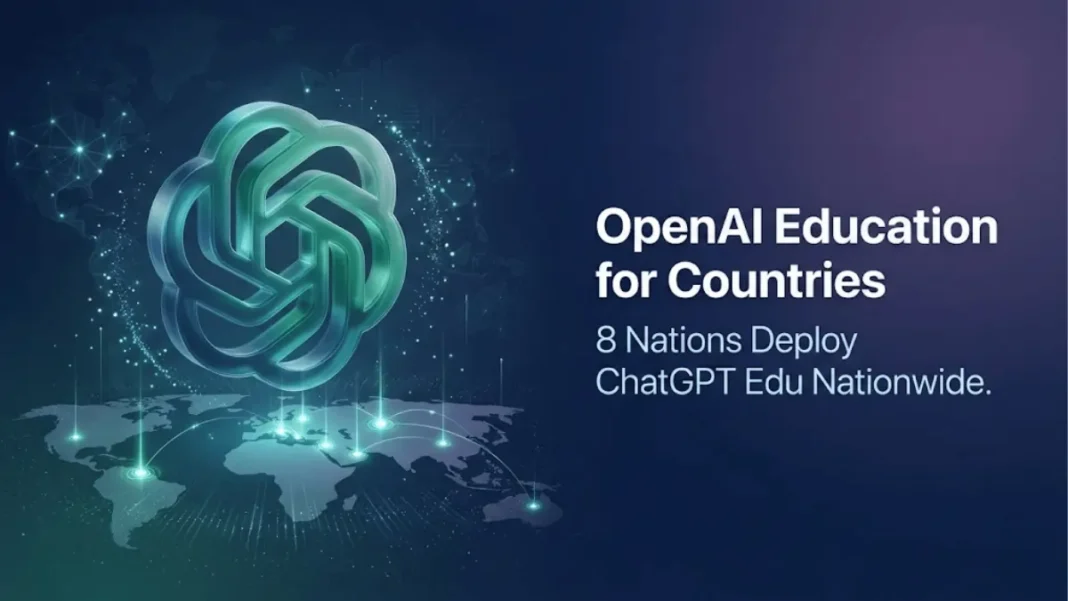
OpenAI announced Education for Countries on January 21, 2026, a global initiative designed to integrate artificial intelligence into national education systems through government partnerships and university consortia. The program includes eight partners in its first cohort: Estonia, Greece, United Arab Emirates, Jordan, Kazakhstan, Slovakia, Trinidad & Tobago, and Italy’s Conference of University Rectors (CRUI). Each partnership provides ChatGPT Edu access, learning outcomes, research collaborations, OpenAI Certifications, and connections to a global network of education leaders.
Deployment Framework and Government Partnerships
Education for Countries delivers ChatGPT Edu OpenAI’s enterprise-grade educational platform through tailored national agreements that prioritize personalized learning and administrative efficiency. Estonia became the first country to integrate ChatGPT Edu nationwide, providing access to all secondary students starting with 10th and 11th graders by September 2025. The deployment reached more than 30,000 students, educators, and researchers in its first year, establishing a model for other nations.
Greece launched a pilot program in upper-secondary schools with regional and socio-economic diversity, backed by the Onassis Foundation and coordinated through a joint task force including the Prime Minister’s Office. The initiative focuses on equipping students with AI literacy while maintaining rigorous academic standards. Italy’s Conference of University Rectors (CRUI) represents over 90 universities in the partnership, enabling higher education institutions across the country to access ChatGPT Edu.
| Partner | Type | Focus Area | Status |
|---|---|---|---|
| Estonia | Nationwide | Secondary schools | 30,000+ users |
| Greece | Pilot program | Upper-secondary schools | Active |
| Italy (CRUI) | University consortium | Higher education | First cohort |
| UAE | Government partnership | Education system | First cohort |
| Jordan | Government partnership | Education system | First cohort |
| Kazakhstan | Government partnership | Education system | First cohort |
| Slovakia | Government partnership | Education system | First cohort |
| Trinidad & Tobago | Government partnership | Education system | First cohort |
Research Partnerships and Learning Outcomes
OpenAI established a research collaboration between the University of Tartu in Estonia and Stanford University to conduct a longitudinal study of 20,000 students examining AI’s impact on learning outcomes. The research aims to measure how ChatGPT Edu affects student achievement, engagement, and skill development across diverse educational contexts. Partner countries commit to sharing implementation data and best practices through a global network of education leaders.
The program addresses what OpenAI describes as the “capability overhang” the gap between AI technological advancement and practical deployment in education systems. Estonia’s first-year results demonstrate ChatGPT Edu’s scalability across secondary education, with students using the platform for personalized tutoring, research assistance, and curriculum-aligned study support. The Estonian Ministry of Education and Research coordinates teacher training and curriculum integration to maximize educational impact.
ChatGPT Edu Technical Specifications
ChatGPT Edu provides access to OpenAI’s latest models including GPT-5.2, with features tailored for educational institutions such as Study Mode, Canvas for collaborative work, and administrative controls for large-scale deployments. The platform supports GDPR compliance, enterprise-grade security, and data residency requirements in multiple countries for Enterprise and Edu tiers. Educational institutions can access data residency options in Japan, India, Singapore, and South Korea to meet local regulatory requirements.
Key features include personalized learning pathways that adapt to individual student needs, tools for educators to create custom GPTs for lesson planning, and API services for institutional integrations. The platform supports over 50 languages with localization capabilities, enabling governments to maintain data sovereignty while customizing AI outputs for national curricula and cultural contexts. Estonian schools reported using ChatGPT Edu for mathematics tutoring, language learning, and science research projects.
Certification Programs and Capacity Building
OpenAI expanded its certification offerings as part of Education for Countries, providing structured training programs for educators and students. The certifications cover AI literacy fundamentals, responsible AI use in educational settings, and advanced applications for curriculum integration. Partner countries receive priority access to OpenAI’s training materials and certification programs as part of their agreements.
Greece’s implementation includes comprehensive teacher professional development coordinated by the Onassis Foundation, ensuring educators understand both the technical capabilities and pedagogical applications of ChatGPT Edu. The Greek program emphasizes critical thinking and AI ethics alongside technical skills, preparing students to use AI tools responsibly in academic and professional contexts. OpenAI works with each partner to customize certification pathways based on national education standards and workforce development priorities.
Expansion Strategy and Global Network
OpenAI established Education for Countries to create a collaborative ecosystem where partner nations share implementation strategies, research findings, and policy frameworks. The global network enables education leaders to exchange best practices for AI integration, teacher training methodologies, and student assessment approaches. Future cohorts will expand the program to additional countries seeking to modernize education systems through AI deployment.
The initiative builds on OpenAI’s broader OpenAI for Countries framework, which partners with governments on infrastructure, public services, and economic development applications beyond education. Estonia’s success demonstrates the viability of nationwide ChatGPT Edu deployment, providing a blueprint for the seven new partners in the first cohort. OpenAI continues to refine the program based on feedback from participating countries and ongoing research into AI’s educational impact.

Frequently Asked Questions (FAQs)
What is OpenAI’s Education for Countries program?
Education for Countries is OpenAI’s initiative to deploy ChatGPT Edu in national education systems through government partnerships, providing AI tools, research collaborations, and certification programs.
Which countries joined Education for Countries first cohort?
Eight partners joined: Estonia, Greece, UAE, Jordan, Kazakhstan, Slovakia, Trinidad & Tobago, and Italy’s Conference of University Rectors representing over 90 universities.
How many students use ChatGPT Edu in Estonia?
Estonia’s nationwide deployment reached more than 30,000 students, educators, and researchers in its first year, starting with 10th and 11th grade students in September 2025.
Does ChatGPT Edu comply with student data privacy laws?
ChatGPT Edu includes GDPR compliance, data residency options in multiple countries, and enterprise-grade security controls designed for educational institutions.

