

Summary: OpenAI announced free certificate courses launching in late 2025/early 2026 through OpenAI Academy, offering three certification levels from basic AI fluency to advanced prompt engineering. The program requires 15-20 hours over 4-6 weeks, uses hands-on projects instead of multiple-choice tests, and aims to certify 10 million Americans by 2030. Major employers like Walmart are already partnering to train their workforce, and OpenAI will launch a dedicated jobs platform in 2026 to connect certified professionals with opportunities.
OpenAI is launching free certificate courses through OpenAI Academy in late 2025 and early 2026, offering three certification levels designed to validate AI skills for the modern workforce. The program targets 10 million certified Americans by 2030 and already has major enterprise partnerships, including Walmart’s 2 million+ employees.
What Are OpenAI Certificate Courses?
OpenAI certificate courses represent the evolution of OpenAI Academy, the free educational platform launched in March 2025. While the Academy provides open access to AI learning resources, the certification program adds formal validation through hands-on assessments and industry-recognized credentials.
OpenAI Academy vs OpenAI Certifications
OpenAI Academy serves as the learning hub with free enrollment for everyone, offering courses, community groups, and educational content without formal certification. The certification program builds on this foundation by adding structured assessment pathways, practical project evaluations, and official credentials that employers can verify.
Official Launch Timeline
The pilot phase begins between late 2025 and early 2026, with gradual expansion throughout 2026. OpenAI’s Jobs Platform, which will connect certified professionals with employers seeking AI-skilled workers, launches in the second half of 2026.
The Three Certification Levels Explained
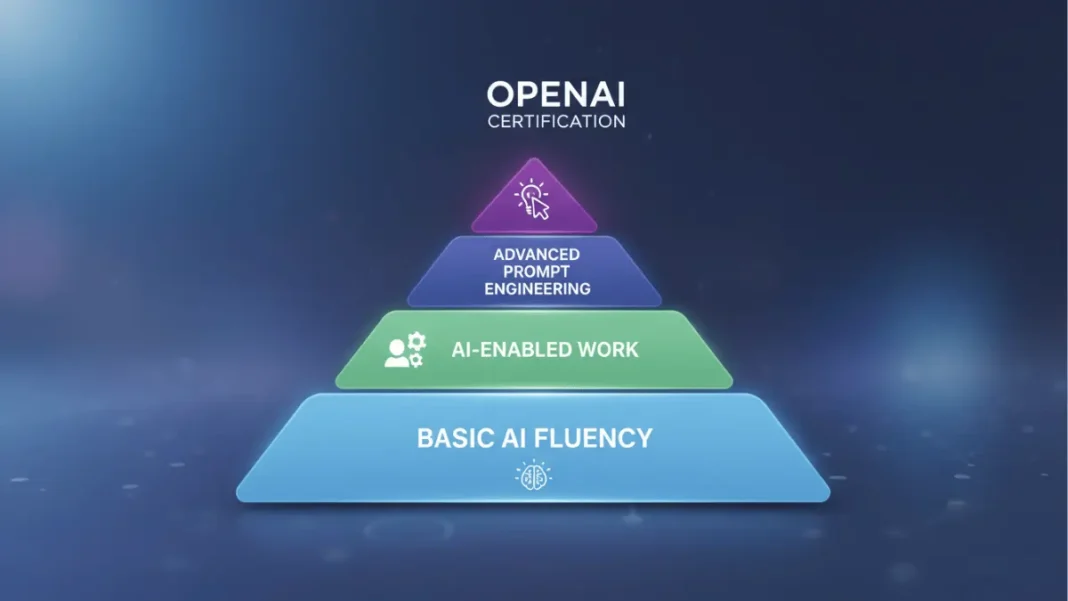
OpenAI structures certifications across three proficiency tiers to accommodate learners from complete beginners to advanced AI practitioners.
Level 1: Basic AI Fluency
This entry-level certification covers fundamental AI concepts, basic ChatGPT usage, and understanding how AI tools fit into everyday workflows. Ideal for professionals who want to understand AI’s capabilities without deep technical implementation, this level requires no prior programming experience.
Level 2: AI-Enabled Work
The intermediate certification focuses on applying AI tools to solve real business problems, optimize workflows, and integrate AI into professional contexts. Participants learn prompt engineering fundamentals, ChatGPT’s advanced features, and practical automation techniques.
Level 3: Advanced Prompt Engineering
The advanced tier targets developers, AI specialists, and technical professionals who want to master prompt engineering, API integration, and custom AI solution development. This level includes hands-on work with OpenAI’s Assistant APIs and building conversational agents.
How to Enroll in OpenAI Certificate Courses
Prerequisites and Requirements
OpenAI Academy requires no prerequisites for basic enrollment. Advanced certification levels may require completion of foundational courses or demonstrated technical proficiency. Some specialized community groups require invitations or referrals, particularly for enterprise partnerships.
Step-by-Step Enrollment Process
Visit academy.openai.com and create a free account. Complete the skills assessment to identify your starting level. Join relevant community groups based on your industry. Begin with Academy courses before certifications launch in late 2025. Enroll in certification tracks when they become available.
First, navigate to academy.openai.com and register with your email address. The platform guides you through a skills assessment that recommends appropriate certification levels based on your current knowledge. Early participants gain access to pre-certification resources and community features that provide immediate value while waiting for formal certification launch.
Special Access for Enterprise Users
Organizations can integrate OpenAI certifications into internal training programs through partnership agreements. Walmart employees, for example, access specialized enrollment paths as part of the company’s workforce development initiative.
Cost Breakdown: Is It Really Free?
What’s Included at No Cost
OpenAI Academy enrollment remains completely free, including access to learning resources, community features, and educational content. The certification assessments themselves carry no enrollment fees, marking a significant departure from traditional paid certification programs.
Potential Additional Expenses
While core certification is free, advanced technical courses may require cloud computing resources. For comparison, Carnegie Mellon’s similar LLM certification costs approximately $300 per course for AWS and OpenAI API usage. OpenAI’s program likely involves minimal API costs for hands-on projects, though official pricing hasn’t been disclosed.
OpenAI Certification vs Other AI Certifications
| Feature | OpenAI Certification | Coursera AI Courses | CMU LLM Certificate |
|---|---|---|---|
| Cost | Free | $39–$79/month | $8,484 per course |
| Duration | 4–6 weeks | Varies | 3 semesters |
| Format | Hands-on projects | Video + quizzes | Graduate-level |
| Industry backing | Walmart, major employers | University partners | Carnegie Mellon |
| Job platform | Integrated (2026) | No | No |
How It Compares to Coursera and CMU Programs
OpenAI’s free model contrasts sharply with paid alternatives like Coursera’s subscription-based AI courses ($39–$79 monthly) and Carnegie Mellon’s graduate certificate ($25,452 total). The hands-on project format differs from traditional video-lecture approaches, focusing on demonstrable competency rather than knowledge retention.
Industry Recognition and Value
Major employers including Walmart have committed to recognizing OpenAI certifications for hiring and promotion decisions. The upcoming Jobs Platform will connect certified professionals directly with opportunities, suggesting strong industry validation.
Course Structure and Time Commitment
Curriculum Overview
Courses cover natural language processing fundamentals, ChatGPT interaction techniques, prompt engineering strategies, AI ethics, and real-world application development. The curriculum emphasizes practical scenarios over theoretical concepts, with each module tied to workplace applications.
Assessment Format
OpenAI certifications use hands-on project assessments instead of multiple-choice exams. You complete practical assignments mirroring real workplace challenges. Projects demonstrate competency in actual scenarios relevant to your certification level. No traditional testing required.
Instead of standardized tests, participants complete practical assignments that mirror actual workplace challenges. This project-based approach validates your ability to apply AI tools effectively rather than memorize facts.
Completion Requirements
Expect 15-20 hours of training spread over 4-6 weeks, making it manageable alongside full-time employment. The self-paced structure allows acceleration or extended timelines based on individual schedules.
Career Benefits and Job Market Impact
The Walmart Partnership and Enterprise Adoption
Walmart’s commitment to train its 2 million+ employees through OpenAI certifications signals massive enterprise adoption. This partnership validates the program’s workplace relevance and creates immediate employment opportunities for certified individuals.
OpenAI Jobs Platform Integration
The Jobs Platform launching in mid-2026 will match certified professionals with employers seeking verified AI skills. This direct pipeline from certification to employment represents a unique advantage over traditional educational programs.
Expected Salary Impact
Research cited by OpenAI suggests AI skills can boost salaries by up to 28% across all industries. Early certification adoption may provide competitive advantages as the market saturates with candidates in subsequent years.
Real-World Applications and Skills You’ll Learn
Practical AI Tools and Techniques
Certification courses teach sentiment analysis, intent recognition, text generation, chatbot development, and AI-powered automation. You’ll learn to optimize AI outputs, evaluate performance, and apply ethical AI principles.
ChatGPT Mastery and API Integration
Advanced levels include working with OpenAI’s Assistant APIs, building conversational agents, and integrating AI capabilities into existing software systems. Participants gain experience with prompt engineering techniques that improve AI response quality and relevance.
OpenAI Certificate Program Technical Specifications
Program Name: OpenAI Academy Certification Program
Launch Date: Late 2025 / Early 2026 (Pilot Phase)
Platform: academy.openai.com
Cost: Free enrollment and certification
Duration: 15-20 hours over 4-6 weeks
Format: Self-paced online with hands-on projects
Assessment Type: Practical assignments (no multiple-choice tests)
Certification Levels: 3 tiers (Basic AI Fluency, AI-Enabled Work, Advanced Prompt Engineering)
Prerequisites: None for basic level; varies by tier
Enrollment Scale: Target 10 million certified by 2030
Enterprise Partnerships: Walmart (2M+ employees), expanding
Jobs Platform: Integrated employment matching launching 2026 H2
Community Features: Industry-specific groups, referral access for specialized cohorts
Study Mode Integration: ChatGPT’s educational features included
Technical Requirements: Internet access, potential cloud computing for advanced levels
Language Support: Initially English (expansion details pending)
Certification Validity: Lifetime (no disclosed expiration)
Mobile Accessibility: Optimized for mobile learning
Limitations and Considerations
Who Should Wait
If you need recognized credentials immediately for job applications, paid certifications from established institutions may provide faster validation. The pilot phase may have limited capacity or regional restrictions not yet announced.
Alternative Certification Paths
Third-party programs from platforms like MentorCruise, Croma Campus, and university partnerships offer immediate enrollment with structured curricula. These alternatives cost between $500-$8,000 but provide immediate certification without waiting for OpenAI’s pilot launch.

Featured Snippet Boxes
What is the Brother DCP-L3551CDW?
An A4 color LED all-in-one that prints 18 ppm, adds duplex printing, a 50-sheet ADF, and Wi-Fi with AirPrint and Mopria. It’s marked discontinued on Brother India, but toners and drum units are readily available.
Enrollment Process
Visit academy.openai.com and create a free account. Complete the skills assessment to identify your starting level. Join relevant community groups based on your industry. Begin with Academy courses before certifications launch in late 2025. Enroll in certification tracks when they become available.
Assessment Format
OpenAI certifications use hands-on project assessments instead of multiple-choice exams. You complete practical assignments mirroring real workplace challenges. Projects demonstrate competency in actual scenarios relevant to your certification level. No traditional testing required.
Cost
OpenAI Academy and certification enrollment is completely free. No tuition, no enrollment fees, no subscription costs. Advanced courses may require minimal cloud computing expenses for API usage, estimated under $300 based on similar programs.
Time Commitment
Expect 15-20 hours of training over 4-6 weeks for certification completion. Self-paced format allows flexible scheduling around full-time work. Early Academy access provides resources before official certification launch in late 2025.
Three Certification Levels
Level 1 covers basic AI fluency and ChatGPT fundamentals. Level 2 focuses on AI-enabled work and practical applications. Level 3 teaches advanced prompt engineering and API integration. Choose based on your technical background and career goals.
Career Impact
AI skills can increase salaries by up to 28% across industries. OpenAI Jobs Platform launching 2026 connects certified professionals with employers. Walmart and major companies are already committed to recognizing credentials for hiring decisions.

