

Quick Brief
- The Launch: Notion 3.2 integrates GPT-5.2, Claude Opus 4.5, and Gemini 3 with Auto-select routing, mobile AI agent capabilities, and enterprise analytics
- The Performance: Desktop loads accelerate 27% on Windows, 11% on Mac; AI transcription now operates offline on mobile devices
- The Impact: Organizations gain access to three competing frontier models under unified context memory, reshaping workplace AI deployment strategies
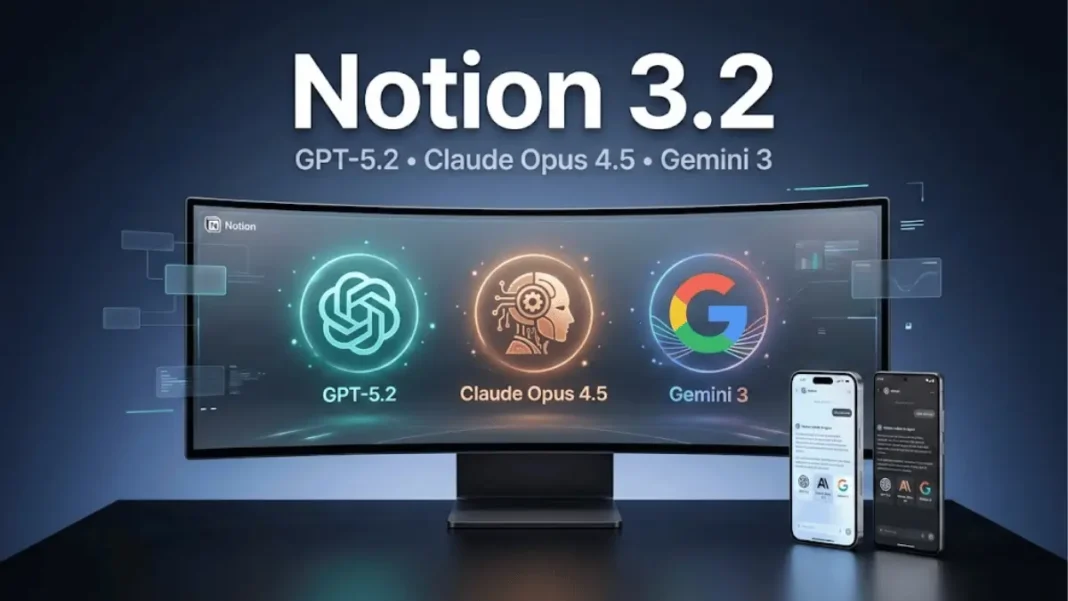
Notion released version 3.2 on January 20, 2026, deploying a tri-model AI infrastructure that combines OpenAI’s GPT-5.2, Anthropic’s Claude Opus 4.5, and Google’s Gemini 3 within a single platform. The update introduces mobile AI agent functionality, enterprise usage analytics, and performance optimizations that reduce page load times by up to 27% on Windows systems. The release positions Notion as the first major productivity platform to offer users direct model selection across all three leading AI providers.
Tri-Model AI Architecture: Technical Implementation
Notion 3.2’s core infrastructure change centers on simultaneous access to GPT-5.2, Claude Opus 4.5, and Gemini 3. Users can manually select models or enable Auto-select routing, which algorithmically assigns tasks to optimal models based on request type.
The integration maintains unified context memory across model switches, allowing users to change AI providers mid-conversation without context loss. GPT-5.2, released in December 2025, brings enhanced coding capabilities. Claude Opus 4.5 delivers extended context windows with advanced reasoning modes. Gemini 3, launched in November 2025, contributes multimodal processing capabilities.
Mobile deployment extends full AI agent capabilities to iOS and Android, enabling database creation, form building, and workspace search from smartphones. AI Notes transcription operates continuously even when apps switch or screens lock, processing audio into summaries, action items, and shareable documents.
AdwaitX Analysis: Strategic Enterprise AI Consolidation
This release signals a fundamental shift in enterprise AI procurement strategy. By consolidating three competing models under one subscription, Notion eliminates the typical enterprise decision of choosing between OpenAI, Anthropic, or Google AI platforms.
Enterprise administrators gain new analytics dashboards tracking AI usage patterns, feature engagement metrics, and value delivery across teams. The analytics interface (Settings → Analytics → AI) provides visibility into which employees utilize AI most frequently and which features drive adoption.
The competitive pressure driving this integration stems from Google’s November 2025 Gemini 3 launch and OpenAI’s December 2025 GPT-5.2 release. Anthropic’s Claude Opus 4.5 introduced advanced tool search and extended reasoning capabilities. Notion’s strategy exploits this AI model race by offering all three simultaneously rather than committing to a single vendor.
The financial implication: organizations no longer need separate ChatGPT Enterprise, Claude Enterprise, or Google Workspace AI subscriptions for different use cases. AdwaitX estimates this could reduce AI tooling costs by 40-60% for mid-market teams currently maintaining multiple AI platform subscriptions.
Infrastructure Performance & Integration Specifications
| Component | Specification | Impact |
|---|---|---|
| Windows load time | 27% faster | Accelerated page rendering |
| Mac load time | 11% faster | Pages load in ⅓ less time vs. early 2025 |
| Mobile AI agent | Full desktop parity | Database creation, forms, search on iOS/Android |
| AI models | GPT-5.2, Claude Opus 4.5, Gemini 3 | Auto-routing or manual selection |
| Jira sync | Bidirectional (Enterprise) | Edit Jira fields from Notion, sync back automatically |
| People Directory | Pre-built HR database | Customizable, HR system import support |
| Mail multi-account | Unlimited accounts | Single interface for personal/work inboxes |
The Jira integration targets engineering-heavy organizations where developers operate in Atlassian tools while product teams coordinate in Notion. Enterprise customers can now edit critical Jira fields directly from Notion dashboards and sync changes bidirectionally, eliminating context-switching overhead.
People Directory introduces a pre-built employee database with HR system import capabilities, addressing a frequent enterprise setup request. The feature appears under Settings → Members → View People Directory or via search for “People”.
Governance Controls & Infrastructure Roadmap
Notion announced upcoming Model Context Protocol (MCP) governance controls for Enterprise customers, enabling admins to whitelist which external AI tools can access workspace data. MCP activity now appears in audit logs, addressing compliance requirements for financial services and healthcare sectors.
The performance improvements stem from Notion’s 2025 infrastructure overhaul, which reduced average page load times by one-third throughout the year. CEO Ivan Zhao documented these performance gains publicly, with continued optimization planned.
Additional interface refinements include confetti automation effects for completed tasks and calendar panel hiding options, representing UX polish alongside the major technical expansion.

Frequently Asked Questions (FAQs)
What AI models does Notion 3.2 support?
Notion 3.2 supports GPT-5.2, Claude Opus 4.5, and Gemini 3, with an Auto-select option that routes tasks to the optimal model automatically.
Can Notion Agent work on mobile devices?
Yes. Notion Agent on mobile matches full desktop functionality, including database creation, form building, and workspace search on iOS and Android.
How much faster is Notion 3.2 on Windows?
Notion 3.2 opens pages 27% faster on Windows and 11% faster on Mac, continuing 2025’s performance improvements that reduced load times by one-third.
What is Notion People Directory?
People Directory is a pre-built employee database accessible via Settings → Members, supporting customization and HR system imports for workspace member management.
Does Notion Mail support multiple accounts?
Yes. Notion Mail now supports unlimited email accounts under one Notion login, allowing easy switching between personal and work inboxes.

