

At a Glance
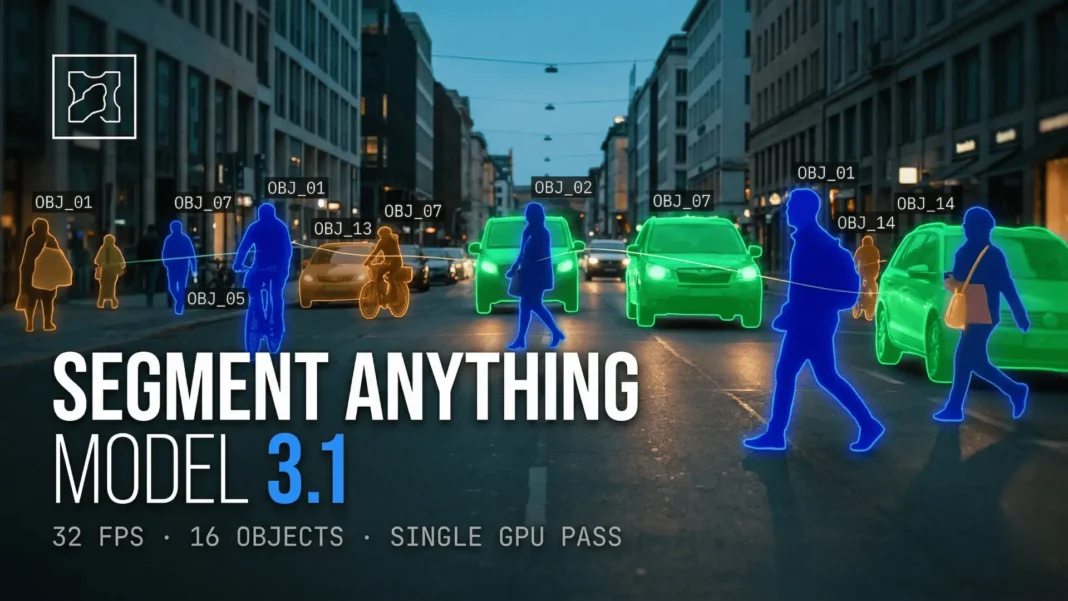
- SAM 3.1 processes up to 16 objects in one forward pass, doubling video throughput from 16 to 32 fps on a single H100 GPU with no accuracy loss
- Object multiplexing eliminates per-object redundant computation and memory bottlenecks, reducing GPU requirements for multi-object scenes
- SAM 3 doubles accuracy over existing systems on Meta’s SA-Co benchmark and outperforms Gemini 2.5 Pro on concept segmentation tasks
- Fine-tuning code is open-sourced; Roboflow integration enables deployment without research-grade infrastructure
32 fps. One H100 GPU. Up to 16 objects tracked simultaneously in a single forward pass. Meta’s SAM 3.1, released March 27, 2026, fixes the one production bottleneck that made SAM 3’s multi-object video tracking impractical at scale. This isn’t a new model; it’s a surgical update that changes the economics of deploying video AI in real applications.
The gain lands hardest for developers running multi-object pipelines at 30fps, where the previous architecture forced sequential per-object passes regardless of how many objects shared the same frame. SAM 3.1 collapses that into a single shared pass, cutting redundant computation and making high-performance applications feasible on smaller, more accessible hardware.
Why the Old Architecture Broke Under Load
SAM 3’s original video architecture processed each tracked object in its own dedicated forward pass. Efficient for two or three objects. Expensive for anything resembling a real-world scene, where crowded environments routinely push object counts into double digits.
Per-object passes also meant no shared context between tracked objects within the same frame. Two people in similar clothing, identical vehicles in a parking lot, or any visually ambiguous pairing caused tracking drift because the model processed each in isolation, without knowledge of what else was being tracked simultaneously.

How Object Multiplexing Actually Changes Inference
Multiplexing bundles up to 16 tracked objects into a single forward pass, sharing per-frame embeddings across all of them at once rather than regenerating those embeddings object by object. This eliminates both the redundant computation and the memory bottlenecks that made high object-count video slow.
The shared global reasoning approach also enhances accuracy in crowded scenes specifically because tracked objects now process within a common context window. Visually similar objects that previously caused identity confusion benefit from this inter-object awareness, which the original SAM 3 architecture structurally lacked.
For medium object counts, throughput doubles from 16 to 32 fps on a single H100 GPU. SAM 3.1 ships as a drop-in replacement for SAM 3 checkpoints, requiring no changes to existing integration code.
What SAM 3 Actually Is (And How It Differs From SAM 2)
Most coverage of SAM 3.1 skips explaining what made SAM 3 a meaningful generational step over SAM 2 in the first place. SAM 2 was an efficient interactive segmentation model extended to video, but constrained to point, box, and mask prompts with fixed-label outputs. SAM 3 accepts text prompts (open-vocabulary short noun phrases) and image exemplar prompts, eliminating fixed label sets entirely.
This “promptable concept segmentation” capability means SAM 3 can find and segment all instances of a concept like “striped red umbrella” or “person in blue jacket” without being trained specifically on those labels. SAM 2 couldn’t do this at all. The difference between the two models isn’t incremental; it’s architectural.
SAM 3 also excels as a perception tool for multimodal large language models. When paired with an MLLM in the SAM 3 Agent configuration, it handles complex relational queries like “people sitting down but not holding a gift box” by letting the MLLM decompose the prompt into noun phrases that SAM 3 then segments.
SAM 3 Performance: What the Benchmarks Actually Confirm
These figures come directly from the official Meta AI blog and the SAM 3 research paper (arXiv:2511.16719).
| Metric | Result |
|---|---|
| SA-Co benchmark improvement over existing systems | 2x gain (image and video) |
| Competitor comparison | Outperforms Gemini 2.5 Pro, GLEE, OWLv2, LLMDet |
| User preference vs. strongest baseline (OWLv2) | ~3 to 1 in favour of SAM 3 |
| Single-image inference speed | 30ms for 100+ detected objects on H200 GPU |
| Video near real-time performance (pre-3.1) | ~5 concurrent objects |
| SAM 3.1 video throughput (medium object count) | 32 fps on single H100 GPU |
| Objects per forward pass (SAM 3.1) | Up to 16 |
| Training dataset unique concepts | 4 million+ |
| Data engine speed vs. human annotators (negative prompts) | ~5x faster |
| Data engine speed vs. human annotators (positive prompts) | 36% faster |
The 5-concurrent-object near real-time ceiling for original SAM 3 in video is the figure most developer documentation underplays. SAM 3.1 directly addresses this, but the practical limit for real-time tracking on a single H100 remains tied to scene complexity beyond the 16-object per-pass ceiling.
Where It Falls Short
SAM 3 struggles to generalize to fine-grained out-of-domain concepts in zero-shot mode. Specific domain terms requiring specialist knowledge, such as “platelet” in medical imagery or terminology from niche scientific visual domains, cause performance degradation without fine-tuning on annotated domain data. Meta explicitly names this as a current limitation.
The model also doesn’t support complex spatial or relational language natively. Prompts like “the second book from the right on the top shelf” fall outside SAM 3’s direct capability. The SAM 3 Agent workaround, which pairs SAM 3 with an MLLM to decompose complex queries, requires additional infrastructure that raises both latency and implementation complexity.
For Indian developers building in healthcare diagnostics, agricultural disease detection, or scientific imaging applications, fine-tuning on annotated local datasets is not a performance optimization. It’s the baseline requirement before production deployment.
Live Applications Running on SAM 3 Right Now
- Facebook Marketplace View in Room – SAM 3 and SAM 3D power AR furniture placement, letting buyers visualize home decor items like lamps and tables in their own spaces before purchase
- Instagram Edits app – SAM 3 enables one-tap dynamic effects, letting creators apply segmentation-based visual treatments to specific people or objects in videos, collapsing what was previously a multi-step manual masking workflow
- Meta AI Vibes – AI visual remix tools on meta.ai and the Meta AI app, using SAM 3 for object-aware video creation
- SA-FARI wildlife dataset – 10,000+ camera trap videos covering more than 100 species, annotated with bounding boxes and per-frame segmentation masks, built with Conservation X Labs and Osa Conservation and publicly available for conservation research
The SA-FARI dataset and the FathomNet underwater segmentation benchmark (led by MBARI) represent the scientific applications most likely to generate long-term research value. Both are public, free, and built on an open-source model.
Getting SAM 3.1 Running: What Developers Need
SAM 3.1 ships as a drop-in checkpoint replacement. Integration code from SAM 3 requires no changes.
Three access paths, all confirmed live as of March 27, 2026:
- Model weights: huggingface.co/facebook/sam3.1
- Codebase + fine-tuning scripts: github.com/facebookresearch/sam3
- No-code playground: Segment Anything Playground at aidemos.meta.com/segment-anything upload images or video without writing a single line of code
Roboflow’s partnership with Meta enables data annotation, fine-tuning, and deployment for custom domains without requiring an H100 cluster. For developers on consumer-grade cloud instances (AWS ap-south-1, Azure Central India), this lowers the barrier considerably versus Meta’s own H100/H200 benchmark hardware.
SAM 3 also performs well on first-person footage from Meta’s Aria Gen 2 research glasses, with select recordings from the Aria Gen 2 Pilot Dataset now featured directly in the Playground.

