

Key Takeaways
- Meta partnered with Oscar Mike Foundation to test Aria Gen 2 glasses with veterans experiencing traumatic brain injury and memory loss
- Aria Gen 2 features 12MP RGB camera, four computer vision cameras, and 6-8 hour battery life enabling real-time memory assistance
- Veterans reported glasses help locate lost items, recall conversation details, and refocus on tasks through voice-activated commands
- Technology addresses three core challenges: remembering conversations, daily task planning, and reducing mobile device distractions
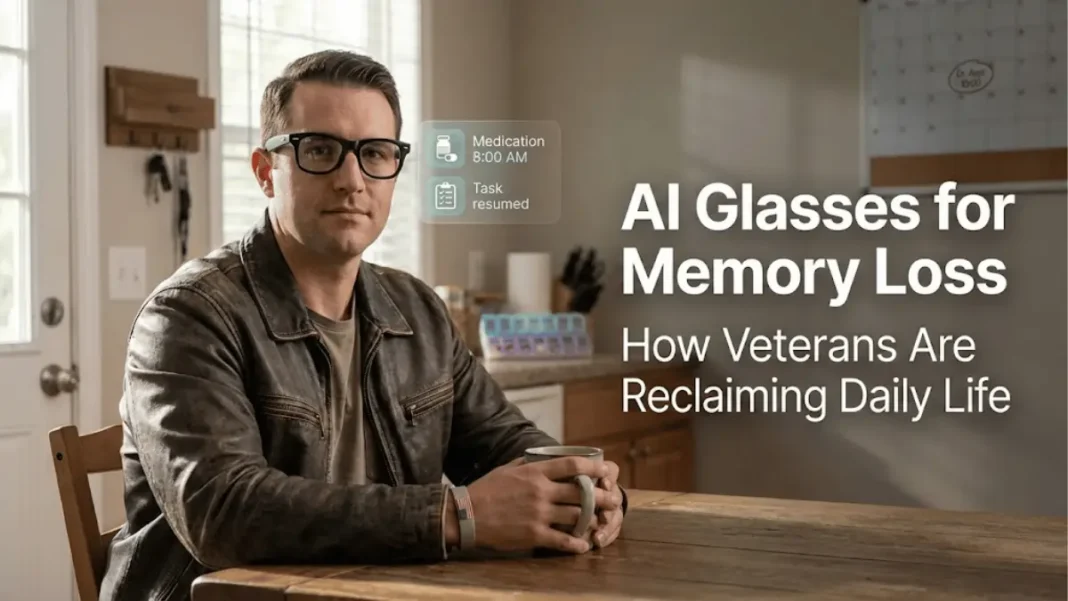
Meta has fundamentally shifted AI Glasses from convenience tools to accessibility lifelines. The company’s February 9, 2026 partnership with the Oscar Mike Foundation reveals how Aria Gen 2 research glasses address memory loss in veterans with traumatic brain injuries, a population facing daily cognitive challenges that traditional assistive technology struggles to resolve. This collaboration demonstrates measurable independence gains through hands-free memory retrieval, spatial awareness enhancement, and distraction management.
Why Veterans With Memory Loss Need Wearable AI
Military veterans living with traumatic brain injuries face distinct cognitive obstacles. Short-term memory deficits disrupt medication schedules, meeting attendance, and object location recall. The Oscar Mike Foundation, established Veterans Day 2011, serves over 7,000 catastrophically injured veterans and identified memory assistance as a critical unmet need.
Army veteran Edward Johnson explained his reliance on written notes for memory retention. “Instead of having multiple resources at hand, [the glasses] would bottle everything into one where I can just have it there,” he said during Meta’s collaborative workshop. Navy veteran Elizabeth Smith, who lives with short-term memory loss, noted the technology “makes you feel human” by eliminating dependency on others for basic recall tasks.

How Meta Aria Gen 2 Glasses Function for Memory Assistance
Meta’s next-generation research glasses integrate hardware and AI algorithms designed for cognitive support. The Aria Gen 2 specifications include a 12-megapixel RGB camera, four computer vision cameras with wider field of view, seven spatial microphones, and eye-tracking sensors. Battery life extends to 6-8 hours, sufficient for sustained daily use during high-demand periods.
The system employs Visual Inertial Odometry to detect glasses position in six degrees of freedom, enabling contextual AI and environmental mapping. Veterans interact through voice commands to retrieve information about their day, receive hands-free reminders, and navigate indoor spaces without pulling out smartphones.
What memory challenges do Meta AI glasses address for TBI patients?
Meta AI glasses help veterans with traumatic brain injuries navigate three primary challenges: remembering conversation details through real-time recording and retrieval, managing daily task planning via voice-activated reminders, and remaining present by reducing smartphone dependency.
Three Core Features Veterans Validated in Testing
During Oscar Mike Foundation design workshops, veterans with memory loss and TBIs identified specific functional benefits:
- Object Location Recall: Glasses help users remember where they left everyday items like keys, phones, and medications through visual memory assistance
- Task Refocusing: When veterans get distracted mid-task, voice prompts help them return to their original activity without external assistance
- Conversation Focus: Ray-Ban Meta glasses’ existing conversation focus feature prevents distraction during dialogue, while live captions on Meta Ray-Ban Display models support hearing-impaired veterans
Workshop participants emphasized that hands-free operation eliminates the physical and cognitive burden of managing multiple assistive devices.
Aria Gen 2 Technical Specifications That Enable Accessibility
Meta’s second-generation research platform delivers substantial hardware upgrades over its predecessor. The global shutter camera sensor captures 120dB high dynamic range compared to 70dB on first-generation models, ensuring computer vision functions across varied lighting conditions. Stereo overlap increased from 35 degrees to 80 degrees, facilitating stereo-based foundation models that improve spatial awareness and depth perception.
Eye-tracking systems monitor gaze per eye, vergence point, blink detection, and pupil diameter to understand visual attention patterns. Hand tracking in 3D space produces joint poses in the frame of reference, enabling precise environmental interaction. A calibrated ambient light sensor with ultraviolet mode distinguishes between color temperatures and indoor lighting, while a contact microphone embedded in the nose pad captures audio and a PPG sensor detects heart rate.
| Feature | Aria Gen 2 | Application for Memory Loss |
|---|---|---|
| RGB Camera | 12MP | Visual memory capture and object recognition |
| Battery Life | 6-8 hours | Full-day support during high-demand periods |
| Computer Vision Cameras | 4 (wider FOV) | Enhanced spatial awareness for navigation |
| Eye Tracking | Dual-camera system | Attention monitoring and interface control |
| Spatial Microphones | 7 | Ambient sound capture for context-aware reminders |
Comparing Meta’s Approach to Other Smart Glasses for Cognitive Disabilities
Meta’s accessibility focus distinguishes its wearables from consumer-oriented competitors. CrossSense, a dementia-focused smart glasses system, limits usage to two hours due to battery constraints and requires an external edge server for data processing. Aria Gen 2’s 6-8 hour battery and on-device machine perception algorithms eliminate external hardware dependencies.
OrCam MyEye and dot Lumen glasses primarily serve visually impaired users through real-time text-to-speech and object identification, addressing sensory rather than cognitive disabilities. Meta’s partnership with Be My Eyes extends Ray-Ban Meta glasses’ functionality to vision assistance, but Aria Gen 2 specifically targets memory and cognitive challenges through conversational AI and spatial memory mapping.
Research published in September 2025 found that smart glasses for older adults with cognitive impairment enabled task completion with less external help compared to paper-based assistance, though completion times increased. Meta’s voice-activated retrieval system addresses this speed limitation by eliminating manual lookup processes.
Real-World Impact: Veterans’ Testimonials on Independence Gains
Elizabeth Smith’s testimony underscores the psychological impact of assistive wearables. “You don’t often feel [human] when you’re disabled,” she said, noting that accessible technology design reduces the stigma associated with visible assistive devices. The Ray-Ban aesthetic integration ensures glasses don’t signal disability, addressing a barrier documented in wearable adoption research.
Oscar Mike Foundation participants emphasized the value of consolidated assistive technology. Edward Johnson noted that voice-activated memory access through glasses eliminates the need to carry multiple devices or notebooks.
How do Meta AI glasses compare to traditional memory aids for veterans?
Unlike written notes or smartphone reminders that require manual input and retrieval, Meta AI glasses provide voice-activated memory access. Veterans reported consolidating multiple assistive resources into one wearable device, reducing cognitive load and physical carrying burden.
Oscar Mike Foundation’s Role in Accessible Technology Development
Founded by injured veterans in a two-car garage on Veterans Day 2011, the Oscar Mike Foundation has provided over 7,000 adaptive opportunities to catastrophically injured service members. The nonprofit’s “On the Move” philosophy emphasizes independence through adaptive sports and technology access.
The organization’s collaborative design workshop with Meta gathered direct feedback from veterans experiencing memory loss, traumatic brain injuries, and spatial awareness challenges. This user-centered approach ensures technology development addresses actual daily obstacles rather than theoretical use cases. Oscar Mike reports zero suicides among participating veterans, attributing outcomes to restored purpose and community engagement.
Broader Accessibility Applications Beyond Veterans
Meta’s AI glasses advances extend to multiple disability communities. The company documented positive impacts on blind and low-vision populations, with users leveraging camera-aware AI for text reading and object identification. The conversation focus feature benefits individuals with attention-related disabilities by filtering auditory distractions during dialogue.
Live captions on Meta Ray-Ban Display glasses support deaf and hard-of-hearing users by eliminating lip-reading dependency while maintaining eye contact during conversations. This multimodal accessibility demonstrates how single-platform design can serve diverse disability needs through adaptable software features.
What other accessibility features do Meta AI glasses offer beyond memory assistance?
Meta AI glasses include live captions for hearing-impaired users, real-time object identification for visually impaired users, and conversation focus to reduce auditory distractions for attention-related disabilities.
Technical Considerations and Limitations
Aria Gen 2 remains a research platform rather than a consumer product. Meta continues partnerships with researchers and disability organizations to refine accessibility features before commercial deployment. Privacy concerns surrounding continuous camera and microphone operation require robust data protection frameworks, particularly for cognitive disability populations who may face challenges consenting to data collection.
Battery life of 6-8 hours, while improved, may not support full waking-day use for severe memory impairment cases requiring constant assistance. External charging interrupts create gaps in memory capture, potentially missing critical information during device downtime. The CrossSense dementia glasses address this through encrypted offline edge servers, though at the cost of portability.
Future Directions for AI Wearables in Cognitive Care
The wearable accessibility market is expanding rapidly, with AI-driven tools improving communication access for cognitive and linguistic disabilities. As machine learning models advance, predictive memory assistance could anticipate user needs based on routine patterns, reducing reliance on reactive voice commands.
Integration with smart home systems could extend memory assistance beyond wearable constraints. Voice-activated environment control combined with spatial awareness would enable location-based reminders for example, prompting medication intake when entering a kitchen or alerting users to locked doors when leaving home.

Frequently Asked Questions (FAQs)
Can Meta AI glasses help with dementia and Alzheimer’s disease?
While Meta specifically tested Aria Gen 2 with traumatic brain injury patients, the memory assistance features voice-activated recall, object location, and task reminders could apply to neurodegenerative conditions. Research is ongoing for dementia-specific applications.
Are Meta Aria Gen 2 glasses available for purchase?
No. Aria Gen 2 is a research platform used for accessibility development. Consumer Ray-Ban Meta glasses offer some features but lack full memory assistance capabilities tested with veterans.
How long does the battery last on Aria Gen 2 glasses?
Aria Gen 2 battery life ranges from 6-8 hours depending on feature usage, enabling sustained daily support during high-demand periods.
Do the glasses require internet connectivity to function?
Meta has not disclosed offline functionality for Aria Gen 2. Competing systems like CrossSense operate offline through local edge servers to protect privacy.
Can veterans get subsidized access to Meta AI glasses?
Oscar Mike Foundation partners with Meta for testing but public subsidy programs have not been announced. The nonprofit utilizes 100% of donations to support injured veterans.
What privacy protections exist for users with cognitive disabilities?
Specific privacy frameworks for Aria Gen 2 have not been detailed. Cognitive disability populations require enhanced consent processes given decision-making challenges.
Do Meta AI glasses work with prescription lenses?
Consumer Ray-Ban Meta glasses support prescription lenses. Aria Gen 2 research glasses specifications do not include prescription customization details.
How do the glasses help with indoor navigation?
Visual Inertial Odometry detects glasses position in six degrees of freedom, enabling environmental mapping and spatial awareness for navigation support.

