

Quick Brief
- The Program: Meta commits nearly $2 million across 30+ grants to organizations deploying Ray-Ban Meta AI glasses for social and economic impact
- The Funding: 15 Accelerator Grants at $25,000, 10 at $50,000, and 5 Catalyst Grants at $200,000 for Device Access Toolkit applications
- The Deadline: US-based organizations can apply through March 9, 2026
- The Context: Follows December 2025 Wearables Community Summit with 80+ developers demonstrating real-world applications
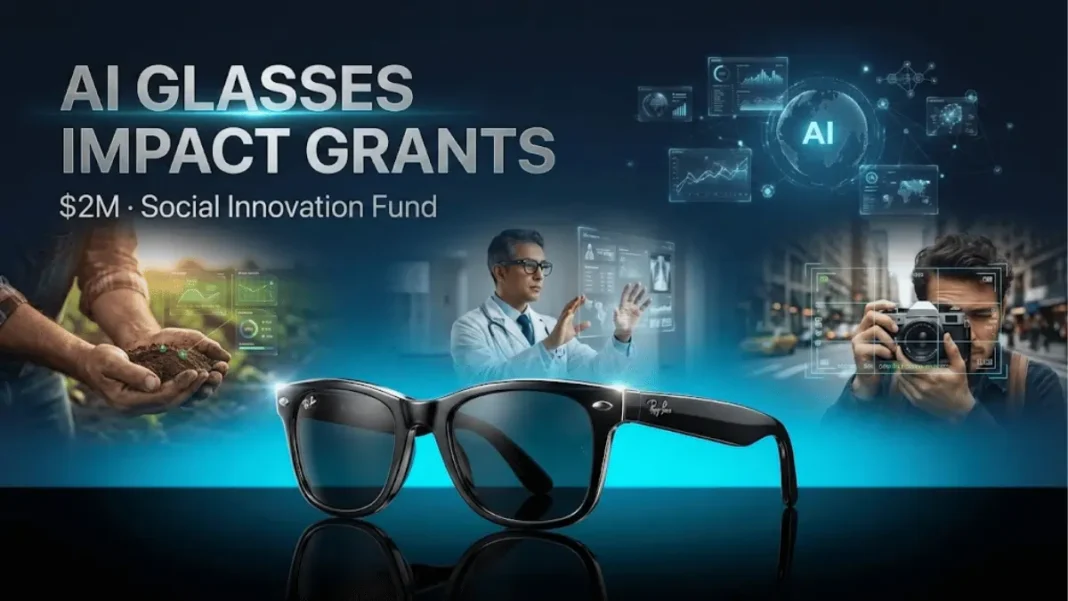
Meta announced the AI Glasses Impact Grants program, committing nearly $2 million to support US-based organizations using its Ray-Ban Meta AI glasses for societal and economic advancement. The initiative offers two grant tiers targeting organizations at different deployment stages, with applications closing March 9, 2026.
Grant Structure and Funding Allocation
The program distributes funding across two categories designed to accelerate existing implementations and catalyze new applications. Accelerator Grants support 25 organizations already leveraging Meta’s AI glasses, with 15 recipients receiving $25,000 and 10 receiving $50,000 based on project scale. Catalyst Grants award $200,000 to five organizations proposing high-impact applications using Meta’s Device Access Toolkit.
Eligibility extends from two-person startups organizing environmental initiatives to multistate enterprises deploying the glasses for accessibility services. The program prioritizes measurable community impact over organizational size, reflecting Meta’s strategy to establish the Ray-Ban Meta glasses as a platform for social and economic applications.
Developer Ecosystem Expansion
The grant program builds on momentum from the December 2025 Wearables Community Summit, where more than 80 developers demonstrated applications across agriculture, healthcare, creative industries, and accessibility. Organizations gathered at the summit to share insights on deploying Ray-Ban Meta glasses for real-world challenges.
Catalyst Grants specifically target organizations proposing new applications using Meta’s Device Access Toolkit, which enables third-party developers to build integrations with the glasses platform. This SDK approach positions Meta to expand use cases beyond consumer applications into enterprise and social impact sectors.
Deployed Use Cases Across Industries
| Industry | Organization | Application | Impact |
|---|---|---|---|
| Agriculture | Agerpoint | Hands-free crop health diagnosis, yield projection, spatial data capture | Real-time AI capabilities for farmers and agricultural workers |
| Healthcare | National Athletic Trainers Association (NATA) | Voice-activated injury documentation and patient charting | Real-time notes on player injuries, hands-free chart updates |
| Education | San Diego State University School of Theatre, Television, and Film | Location scouting, shot pre-visualization, footage capture | Accessible early-stage filming for prospective filmmakers |
Kevin Lang, President and CEO of Agerpoint, employs the glasses to provide farmers with AI-driven diagnostics for crop health assessment and harvest readiness. David Gallegos, a certified athletic trainer with NATA, integrates voice recognition for hands-free documentation during field care, stating the technology enables real-time injury notes and chart updates while maintaining patient focus. Stuart Voytilla at San Diego State University cites the accessible form factor as transformative for students recording footage and scouting locations collaboratively.
Program Objectives and Impact Areas
Meta designed the Impact Grants to support organizations addressing critical challenges through wearable AI technology. The program targets applications that deliver measurable social or economic value, from agricultural productivity enhancements to healthcare workflow improvements.
Current deployments demonstrate the glasses’ utility in hands-free environments where traditional mobile devices create workflow interruptions. Agricultural workers access AI-powered crop analysis without interrupting fieldwork, athletic trainers document injuries while providing care, and film students capture footage without expensive equipment barriers.
Application Requirements and Timeline
Organizations must submit applications through Meta’s official portal by March 9, 2026. Accelerator Grant applicants demonstrate existing Ray-Ban Meta glasses deployments with quantifiable community or economic impact. Catalyst Grant proposals outline new applications leveraging Device Access Toolkit capabilities.
The program accepts applications from US-based organizations regardless of size, from small teams to multistate enterprises. Meta evaluates proposals based on demonstrated or projected impact on communities and economic outcomes.
Frequently Asked Questions (FAQs)
What are Meta AI Glasses Impact Grants?
Funding program awarding nearly $2 million to US organizations using Ray-Ban Meta AI glasses for social and economic impact initiatives.
How much funding does Meta offer for AI glasses grants?
Accelerator Grants range from $25,000 to $50,000; Catalyst Grants provide $200,000 each, totaling $2 million across 30+ recipients.
Who qualifies for Meta’s AI Glasses Impact Grants?
US-based organizations from startups to multistate enterprises deploying or proposing Ray-Ban Meta glasses applications with community impact.
When is the application deadline for these grants?
Applications close March 9, 2026, through Meta’s official grant portal.
How are Ray-Ban Meta glasses used for social good?
Current deployments include agricultural diagnostics, hands-free medical documentation, accessibility services, and filmmaking education.

