

Quick Brief
- AI data centers will consume 70% of memory chips made in 2026, leaving consumer electronics producers with limited supply
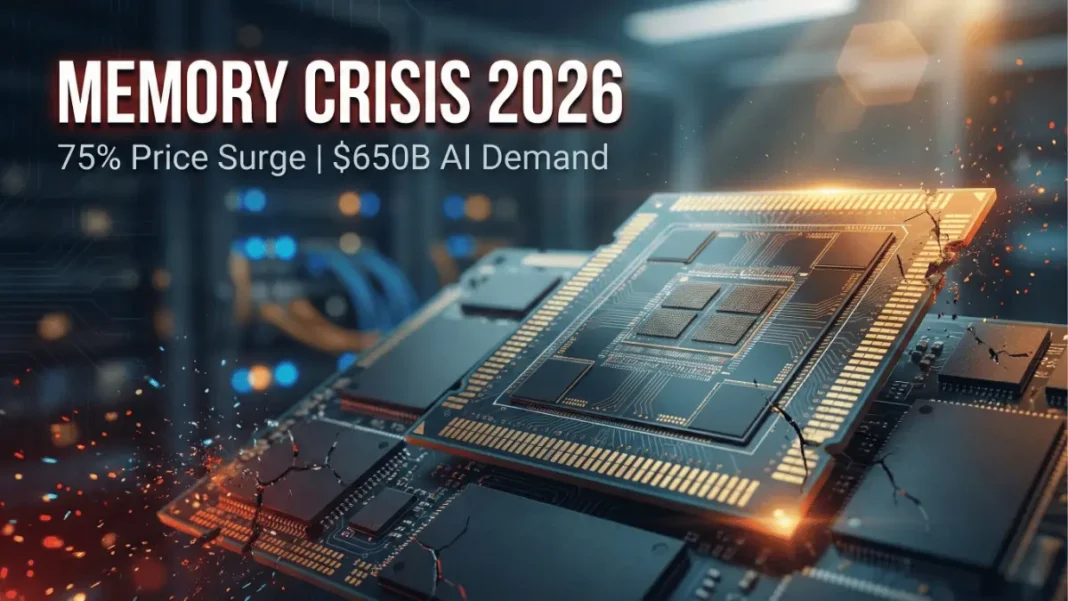
- DRAM prices jumped 75% between December 2025 and January 2026, with industry analysts labeling the crisis “RAMmageddon”
- Tesla CEO Elon Musk announced plans to build its own memory fabrication plant after supply constraints threatened production
- Apple projects iPhone margins will compress to 48-49% in Q1 2026 due to rising memory costs
A widening shortage of DRAM and NAND memory chips is squeezing the global tech industry in 2026. Companies from Tesla to Apple are warning that the crunch will constrain production, inflate prices, and compress profit margins for months ahead. More than a dozen major corporations have signaled since January 2026 that the shortage will hamper operations, with Micron Technology calling the bottleneck “unprecedented.”
Why the Shortage Is Happening Now
The fundamental driver is the explosive buildout of AI data centers. Companies like Alphabet, Amazon, Microsoft, and Meta are pouring unprecedented sums into AI infrastructure, with combined spending estimated to reach $650 billion in 2026, up from roughly $360 billion in 2025.
These hyperscalers are buying millions of Nvidia AI accelerators that come with enormous memory allotments. This leaves consumer electronics producers fighting over dwindling supplies from Samsung Electronics, SK Hynix, and Micron. High-bandwidth memory for AI chips is “consuming so much of the available capacity across the industry that it’s leaving a tremendous shortage for the conventional side,” Micron Executive Vice President Manish Bhatia said in January 2026.
Data centers will consume approximately 70% of memory chips manufactured in 2026, according to industry reports. AI servers and enterprise environments require far more memory per system than consumer devices, pulling a disproportionate share of global capacity.
What’s driving DRAM price spikes?
DRAM prices are going “parabolic” according to Bernstein analyst Mark Li, with one DRAM type soaring 75% from December 2025 to January 2026 alone. IDC expects 2026 DRAM supply growth at just 16% year-on-year and NAND at 17% year-on-year below historical norms despite rising demand. Three manufacturers control approximately 95% of global DRAM production, creating systemic vulnerability when supply tightens.

How Major Tech Companies Are Responding
Tesla’s Fabrication Plant Plans
Elon Musk surprised investors during Tesla’s Q4 2025 earnings call by declaring the electric vehicle maker may need to build its own memory fabrication plant. “We’ve got two choices: hit the chip wall or make a fab,” Musk said, announcing plans for a “Tesla TeraFab” that includes logic, memory, and packaging.
The move fits Tesla’s vertical integration strategy. Musk cited supply security concerns and the need for domestic chip capacity to support autonomous vehicle production and the Optimus robot program. He indicated the facility could launch within three to four years.
Apple’s Margin Compression
Apple CEO Tim Cook warned that rising memory costs would compress iPhone margins significantly. The company projects gross margins of 48% to 49% for the March 2026 quarter.
Cook noted that rising memory had minimal impact during the December 2025 quarter but would significantly affect Q1 2026 results. “As always, we will consider various options to tackle that,” Cook remarked during Apple’s earnings call.
Apple faces constraints securing enough advanced processors from TSMC as well. The company cannot secure sufficient capacity to produce more chips for its popular products as AI accelerators based on TSMC’s latest manufacturing processes ramp up.
Nvidia’s Gaming GPU Halt
For the first time in nearly three decades, Nvidia will not release new gaming GPUs in 2026. The company has abandoned plans for any new graphics card launches this year, prioritizing its limited memory supply for AI accelerators over gaming products.
Nvidia postponed development of “Kicker” the codename for the anticipated RTX 50-series refresh including “Super” variants. Although designs were completed, the company determined memory expenses could not be justified. The postponement shifts mass production timelines for next-generation gaming GPUs to late 2027, creating a nearly three-year gap between major GPU generations.
Production of existing RTX 50-series GPUs is also being reduced. Prices for the RTX 50 lineup are already surging at retail due to limited availability.
Impact Across Industries
Automotive Sector Pressure
The automotive sector faces growing pressure as DRAM manufacturers shift capacity toward AI applications. Counterpoint analyst MS Hwang reported “signs of panic buying” emerging in the auto sector as manufacturers rush to secure supplies.
DRAM vendors can redirect capacity across customers and memory types with shorter qualification cycles compared to foundry capacity. However, the speed and scale of AI demand is outpacing this flexibility.
Smartphone Market Adjustments
Chinese smartphone makers including Xiaomi and Oppo are trimming shipment targets for 2026. Oppo cut its forecast by as much as 20% due to memory supply constraints and rising component costs.
The smartphone market faces dual pressure from both supply constraints and price increases. Memory is a commodity component, but large OEMs must qualify specific memory devices before production, limiting substitution options when shortages occur.
How long will the memory shortage last?
The shortage is likely to persist through 2026 and into 2027, according to Synopsys CEO Sassine Ghazi. Building new chip fabrication facilities takes years, and current expansion plans won’t meaningfully increase supply until 2027-2028. Lenovo CEO Yang Yuanqing confirmed the crunch will last at least through the rest of 2026.
Supply Response and Future Outlook
Samsung’s P5 facility is poised to become the company’s largest and most sophisticated memory manufacturing plant. Initially paused in 2024 due to a downturn in the memory market, it has been revived with an expected launch in 2028, driven by urgent demand from AI data centers.
SK Hynix is expanding its fabrication cluster, anticipating $90 billion in memory manufacturing capacity to come online during 2027 and 2028. However, these expansions will not address the immediate 2026 shortage.
TrendForce notes that inventories are tightening and shipment growth is increasingly reliant on wafer output increases, amplifying price pressure. The supply growth lag creates a fundamental mismatch between AI-driven demand and available production capacity.
What This Means for Consumers
Consumers should expect higher prices for smartphones, laptops, gaming PCs, and other devices throughout 2026. Product launches may face delays as manufacturers prioritize flagship models over mid-range offerings to maximize margins amid component cost increases.
Gaming enthusiasts face particularly limited options, with Nvidia’s production cuts making RTX 50-series cards scarce at suggested retail prices. The lack of new GPU releases through 2026 removes competitive pressure that typically drives innovation and value.
For enterprise buyers, memory-intensive products like high-end workstations and AI-capable laptops will see the steepest price increases. Organizations planning hardware refreshes should consider accelerating purchases or securing supply commitments early in the year.

Frequently Asked Questions (FAQs)
What is causing the 2026 memory chip shortage?
AI data centers consuming 70% of 2026 memory chip production are the primary cause. Hyperscalers like Amazon, Microsoft, and Meta are building massive AI infrastructure requiring enormous memory allotments, leaving consumer electronics makers with limited supply.
Which companies are most affected by the DRAM shortage?
Apple, Tesla, Nvidia, Sony, Nintendo, Xiaomi, and Oppo face significant constraints. Apple expects compressed iPhone margins, Tesla may build its own fab, and Nvidia halted new gaming GPU development for the first time in 30 years.
How much have memory prices increased in 2026?
One DRAM type surged 75% from December 2025 to January 2026 alone. Bernstein analyst Mark Li described prices as going “parabolic,” with the crisis dubbed “RAMmageddon” by industry observers.
Will memory chip prices come down in 2026?
Unlikely. IDC expects supply growth of only 16% for DRAM and 17% for NAND in 2026 below historical norms despite surging demand. Industry experts predict the shortage will persist through 2026 and into 2027.
Why can’t manufacturers just make more memory chips?
Building new fabrication facilities takes 3-4 years and billions in investment. Samsung’s P5 facility won’t launch until 2028, and SK Hynix’s $90 billion expansion comes online in 2027-2028. Three companies control 95% of DRAM production, limiting rapid capacity increases.
Is Nvidia releasing new GPUs in 2026?
No. Nvidia will not release new gaming GPUs in 2026 for the first time in nearly three decades. The company postponed its RTX 50-series “Super” refresh and reduced production of existing RTX 50 cards to prioritize memory for AI accelerators.
What is a TeraFab and why is Tesla building one?
A TeraFab is Tesla’s planned massive semiconductor fabrication facility that would produce logic chips, memory, and packaging domestically. Elon Musk announced the plan after supply constraints threatened Tesla’s autonomous vehicle and Optimus robot production.
How does this shortage affect smartphone prices?
Chinese manufacturers like Oppo cut 2026 shipment forecasts by up to 20% due to memory costs. Apple warned rising memory prices will compress iPhone margins to 48-49% in Q1 2026, likely leading to higher retail prices or reduced features in mid-range models.

