

What You Need to Know
- Grok uses on-demand retrieval from X’s public post stream, not an always-on live firehose, to incorporate fresh data
- Developers can control exactly when and where real-time retrieval activates through xAI’s Live Search API
- Live social data carries structural risks: viral misinformation and prompt-injection from untrusted content can affect outputs
- Grok accesses only public X posts; private accounts, deleted content, and restricted material remain outside retrieval scope
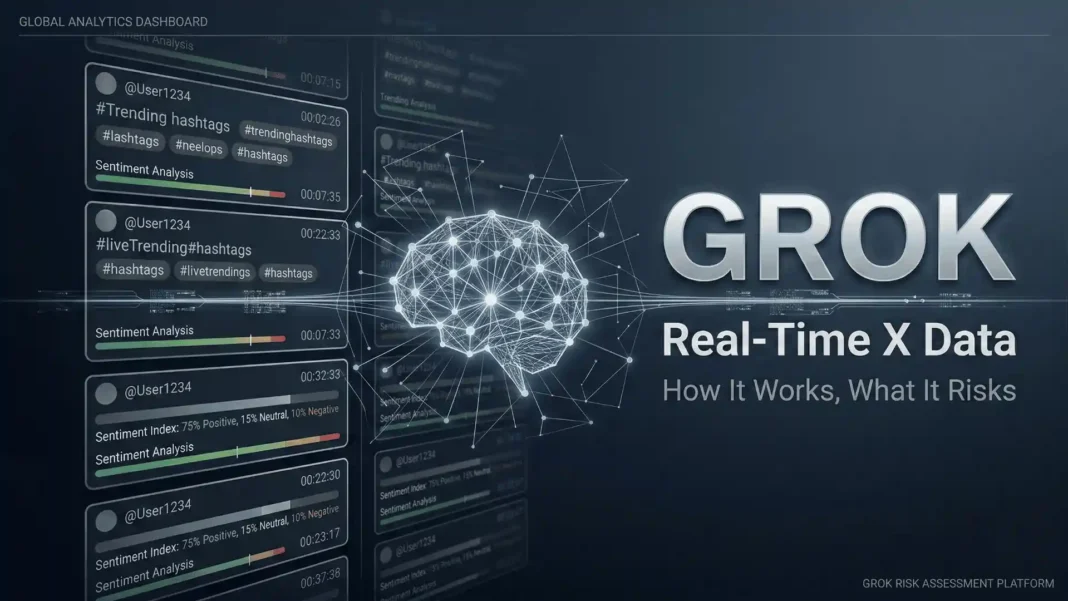
Real-time AI just crossed a threshold most researchers have not noticed yet. Grok does not simply search the web like other AI assistants. It can pull from X’s live public post stream as a primary input, giving it access to breaking narratives, market reactions, and public sentiment as they form. This article breaks down exactly how that mechanism works, where it delivers genuine value for market research, and where it introduces risks no analyst can afford to ignore.
How Grok’s Real-Time Data Pipeline Actually Works
Grok’s real-time capability is not a passive background process. It operates through an on-demand retrieval step: when a query signals a need for fresh information, Grok can search or fetch relevant X posts and live web sources, then inject that retrieved content as context before generating a response. The accurate mental model is that Grok incorporates live X posts when live search is enabled and available, but the model still generates its answer from a prompt plus retrieved snippets, not from a constantly streaming data connection.
Whether live retrieval activates at all depends on three factors simultaneously: the product surface in use (X app, Grok.com, or API), user settings (auto, on, or off), and active policy constraints such as safe search, allowed accounts, or regional restrictions. Users who need guaranteed real-time context should confirm live search is enabled and phrase prompts explicitly to request recent post data with timestamps.
The infrastructure behind this is xAI’s Live Search API, launched in 2025. It extends access beyond conversational use into developer pipelines, allowing teams to specify whether Grok should query X, the web, or both, set time ranges, limit result volume per request, and filter by domain. The API also integrates DeepSearch, which surfaces the reasoning behind search results for added transparency. A Python SDK is available for developers to integrate the API directly into their projects.

What Sets Grok Apart From Other AI Assistants
Most AI assistants operate from static training data with a fixed knowledge cutoff. Grok’s architecture breaks that limitation by coupling a trained large language model with a live retrieval layer anchored to X’s public post stream.
| Capability | Grok | ChatGPT (standard) |
|---|---|---|
| Real-time post access | Yes, via X public stream when enabled | Limited, via Bing web search |
| Source type | X posts + live web + breaking news | Primarily indexed web pages |
| Developer retrieval control | Fine-grained API parameters, start/stop, time ranges, domain filters | Plugin-dependent |
| Prompt-injection risk | Present; untrusted live content can affect outputs | Lower; indexed sources are more pre-vetted |
| Auditability | Retrieval metadata logging recommended | Standard API logging |
This structural difference makes Grok faster at capturing emerging signals but inherently more exposed to the noise and manipulation that characterize live social platforms.
Benefits for Market Research: Where Grok Delivers Real Value
Real-time social data is among the closest proxies researchers have to consumer sentiment as it forms. Grok’s integration with X makes it practical to extract that signal without building a custom data pipeline from scratch.
Sentiment tracking at speed. Grok can summarize how a specific audience segment reacts to a product announcement, policy change, or brand crisis based on current public X conversation. Because retrieval is on-demand and pulls from live posts, outputs reflect the state of discourse at query time rather than days-old indexed data.
Competitor and trend monitoring. Analysts can query Grok to surface emerging competitor mentions, track developing narratives, and identify which topics are gaining traction before they reach mainstream news cycles. The Live Search API allows time-range filtering, so researchers can scope queries to specific windows and isolate event-driven spikes from background noise.
Automated analytics workflows. Through the Live Search API, organizations can build programmatic pipelines where Grok retrieves live X posts on a defined schedule, processes them for sentiment or topic extraction, and outputs structured results. The Python SDK makes integration into existing data infrastructure straightforward.
Hybrid data architectures. One of the most practical production patterns is combining Grok’s live X retrieval with a private vector database. Grok handles the real-time public signal (“what are people saying now?”) while the vector store serves official internal documents (“what is our verified policy response?”). This split design keeps ground truth anchored in governed internal sources while still capturing live discourse.
Risks of Live Data: What Researchers Must Not Ignore
Speed without verification is a liability. Grok’s real-time model introduces three categories of risk that any serious analyst must account for before acting on outputs.
Misinformation amplification. Live social streams contain unverified claims, parody accounts, coordinated inauthentic behavior, and fleeting narratives. Grok synthesizes what it retrieves; it does not independently verify source credibility before including a post in its context window. Early-stage outputs on breaking events can reflect rumors as prominently as confirmed facts.
Prompt-injection from untrusted content. This is a production-grade risk specific to live retrieval systems. Malicious or manipulative content embedded in public X posts can, in certain configurations, influence how Grok interprets and responds to subsequent queries. Organizations building on the Live Search API need explicit input sanitization and retrieval scope controls to mitigate this.
Platform representation bias. X’s public post distribution is not demographically representative. High-follower accounts, algorithmic amplification, and engagement-optimized posts distort what Grok perceives as public sentiment. A sentiment analysis built from Grok’s X retrieval reflects the platform’s most vocal and algorithmically favored voices, not a balanced cross-section of a target market.
Retrieval scope gaps. Grok accesses only public posts. Private accounts, deleted posts, and content behind regional restrictions or paywalls are invisible to the retrieval layer. Specialized industry conversations that happen predominantly in private or subscription-gated spaces will be underrepresented or absent from Grok’s outputs.
How to Use Grok’s Live Data Responsibly
Responsible use of Grok’s real-time capabilities requires discipline at both the prompt and workflow levels.
- Confirm live search is enabled for your product surface and query type before relying on real-time outputs
- Log retrieval metadata for every production query: which posts were consulted, which handles were included, and what filters were applied
- Use the API’s time-range and domain filters to scope retrieval precisely and reduce noise from off-topic content
- Treat Grok’s sentiment outputs as directional signals, not statistically validated consumer research
- Implement input sanitization in API pipelines to reduce prompt-injection risk from untrusted live content
- Pair live X retrieval with a private vector database for any use case requiring both real-time public signals and verified internal ground truth
Limitations to Keep in Mind
Grok’s real-time X integration is powerful but bounded. Retrieval is selective, pulling from available public posts rather than indexing every post at the precise moment of publication. For low-volume, specialized industry conversations with limited X activity, live retrieval may surface thin or unrepresentative data. Results on the same prompt can vary across days because the retrieved live context changes with each query, which is expected behavior but must be accounted for in any longitudinal research design.
Frequently Asked Questions (FAQs)
Does Grok access all X posts in real time?
No. Grok accesses only public X posts through on-demand retrieval when live search is enabled. Private accounts, deleted content, and material behind regional restrictions or paywalls are outside its scope. Whether live retrieval activates depends on the product surface, user settings, and active policy constraints.
How does Grok’s real-time retrieval actually work?
When a query signals a need for fresh data and live search is active, Grok fetches relevant public X posts and web sources and uses them as context before generating a response. The model still produces its answer from a prompt plus retrieved snippets; it does not maintain a constant streaming connection to all X activity.
What is xAI’s Live Search API?
xAI’s Live Search API, launched in 2025, gives developers granular control over Grok’s retrieval behavior. It supports start/stop controls, result count limits, time-range filtering, domain specification, and DeepSearch reasoning transparency. A Python SDK is available for direct project integration.
Can businesses use Grok’s real-time data for market research?
Yes. Businesses can use Grok for sentiment tracking, trend monitoring, and competitor mention detection through conversational queries or the Live Search API. Programmatic pipelines can retrieve and process live X posts on a schedule. Results should be treated as directional signals and verified against primary data for high-stakes decisions.
What is prompt-injection risk in Grok’s live retrieval?
Prompt injection occurs when malicious or manipulative content in retrieved live posts influences Grok’s response behavior in unintended ways. This is a documented production risk for any live-retrieval AI system. Organizations can reduce exposure through retrieval scope controls, input sanitization, and restricting which accounts or domains are eligible for retrieval.
How should developers handle result variability in Grok’s live outputs?
Because retrieved context changes with every query, the same prompt can produce different outputs on different days. Developers should log retrieval metadata per request, including post handles, timestamps, and applied filters, to maintain auditability and reproduce results for compliance or research reporting purposes.
What is the most reliable production architecture for using Grok with live data?
The recommended pattern combines Grok’s live X retrieval for real-time public signals with a private vector database storing official internal documents. Grok handles live discourse summarization while the vector store anchors verified, governed information. This hybrid design reduces hallucination risk and keeps authoritative content separate from unverified social data.

