

Quick Brief
- Grok Build is xAI’s local-first CLI agent that converts natural language into production code without sending code to any cloud server
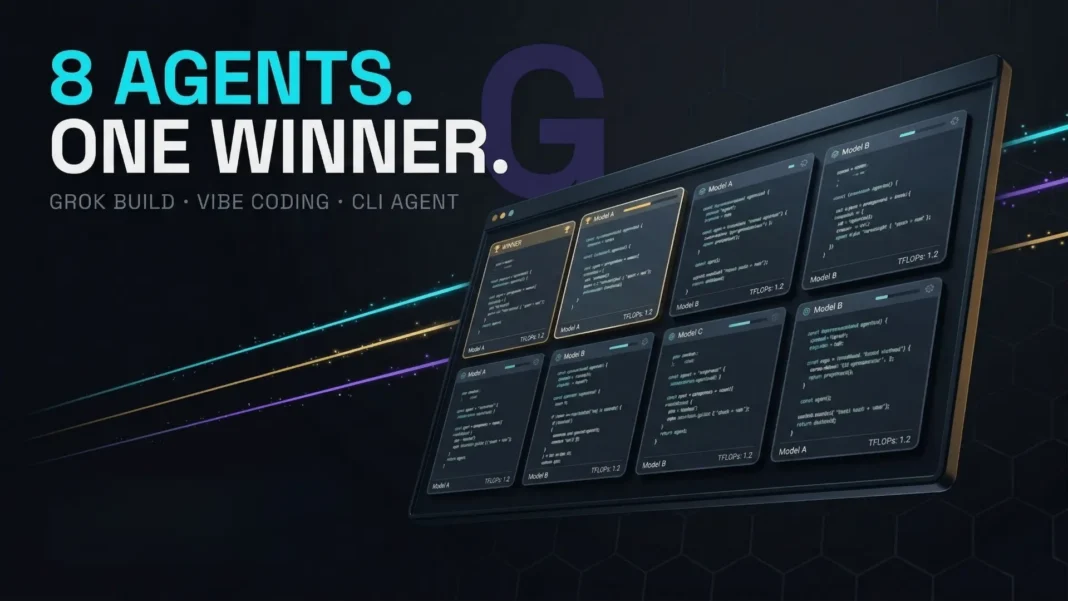
- Up to 8 concurrent AI agents run simultaneously, generating multiple code variants side by side in real time
- Arena Mode introduces automated agent competition, where outputs are ranked algorithmically before the developer reviews results
- grok-code-fast-1, the underlying model, scored 70.8% on SWE-Bench Verified and supports a 256,000-token context window
The way developers write software is splitting into two distinct eras: before autonomous agents, and after. Grok Build is xAI’s answer to what the “after” looks like, combining a local-first CLI, multi-agent orchestration, and an automated evaluation layer into a single vibe coding environment that handles planning, execution, and output ranking in one uninterrupted workflow.
What Grok Build Actually Does
Grok Build is xAI’s vibe coding agent that transforms natural language descriptions into functional, production-ready software. Unlike browser-based AI coding tools, it runs locally on your machine, which means your source code, credentials, and project data never transmit to an external server.
The agent operates across three stages: it plans the task architecture, searches for relevant documentation or API context, and then writes and executes code. This end-to-end loop runs without requiring the developer to switch between a browser, terminal, and editor.
Installation follows a standard npm workflow. Running npm install -g grok-build and grok-build init starts a local agent with a WebSocket connection that syncs with both the CLI and an optional web UI. Developers who prefer visual feedback can monitor the web interface while the agent works in the background.
8 Parallel Agents: The Core Architecture
The primary differentiator in Grok Build is its multi-agent concurrency. Developers can spawn up to eight coding agents simultaneously, with all agent responses visible side by side in a context-tracked session. This means different modules, branches, or approaches for a single project can be developed in parallel without manual coordination.
This approach moves Grok Build well beyond what competitors currently offer. Claude Code operates as a single agent with sequential steps. Cursor provides limited orchestration. Grok Build’s eight-agent parallelism is a purpose-built architectural decision, not a bolt-on feature.
Beyond the parallel output display, xAI is building a deeper evaluation layer called Arena Mode.
Arena Mode: Agents Compete, Best Code Wins
Arena Mode is the most significant feature in Grok Build’s roadmap. Rather than showing eight agent outputs and leaving the selection to the developer, Arena Mode introduces an automated evaluation layer where agents compete or collaborate and their outputs are ranked algorithmically before human review.
This mirrors Google’s Gemini Enterprise tournament-style framework for idea generation, but xAI applies it directly to code production. When Arena Mode triggers, a dedicated session opens with all agent responses visible side by side alongside a context usage tracker. Outputs are scored and surfaced in ranked order.
Arena Mode was identified in code traces as of February 2026 and is not yet publicly available. Its infrastructure demands are substantial: running eight competing agents simultaneously requires significantly more compute than a single-agent session.
Grok Build as a Full IDE
Beyond the agent and evaluation features, Grok Build is evolving into a full development environment. Code findings from February 2026 reveal the following features in active development:
- Dictation support: Describe what you want verbally, in line with the vibe coding philosophy
- Navigation tabs: Edits, Files, Plans, Search, and Web Page views transform the interface into a browser-style IDE
- Live code previews: See generated output as agents write code in real time
- GitHub integration: Native repository, branch, and pull request management
- Share and Comments: Collaboration features pointing toward team usage
This positions Grok Build not as a coding assistant but as a full development environment where AI agents act as primary workers and developers function as reviewers and coordinators.
grok-code-fast-1: The Model Behind the Agent
xAI released grok-code-fast-1 on August 26, 2025, specifically built for agentic coding workflows. It is proficient in TypeScript, Python, Java, Rust, C++, and Go, and targets common developer tasks including project scaffolding, codebase queries, and precise bug fixes.
The model carries a 256,000-token context window, allowing it to hold large codebases in memory across a single session. It runs at approximately 176 tokens per second based on third-party benchmarks, with pricing at $0.20 per million input tokens and $1.50 per million output tokens. Cache reads are priced at $0.00 per million tokens, making repeated context retrieval cost-free.
On the SWE-Bench Verified benchmark, grok-code-fast-1 scored 70.8%, confirmed directly via xAI’s official channels. The model includes visible reasoning traces in its responses, allowing developers to steer its decision-making during complex coding tasks.
How Grok Build Compares to Competing CLI Agents
| Feature | Grok Build | Claude Code | OpenAI Codex CLI |
|---|---|---|---|
| Architecture | Local-first, WebSocket sync | Cloud-based | Open-source |
| Concurrent agents | Up to 8 simultaneously | Single agent | Parallel via Git worktrees |
| Context window | 256K tokens | 200K tokens | 128K tokens |
| Arena Mode | Yes (in development) | No | No |
| SWE-Bench Verified | 70.8% | Not directly comparable | Not published |
| Local code execution | Yes | No | Yes |
| GitHub integration | Yes (native) | Yes | Yes |
| Input pricing | $0.20 / 1M tokens | Higher tier | Varies |
Claude Code currently leads in multimodal depth and ecosystem maturity. Codex CLI holds advantages for developers already inside OpenAI’s infrastructure. Grok Build’s edge is the combination of local-first privacy, the highest published SWE-Bench score among the three, and the only natively built multi-agent competitive evaluation architecture.
Security and Privacy Model
Grok Build addresses code privacy with a local-first architecture: all code executes on the developer’s hardware and no source code transmits to xAI’s servers. Every action the agent takes is visible and auditable before execution. Fine-grained permissions govern file access, script execution, and network requests, giving developers precise control.
The tool is air-gap compatible, meaning it functions in sensitive offline environments once dependencies are installed. This matters for contractors, regulated industries, and developers working with proprietary codebases who cannot use cloud-dependent agents.
Limitations and Current Status
Grok Build was announced on January 12, 2026 and remains on a waitlist as of March 2026. Arena Mode exists in code traces but is not yet deployed publicly. The eight-agent parallel system places exponential compute demands on xAI’s infrastructure, and the company reported infrastructure delays as recently as February 2026 that affected related model training.
GitHub integration is visible in settings but listed as currently nonfunctional in early builds. Developers who need a fully stable, production-ready multi-agent environment today will find Claude Code or Codex CLI more immediately accessible.
 ChatGPT for Excel Changes How Analysts, Accountants, and Researchers Handle Spreadsheet Work in 2026
Frequently Asked Questions (FAQs)
What is Grok Build?
Grok Build is xAI’s local-first AI coding agent that converts natural language descriptions into production-ready software. It runs entirely on the developer’s machine, keeping all source code, credentials, and project data off xAI’s servers. It supports GitHub integration and an optional web UI alongside the CLI.
How many agents can Grok Build run at once?
Grok Build supports up to eight concurrent AI coding agents running simultaneously on a single project. All agent responses appear side by side with a context usage tracker. This parallel approach lets developers compare multiple code solutions without switching between tools.
What is Arena Mode in Grok Build?
Arena Mode is an automated evaluation layer where multiple agents compete or collaborate, with outputs ranked algorithmically before the developer sees results. Instead of manually comparing eight responses, the system surfaces the best-ranked code automatically. It was found in code traces in February 2026 and is not yet publicly live.
What is grok-code-fast-1’s SWE-Bench score?
grok-code-fast-1 scored 70.8% on the SWE-Bench Verified benchmark, confirmed via xAI’s official X post on August 28, 2025. This places it among the top-performing agentic coding models publicly benchmarked as of that date.
Which programming languages does Grok Build support?
grok-code-fast-1 is proficient in TypeScript, Python, Java, Rust, C++, and Go. These are confirmed by Oracle’s official model documentation and xAI’s release materials.
What does grok-code-fast-1 cost to use via API?
Pricing is $0.20 per million input tokens and $1.50 per million output tokens. Cache reads are free at $0.00 per million tokens, which reduces costs significantly for repeated context retrieval in long coding sessions.
When will Grok Build be publicly available?
Grok Build was officially announced on January 12, 2026, with a public waitlist active on grokai.build. Full public availability has not been confirmed by xAI as of March 2026, and infrastructure scaling for the multi-agent system remains an active challenge.
How does Grok Build protect sensitive code?
Grok Build uses a local-first architecture where code never leaves the developer’s machine. It supports air-gap operation for offline environments and gives developers granular control over file access, script execution, and network permissions before any action executes.

