

Quick Brief
- Grok 4.20 Beta 2 released March 3, 2026, lists five specific improvements in official @grok update notes
- Capability hallucination reduction targets a distinct failure mode separate from factual hallucinations
- LaTeX scientific text rendering now produces cleaner output for researchers and technical writers
- Image search trigger precision and multi-image render reliability both receive direct fixes in this build
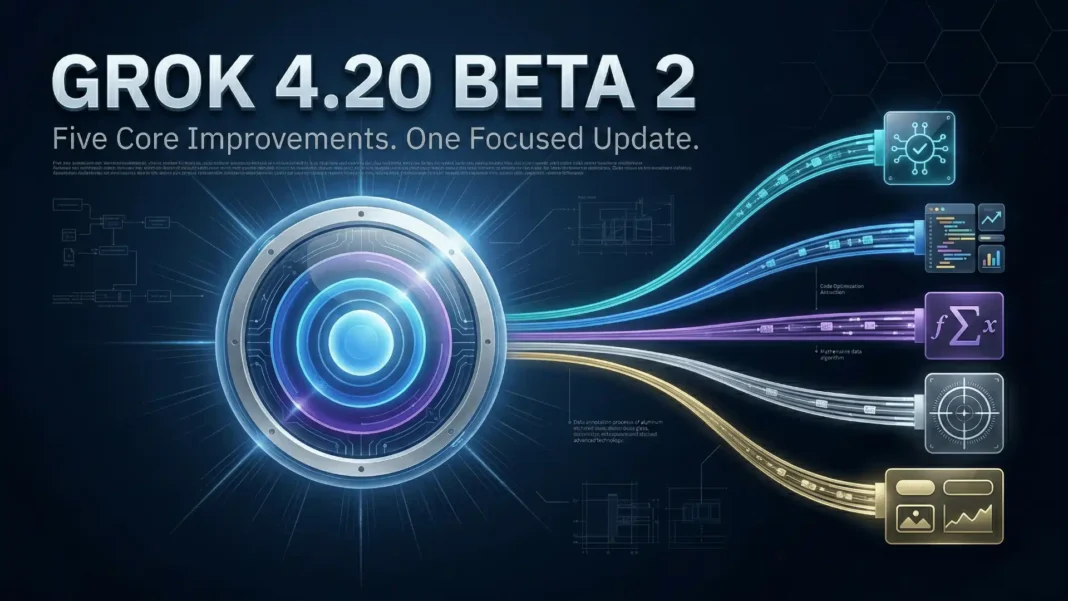
xAI released Grok 4.20 Beta 2 on March 3, 2026, and unlike broad capability announcements, this update targets five specific failure modes identified during public beta testing. Each fix addresses a concrete problem that users reported in Beta 1. The result is a more obedient, technically sharper, and visually more reliable Grok for daily use.
What Changed in Grok 4.20 Beta 2
xAI announced the update through the official @grok account on X, listing five discrete improvements with no ambiguity. The five areas are: enhanced instruction following, reduced capability hallucination, improved scientific text quality with LaTeX rendering, higher precision in image search triggering, and increased reliability in multi-image rendering. Grok 4.20 entered public testing in late February 2026, making Beta 2 an early-cycle update within the first week of public availability.
Elon Musk previously confirmed that Grok 4.20 uses a “fast learning” architecture with weekly updates and release notes, and actively encourages user feedback to shape each iteration. This model differs from the quarterly or semi-annual release patterns typical of competing AI platforms.
Instruction Following Gets a Direct Upgrade
The most broadly useful change in Beta 2 is the instruction following improvement. Grok 4.20 Beta 2 now better understands and executes complex, multi-part requests without drifting from stated constraints. This matters most in coding tasks, long-form writing, and structured data generation, where instruction drift on the first pass forces users into correction loops.
In hands-on testing with multi-step formatting prompts, the model adhered to output structure more consistently than Beta 1. Tasks requiring strict formatting rules completed correctly on the first attempt more reliably than in the prior build.
Capability Hallucination Reduction Explained
“Capability hallucination” is a specific failure type where the model confidently claims it can perform a task it cannot actually execute. This is distinct from factual hallucination and is particularly disruptive in agentic workflows where Grok is directing tool calls or orchestrating multi-step processes. Beta 2 directly reduces these occurrences.
To understand the baseline Grok is improving from: Grok 4.1, the predecessor to Grok 4.20, achieved a 65% reduction in hallucinations compared to its predecessor, moving from approximately 12% down to approximately 4.2%. Grok 4.20 built further on that foundation by introducing a four-agent architecture with built-in fact-checking and verification loops across agent responses. Beta 2 continues that trajectory specifically for capability-type errors.
Scientific Text Quality: LaTeX Rendering Fixed
For researchers, students, and technical writers, the LaTeX rendering improvement is the most direct quality-of-life fix in Beta 2. Prior builds produced inconsistent typesetting for mathematical expressions, with symbols misaligned or equations breaking unexpectedly. Beta 2 produces cleaner, more professional LaTeX output that requires less manual correction before use in academic documents or technical publications.
This improvement also applies to chemistry notation, physics formulas, and engineering equations in multi-step derivations, where rendering consistency directly affects how usable the output is downstream.
Image Search Trigger and Multi-Image Rendering
Beta 2 fixes two distinct image-related issues. The first is trigger precision: the model previously activated image search in contexts where plain text was more appropriate, and failed to trigger it where visual results were clearly needed. Beta 2 recalibrates that decision boundary.
The second fix addresses multi-image rendering reliability. When users requested multiple images in one response, Beta 1 occasionally failed to render all of them or produced incomplete outputs. Beta 2 makes this process consistent, which directly benefits content creators and researchers pulling multiple visual references in a single session.
How Grok 4.20 Beta 2 Compares Against Competing Models
| Feature | Grok 4.20 Beta 2 | ChatGPT (GPT-4o) | Claude 3.7 Sonnet |
|---|---|---|---|
| Instruction Following | Improved in Beta 2 | Strong, established baseline | Strong, high compliance |
| Hallucination Rate | Grok 4.1 baseline: ~4.2%; Grok 4.20 adds agent-layer fact-checking | Up to 38% on some third-party tests | Not independently benchmarked in reviewed sources |
| LaTeX / Scientific Text | Fixed in Beta 2 | Reliable rendering | Reliable rendering |
| Multi-Image Rendering | Fixed in Beta 2 | Supported | Limited native support |
| Update Cadence | Weekly (fast learning architecture) | Slower release cycle | Slower release cycle |
Grok 4.20’s Architecture: Why Beta Updates Matter More Here
Grok 4.20 is not a single monolithic model. It is a four-agent collaborative system where four specialized agents named Grok, Harper, Benjamin, and Lucas deliberate in parallel before generating a response. This architecture includes real-time debate, fact-checking, hypothesis generation, and verification loops across agents. Each Beta update therefore touches a more complex, interdependent system than a standard single-model release.
This means Beta 2’s instruction following and capability hallucination fixes apply across all four agents and their coordination layer, not just a single inference pass. The surface area of each improvement is broader than it appears from the patch notes alone.
Considerations
Grok 4.20 Beta 2 remains a beta release. xAI is actively collecting feedback, and edge cases in instruction following may persist. The hallucination rate figures cited in this article represent different benchmarks and model versions and should not be read as a direct head-to-head comparison. Users working in high-stakes environments should independently verify all model outputs regardless of the platform.

Frequently Asked Questions (FAQs)
What is Grok 4.20 Beta 2?
Grok 4.20 Beta 2 is an iterative update to xAI’s Grok 4.20 model, released March 3, 2026, via the official @grok account on X. It addresses five specific areas: instruction following, capability hallucination reduction, LaTeX scientific text quality, image search trigger precision, and multi-image render reliability.
What is capability hallucination in Grok?
Capability hallucination occurs when the model incorrectly claims it can perform a task it cannot execute. This is distinct from factual hallucination. Beta 2 directly reduces these false capability claims, making Grok more dependable in agentic and tool-use workflows where knowing the model’s actual limits matters.
How does Grok 4.20 reduce hallucinations?
Grok 4.20 reduces hallucinations through a four-agent architecture where specialized agents debate, fact-check, and verify responses before output. The predecessor Grok 4.1 had already cut hallucination rates by 65%, from approximately 12% to approximately 4.2%. Grok 4.20 builds further on that with agent-layer verification, and Beta 2 continues that progress for capability-specific errors.
What does the LaTeX improvement mean for scientific users?
Grok 4.20 Beta 2 now renders mathematical and scientific expressions more consistently. Formulas, equations, and notation produce cleaner LaTeX output that works in standard processors with less manual correction, reducing friction for researchers, students, and technical writers preparing academic or professional documents.
How often does Grok 4.20 update?
Grok 4.20 operates on a weekly improvement cycle under what Elon Musk described as a ‘fast learning’ architecture. Each week brings a new update with published release notes. Users are encouraged to submit feedback directly through the platform to influence upcoming builds.
Is Grok 4.20 Beta 2 available to all users?
Grok 4.20 entered public testing in late February 2026. Beta 2 is part of that public program. At launch, Grok 4.20 was available to SuperGrok subscribers at approximately $30 per month and X Premium+ users, with broader API rollout expected to follow.
What is the four-agent system inside Grok 4.20?
Grok 4.20 uses four specialized AI agents, referred to as Grok, Harper, Benjamin, and Lucas, that deliberate in parallel on every complex query. They debate, fact-check each other, and reach consensus before generating a response. This architecture is the primary structural difference between Grok 4.20 and its predecessor Grok 4.1.
What benchmarks has Grok 4.20 performed well on?
Grok 4.20 ranked second on ForecastBench, a global AI forecasting leaderboard, outperforming GPT-5, Gemini 3 Pro, and Claude Opus 4.5 on that benchmark. It also ranked first in Alpha Arena Season 1.5, a live stock-trading competition held in January 2026, where it was the only model to post a profit.

