

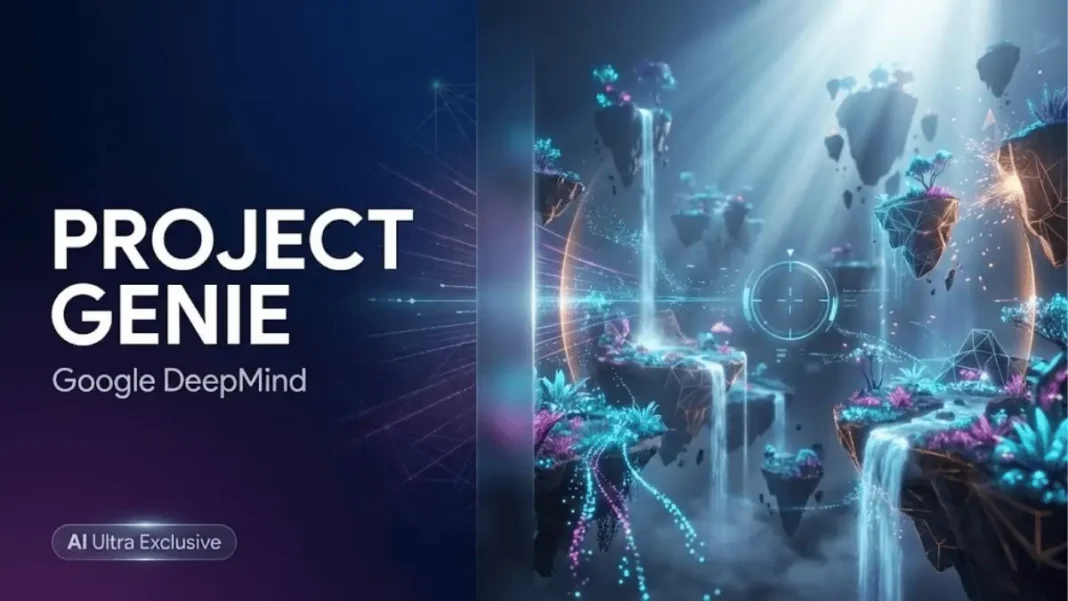
Quick Brief
- The Launch: Google deployed Project Genie on January 28, 2026, granting Google AI Ultra subscribers ($249.99/month) access to create interactive 3D worlds powered by Genie 3 world model
- The Impact: Provides real-time environment generation at 720p resolution and 24 FPS, simulating physics and interactions for dynamic worlds
- The Context: Built on Genie 3 announced August 2025, the prototype expands access beyond trusted testers to paid subscribers in experimental research phase
Google DeepMind released Project Genie to Google AI Ultra subscribers in the United States on January 28, 2026, enabling paid users to generate and navigate interactive 3D environments through text prompts and images. The experimental research prototype, available exclusively to subscribers 18 and older, expands access to Genie 3, a general-purpose world model previewed in August 2025.
Architecture: Genie 3 Powers Real-Time World Generation
Project Genie operates on three integrated AI models: Genie 3 for world simulation, Nano Banana Pro for image preprocessing and world sketching, and Gemini for prompt understanding. The system generates navigable spaces at 720p resolution and 24 frames per second, simulating physics and interactions in real time as users move through environments.
The platform delivers three core functionalities:
- World Sketching – Users input text descriptions and images to define environments, characters, and movement modes including walking, flying, and driving; Nano Banana Pro provides preview controls and perspective adjustments (first-person or third-person)
- World Exploration – Real-time path generation as users navigate, with dynamic camera controls responding to user actions
- World Remixing – Modification of existing worlds through prompt variations, with curated gallery access and video download capability
Technical specifications reveal generation limits of 60 seconds per session. Google disclosed known limitations including non-photorealistic outputs, prompt deviation, physics inaccuracies, reduced character controllability, and potential control latency.

Model Capabilities and Development Status
Genie 3 generates environments that simulate “any real-world scenario from robotics and modelling animation and fiction, to exploring locations and historical settings,” according to Google DeepMind. Unlike static 3D snapshots, the system generates forward paths in real time based on user movement and interaction.
Promptable events dynamic world changes triggered during exploration remain unavailable in the current prototype despite being demonstrated during the August 2025 preview. Google frames world models as supporting its AGI mission by enabling systems to “navigate the diversity of the real world” beyond specific environments like Chess or Go.
Access Requirements and Subscription Details
Project Genie requires a Google AI Ultra subscription at $249.99 per month, currently limited to U.S. users aged 18 and older. The subscription bundles Project Genie with Veo 3 video generation, Flow filmmaking tools, Project Mariner, 30TB cloud storage, and YouTube Premium.
New subscribers receive a 50% discount for the first three months. Google stated international expansion will occur “in due course” without providing specific timelines.
Technical Specifications
| Feature | Specification |
|---|---|
| Resolution | 720p |
| Frame Rate | 24 FPS |
| Generation Limit | 60 seconds per session |
| AI Models | Genie 3, Nano Banana Pro, Gemini |
| Interactivity | Real-time path generation |
| Access | Google AI Ultra subscription |
| Pricing | $249.99/month |
| Availability | U.S. only, 18+ |
Development Roadmap and Limitations
Google Labs categorizes Project Genie as an “experimental research prototype” in early development. The company deployed the system to gather user feedback after internal testing with trusted testers across industries and domains.
Known improvement areas include achieving photorealistic outputs, improving prompt adherence, enhancing physics accuracy, and reducing character control latency. Google stated its goal is “to make these experiences and technology accessible to more users” following the U.S. rollout phase.
The August 2025 Genie 3 preview demonstrated capabilities including dynamic world modification through promptable events, which have not yet been integrated into the Project Genie prototype. Google has not disclosed timelines for feature parity between the research model and public-facing prototype.

Frequently Asked Questions (FAQs)
What is Google Project Genie?
Project Genie is an experimental AI prototype enabling users to create and explore interactive 3D worlds through text and image prompts, powered by Genie 3 world model.
How much does access to Project Genie cost?
Access requires Google AI Ultra subscription at $249.99/month, currently available only to U.S. users 18 and older with 50% discount for the first three months.
What is a world model in AI?
A world model simulates environmental dynamics and predicts how actions affect them in real time, enabling interactive spatial experiences rather than passive content.
When will Project Genie launch globally?
Google stated international expansion will occur “in due course” without providing specific timelines beyond the January 28, 2026 U.S. launch.
What are the technical specifications of Project Genie?
Project Genie generates environments at 720p resolution, 24 FPS, with 60-second generation limits per session.

