

Quick Brief
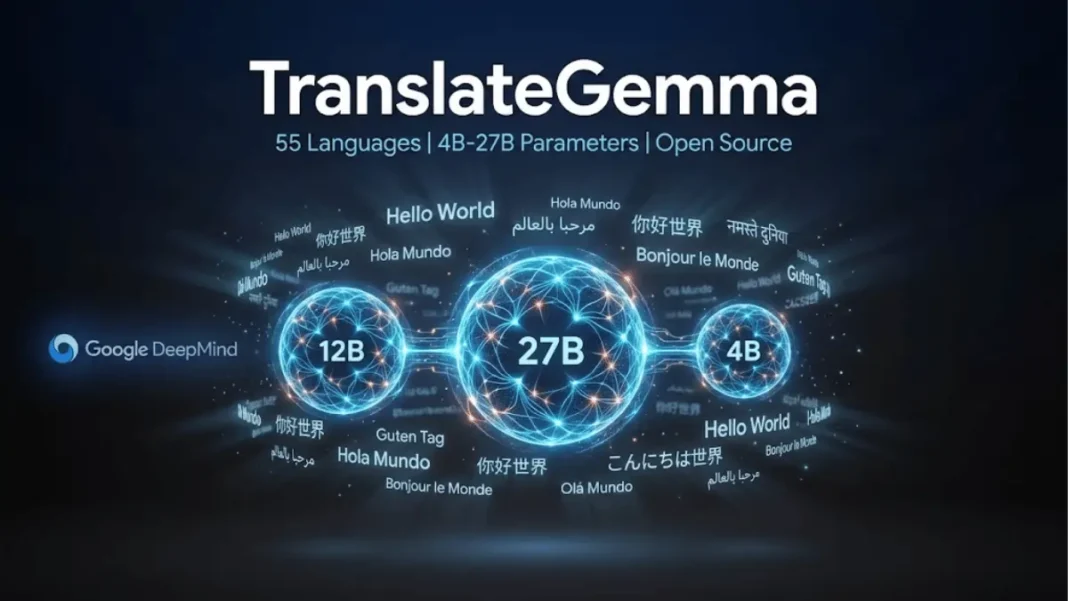
- The Launch: Google DeepMind released TranslateGemma on January 14, 2026 a suite of open-source translation models in 4B, 12B, and 27B parameter configurations supporting 55 rigorously evaluated languages
- The Efficiency: The 12B model achieves a MetricX score of 3.60 on WMT24++ benchmarks, outperforming the 27B baseline (3.09) with less than half the parameters
- The Reach: Available immediately on Hugging Face, Kaggle, and Vertex AI, with deployment options spanning mobile devices (4B), consumer laptops (12B), and cloud infrastructure (27B)
- The Context: This release advances Google’s open-source AI strategy amid escalating enterprise demand for multilingual content generation and localization workflows
Google DeepMind launched TranslateGemma on January 14, 2026, introducing three open-weight translation models built on the Gemma 3 architecture that handle 55 languages across mobile, desktop, and cloud environments. The release marks a strategic shift toward democratizing state-of-the-art translation technology through parameter-efficient models distilled from Google’s proprietary Gemini systems.
Technical Architecture
TranslateGemma employs a two-stage training methodology combining supervised fine-tuning with reinforcement learning. The models processed 4.3 billion tokens during supervised fine-tuning and 10.2 million tokens during the reinforcement learning phase, trained on TPUv4p, TPUv5p, and TPUv5e hardware using JAX and ML Pathways. Google refined translations through an ensemble of reward models including MetricX-QE and AutoMQM.
This distillation process enables the 12B variant to achieve a WMT24++ MetricX score of 3.60 outperforming the 27B Gemma 3 baseline (3.09) where lower scores indicate higher quality. The 4B model scores 5.32 while rivaling the performance of the larger 12B baseline from previous generations, making it viable for on-device inference on mobile hardware. Google trained the suite on nearly 500 additional language pairs beyond the core 55, though evaluation metrics for this extended set remain unconfirmed.

Deployment Specifications
| Model Size | Target Environment | Hardware Requirement | WMT24++ Score |
|---|---|---|---|
| 4B | Mobile/Edge | Smartphones, IoT devices | 5.32 |
| 12B | Consumer Laptops | Standard workstations | 3.60 |
| 27B | Cloud Infrastructure | Single H100 GPU or TPU | 3.09 |
Developers can access TranslateGemma through Hugging Face repositories, Kaggle notebooks, or deploy directly via Google’s Vertex AI platform. The models operate under an open-weights license, enabling fine-tuning for domain-specific translation tasks. TranslateGemma retains Gemma 3’s multimodal capabilities, supporting translation from images containing text.
Market Implications
TranslateGemma enters a translation AI landscape shifting from neural machine translation to large language model-based content generation throughout 2026. The release directly competes with proprietary systems by offering transparency and customization critical factors for enterprises managing multilingual content at scale. Google’s timing coincides with its December 2025 integration of Gemini translation capabilities into Google Translate, demonstrating a dual-track strategy of consumer services and developer tools.
The open-source positioning enables research institutions and startups to build specialized translation systems without infrastructure costs associated with training foundation models from scratch. Sarvam AI’s recent deployment of a Gemma 3-based model translating 22 Indian languages illustrates this adaptation pathway for regional language coverage.
What’s Next
Google plans community-driven exploration of the 500 extended language pairs, encouraging researchers to publish evaluation metrics and fine-tune models for low-resource languages. The company has not disclosed a roadmap for additional model sizes or enhanced multimodal features, though its concurrent development of real-time speech-to-speech translation suggests future integration possibilities.
Adoption metrics will surface through Hugging Face download statistics and Vertex AI usage patterns over Q1 2026. Industry observers expect enterprises to benchmark TranslateGemma against Meta’s NLLB-200 and Microsoft’s translation APIs, particularly for cost-per-translation comparisons in cloud versus on-premise deployments.

Frequently Asked Questions (FAQs)
What is TranslateGemma and how many languages does it support?
TranslateGemma is Google DeepMind’s open-source translation model suite built on Gemma 3, rigorously evaluated across 55 languages with training extended to nearly 500 language pairs.
How does TranslateGemma 12B compare to larger translation models?
The 12B model outperforms the Gemma 3 27B baseline on WMT24++ benchmarks using MetricX, delivering superior quality with less than half the parameters through specialized distillation training.
Where can developers deploy TranslateGemma models?
Models are available on Hugging Face, Kaggle, and Vertex AI. The 4B runs on mobile devices, 12B on consumer laptops, and 27B requires a single H100 GPU or TPU.
What training methodology powers TranslateGemma’s accuracy?
Google used two-stage fine-tuning: supervised learning on human-translated and Gemini-generated data, followed by reinforcement learning guided by MetricX-QE and AutoMQM reward models.
Which devices can run TranslateGemma translation AI?
The 4B model operates on smartphones and edge devices, 12B on standard laptops, and 27B on cloud servers with single H100 GPU or TPU hardware.

