

Quick Brief
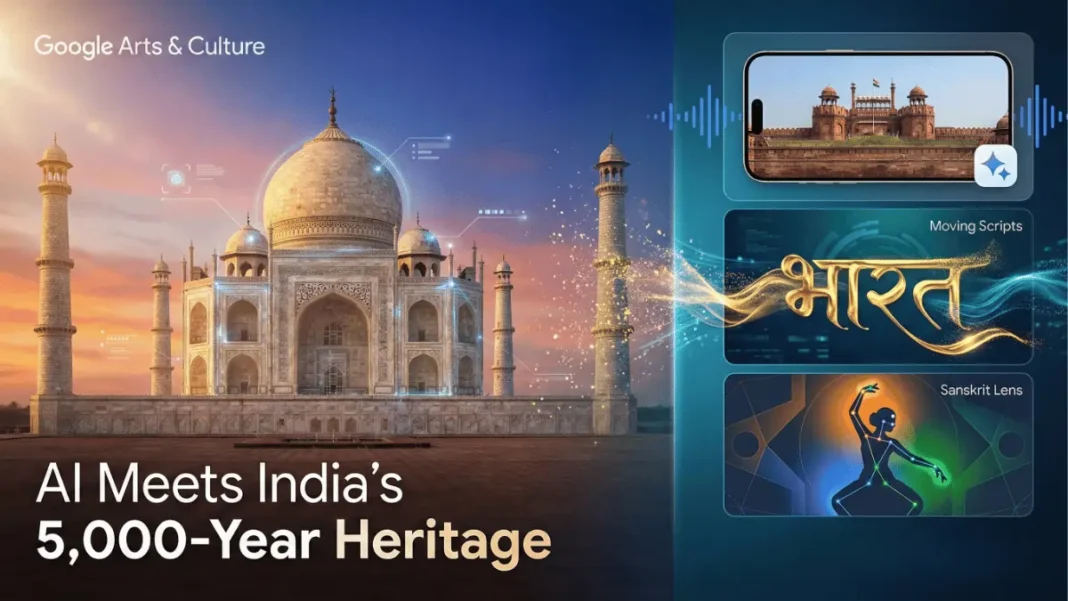
- Talking Tours India Edition uses Gemini to power interactive dialogues at 200+ iconic sites including Red Fort and Taj Mahal
- Moving Scripts Sanskrit Edition visualizes Devanagari letters using Google’s Veo video model and Nano Banana image generator
- Sanskrit Lens by Harshit Agrawal interprets 2,000-year-old Rasa theory through MediaPipe Pose and Imagen AI
- Launch timed with India AI Impact Summit 2026 (February 19-20) at Bharat Mandapam, New Delhi
Google has fundamentally redefined how artificial intelligence preserves cultural heritage and three new tools launched ahead of India AI Summit 2026 prove it. Announced February 11, 2026, Google Arts & Culture introduced experiences that transform passive viewing into active conversation, ancient scripts into cinematic motion, and classical aesthetics into interactive art. These aren’t experimental demos they’re fully deployed tools addressing cultural preservation through advanced AI models.
Talking Tours India Edition: Gemini Becomes Your Heritage Guide
Google Arts & Culture deployed Gemini’s advanced reasoning across 200+ Indian landmarks, creating real-time audio tours that respond to specific visual elements. The system analyzes Street View panoramas from Hampi’s ancient structures to Gujarat’s Rani Ki Vav and generates contextually aware guides in English and Hindi.
How it works: Users navigate 360-degree Street View imagery and press “Snapshot” for instant information. Gemini processes GPS data and visual context to produce descriptive scripts converted into natural-sounding audio. The AI generates three follow-up questions based on current views, encouraging deeper engagement beyond typical virtual tours.
Coverage spans architectural marvels (Red Fort, Taj Mahal), archaeological sites (Khandagiri Caves), and cultural institutions (Ramoji Film City in Hyderabad). Google Arts & Culture Lab artists Emmanuel Durgoni and Gaël Hugo created the experience with Google India teams.
India AI Impact Summit 2026 Context
The February 11 announcement preceded the India AI Impact Summit 2026 by eight days the first global AI summit hosted in the Global South. The main summit runs February 19-20, 2026 at Bharat Mandapam in New Delhi, with extended exhibitions and sessions February 16-20.
Prime Minister Narendra Modi delivers the opening address February 19, with confirmed attendees including Google CEO Sundar Pichai, OpenAI’s Sam Altman, Nvidia’s Jensen Huang, Anthropic’s Dario Amodei, DeepMind’s Demis Hassabis, Microsoft President Brad Smith, and Qualcomm CEO Cristiano Amon. The summit features 400 exhibitors and over 35,000 registered participants from 100+ countries.
This strategic timing positions Google’s cultural AI tools within India’s broader digital initiatives. With major tech companies competing for influence in India’s fast-growing market, Google’s heritage-focused approach offers differentiation beyond enterprise automation.
Moving Scripts Sanskrit Edition: Ancient Language Meets Video AI
Google applied Veo (its advanced video generation model) and Nano Banana (image generation) to visualize Sanskrit Devanagari letters as cinematic sequences. The experience treats Sanskrit, one of the world’s oldest systematic languages, as what the official announcement describes as “a meticulously engineered science of vibration and sound”.
Building on previous Moving Archives and Moving Paintings projects, Moving Scripts transforms ink into explorations of visual wisdom embedded within the alphabet. Each letter becomes animated sequences connecting linguistic structure to conceptual representations.
The technical achievement lies in AI interpretation of phonetic roots: Veo generates video representations of sounds forming language foundations, while Nano Banana creates accompanying imagery. This marks application of generative video AI to ancient linguistic visualization.
Sanskrit Lens: Interactive Art Bridging 2,000-Year Aesthetics
Bangalore-based artist Harshit Agrawal created Sanskrit Lens through Google Arts & Culture Lab’s long-term residency program. The digital artwork interprets Rasa theory from the Nāṭya Śāstra India’s foundational 2,000-year-old text on aesthetics codifying nine essential human emotions.
The technical integration: Google’s MediaPipe Pose tracks user movements, which interact with abstract artworks Agrawal generated using Imagen (Google’s text-to-image model). Each gesture visualizes the “essence” or “flavor” of one of nine Rasa emotions identified in Sanskrit texts.
Agrawal explained: “Using Google technology to explore something as fundamental to Indian aesthetic theory as Rasas has been fascinating for me; it carries through an essential part of my practice exploring how technology enables not only a preservation of cultural material but an active engagement with it“. Google Arts & Culture Lab artists-in-residence Mélanie Fontaine and Simon Doury collaborated on the project.
The artwork officially debuted at India AI Impact Summit 2026 after a behind-the-scenes preview film shared in the February 11 announcement.
Google’s Decade-Long India Heritage Strategy
These three 2026 tools extend partnerships Google Arts & Culture established over ten years with Indian institutions and artists. Previous collaborations include:
- Raja Ravi Varma’s timeless lithographs digitization
- Indian Miniatures precision artwork archives
- Crafted in India showcase featuring traditional artisans
- Contemporary artist Jitish Kallat collaboration
The 2026 AI tools represent an evolution from passive digitization (scanning museum collections) to active interpretation (generative AI creating new educational formats). This shift addresses challenges physical heritage sites face: environmental damage, limited public access, and engagement barriers for younger audiences.
Technical Architecture and AI Model Integration
The three experiences demonstrate multimodal AI integration across Google’s model ecosystem:
Talking Tours India Edition:
- Gemini processes visual Street View data and geographic context
- Natural language generation creates historically accurate narration
- Text-to-speech conversion produces English and Hindi audio
- Question generation system encourages interactive exploration
Moving Scripts Sanskrit Edition:
- Veo video model generates cinematic letter animations
- Nano Banana creates supporting visual imagery
- AI interprets phonetic and conceptual Sanskrit elements
Sanskrit Lens:
- MediaPipe Pose tracks real-time user movement
- Imagen generates abstract artwork representing Rasa emotions
- Interactive system maps gestures to nine aesthetic states
Access the experiences through the Google Arts & Culture website at artsandculture.google.com or via Android and iOS mobile apps.
Limitations and Technical Considerations
While Google’s AI heritage tools advance cultural preservation technology, several constraints exist:
Language support: Talking Tours currently offers English and Hindi only, excluding India’s 22 officially recognized languages. Regional language expansion would improve accessibility for non-English speakers.
Internet infrastructure requirements: High-quality Street View and AI-generated content demand stable broadband connections, potentially limiting access in areas with connectivity challenges.
Cultural interpretation accuracy: AI-generated historical narratives require verification by subject matter experts to ensure factual accuracy and appropriate cultural context.
Technical requirements: Advanced features may require recent smartphone models and sufficient data plans for optimal performance.

Frequently Asked Questions (FAQs)
What is Talking Tours India Edition?
Talking Tours India Edition is a Google Arts & Culture experience using Gemini AI to create interactive audio guides for 200+ Indian landmarks. Users explore Street View panoramas and receive real-time historical context in English and Hindi.
How does Google’s Moving Scripts visualize Sanskrit?
Moving Scripts Sanskrit Devanagari Edition uses Google’s Veo video model and Nano Banana image generator to transform Sanskrit letters into cinematic sequences. The AI interprets phonetic roots and sound vibrations as described in the official Google announcement.
Who created Sanskrit Lens artwork?
Bangalore-based artist Harshit Agrawal created Sanskrit Lens through Google Arts & Culture Lab’s residency program. The interactive artwork uses MediaPipe Pose and Imagen AI to visualize the nine Rasa emotions from India’s 2,000-year-old Nāṭya Śāstra aesthetics text.
When is India AI Impact Summit 2026?
India AI Impact Summit 2026’s main sessions run February 19-20, 2026 at Bharat Mandapam in New Delhi, with extended exhibitions February 16-20. Prime Minister Modi delivers the opening address February 19. The summit is the first global AI summit hosted in the Global South.
Which Indian landmarks are included in Talking Tours?
Talking Tours covers Red Fort, Taj Mahal, Hampi’s ancient structures, Gujarat’s Rani Ki Vav, Khandagiri Caves, and Ramoji Film City in Hyderabad among 200+ total locations across India.
What AI models power Google’s heritage tools?
The heritage tools use Gemini for interactive dialogue, Veo for video generation, Nano Banana for image creation, MediaPipe Pose for movement tracking, and Imagen for text-to-image artwork generation. Each model handles specific aspects of the cultural experiences.
How can I access Google’s AI heritage experiences?
Access Talking Tours India Edition, Moving Scripts Sanskrit Edition, and Sanskrit Lens through the Google Arts & Culture website at artsandculture.google.com or via Android and iOS mobile apps. All three experiences launched February 11, 2026.
Who are the confirmed speakers at India AI Summit 2026?
Confirmed speakers include Google CEO Sundar Pichai, OpenAI’s Sam Altman, Nvidia’s Jensen Huang, Anthropic’s Dario Amodei, DeepMind’s Demis Hassabis, Microsoft President Brad Smith, and Qualcomm CEO Cristiano Amon. Prime Minister Narendra Modi delivers the opening address.

