

Quick Brief
- The Launch: GitHub released the Copilot SDK on January 14, 2026, in technical preview across Node.js/TypeScript, Python, Go, and .NET, enabling programmatic access to Copilot CLI capabilities.
- The Impact: Developers can now embed production-grade AI agent workflows multi-model orchestration, tool calling, and MCP integration directly into applications without building custom infrastructure.
- The Context: Launches amid a $52.62 billion projected AI agents market by 2030 (46.3% CAGR), as full AI implementations by organizations increased 282% in 2025, with 96% of CIOs planning AI agent deployments within two years.
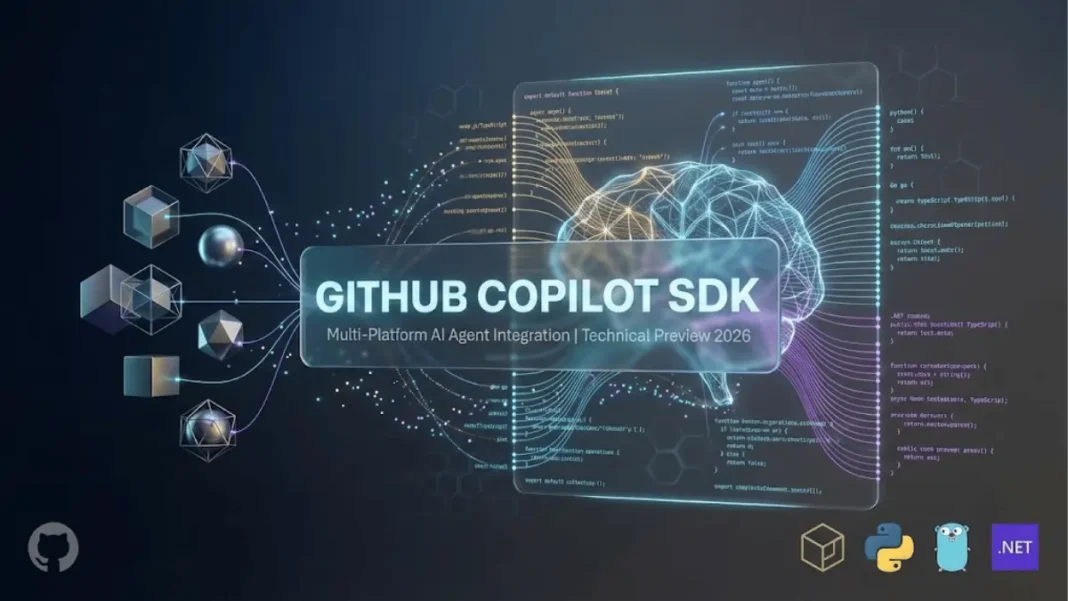
GitHub announced the Copilot SDK technical preview on January 14, 2026, delivering language-specific SDKs that provide programmatic access to the GitHub Copilot CLI runtime. The SDK brings multi-step planning, multi-model orchestration, tool invocation, Model Context Protocol (MCP) integration, authentication, and streaming capabilities directly into developer applications. This release marks GitHub’s strategic move to standardize AI agent infrastructure as the developer ecosystem transitions from syntax-driven to intent-driven development paradigms.
SDK Architecture and Technical Capabilities
The Copilot SDK operates through a JSON-RPC architecture where each SDK communicates with a Copilot CLI server, managing the CLI process lifecycle automatically. Developers can also connect to external Copilot CLI servers for distributed deployments. The SDK is available across four language ecosystems: @github/copilot-cli-sdk for Node.js/TypeScript, copilot for Python, github.com/github/copilot-cli-sdk-go for Go, and GitHub.Copilot.SDK for .NET.
Core functionality includes multi-turn conversations for context-aware interactions, custom tool definition for model invocation, and full lifecycle control for managing client and session states programmatically. The SDK’s default configuration enables all first-party tools, covering file system operations, Git operations, and web requests, with customizable tool availability through client options. Native MCP support allows integration with standardized tooling protocols, extending agent capabilities beyond GitHub’s ecosystem.
Market Position in the AI Agent Infrastructure Race
The SDK enters a rapidly consolidating market where full AI implementation by organizations increased 282% from 11% to 42% in 2025. According to enterprise surveys, 96% of CIOs plan to deploy AI agents within two years, with 30% of AI budgets now dedicated to agentic AI initiatives. GitHub’s approach differs from competitors by offering a production-hardened runtime rather than a development framework.
Google’s Agent Development Kit (ADK) focuses on native integration with Vertex AI and Google Cloud services, while OpenAI’s Agents SDK emphasizes provider-agnostic design across 100+ LLMs with built-in guardrails. The strategic distinction lies in GitHub’s decision to expose Copilot’s existing infrastructure rather than creating a new framework. By providing the same orchestration layer that powers Copilot CLI, GitHub offers immediate access to production-tested error recovery, memory management, and governance capabilities. The AI agents market is projected to reach $52.62 billion by 2030, making infrastructure standardization a critical competitive factor.
Pricing Structure and Access Requirements
The SDK requires an active GitHub Copilot subscription, though developers can access the free tier of Copilot CLI with limited usage. GitHub’s current pricing structure includes Copilot Free ($0/month with 2,000 code completions), Copilot Pro ($10/month with unlimited completions and 300 premium requests), Copilot Pro+ ($39/month with 1,500 premium requests and access to all AI models), Copilot Business ($19/user/month with centralized management), and Copilot Enterprise with full organizational features.
Premium requests, which power Copilot Chat, agent mode, and code reviews, are consumed when using SDK capabilities. Students receive free Copilot Pro access through the GitHub Student Developer Pack. The SDK’s pricing model mirrors GitHub’s broader strategy of tiered access, allowing individual developers to prototype with free tiers while enterprises scale with business plans that include IP indemnity protection and audit logs.
Developer Workflow Transformation
| Feature | Previous Method | With Copilot SDK |
|---|---|---|
| Agent Execution | Manual CLI interaction | Programmatic API calls |
| Multi-Model Support | Single model per session | Runtime model switching |
| Tool Integration | Custom orchestration code | Native MCP support |
| Context Management | Session state handling | Built-in multi-turn memory |
| Error Recovery | Manual retry logic | Production-tested runtime |
The SDK fundamentally changes how developers integrate AI capabilities by shifting responsibility from implementation details to orchestration. Developers define intent and parameters while the agent handles granular execution, a paradigm shift from writing code to compiling logic flows. This abstraction layer reduces development time for agentic workflows, particularly for teams lacking specialized AI infrastructure expertise.
Enterprise Adoption Pathways and Regulatory Considerations
The technical preview phase signals GitHub’s approach to enterprise readiness, focusing on production stability before general availability. Organizations using the SDK gain access to the same runtime handling millions of Copilot users across thousands of organizations. The architecture supports centralized seat management, content exclusion policies, and SAML SSO authentication available in Business and Enterprise tiers.
Early adopters can define custom agents, skills, and tools, extending functionality with proprietary logic and integrations. The SDK’s model-agnostic design allows teams to switch between providers as licensing agreements and model capabilities evolve. This flexibility addresses a critical enterprise concern: avoiding platform lock-in as AI infrastructure rapidly consolidates. Technical preview access enables organizations to validate integration patterns before committing to production deployments.

Frequently Asked Questions (FAQs)
What is the GitHub Copilot SDK?
A technical preview SDK providing programmatic access to GitHub Copilot CLI with multi-model orchestration, tool calling, and MCP integration across Node.js, Python, Go, and .NET.
How much does GitHub Copilot SDK cost?
Requires a Copilot subscription starting at $0/month (limited), $10/month for Pro, or $19/user/month for Business. Free tier includes restricted usage.
What languages does the GitHub Copilot SDK support?
Node.js/TypeScript, Python, Go, and .NET with language-specific packages for each ecosystem.
What is Model Context Protocol in GitHub Copilot SDK?
MCP provides native support for standardized tool integration, allowing the SDK to interact with external systems and services beyond GitHub’s ecosystem.
How does GitHub Copilot SDK compare to other AI agent frameworks?
Unlike development frameworks, it exposes a production-hardened runtime with built-in error recovery and governance, reducing infrastructure development overhead.

