

Key Takeaways
- GIGABYTE released AGESA 1.3.0.0a BIOS on March 27, 2026, covering all AM5 800 Series and 600 Series motherboards
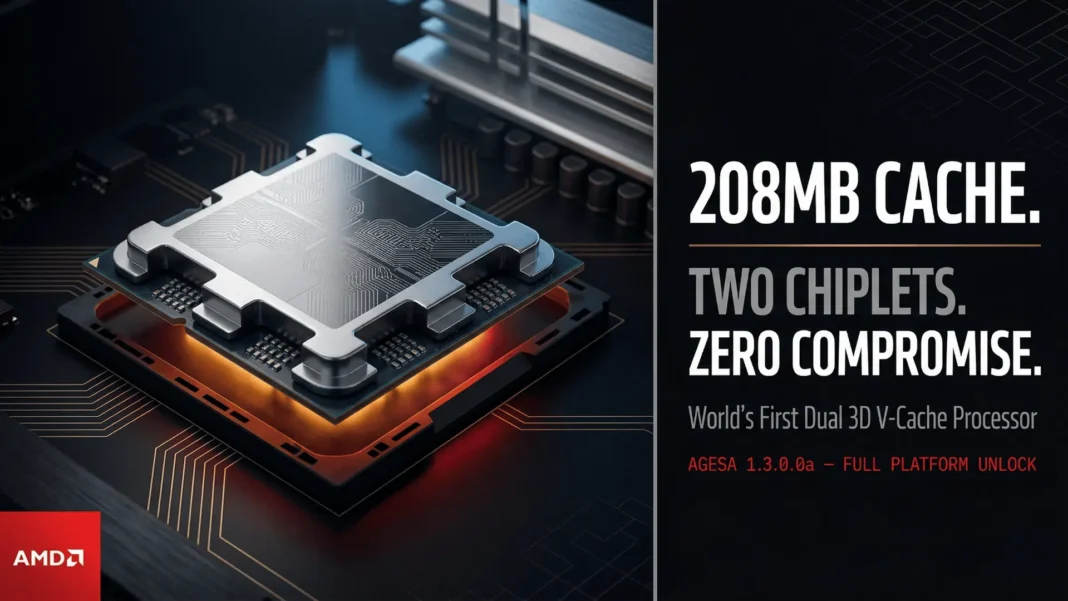
- AMD’s Ryzen 9 9950X3D2 Dual Edition stacks 3D V-Cache on both CCDs, delivering 192MB of L3 and 208MB total cache
- X3D Turbo Mode 2 uses a built-in AI model to prioritize the active task’s access to the processor’s expanded cache in real time
- AMD quotes 5 to 13 percent performance gains over the 9950X3D in workstation tasks including V-Ray, Blender, and DaVinci Resolve
AMD’s Ryzen 9 9950X3D2 Dual Edition is the first desktop processor to stack 3D V-Cache on both core complex dies simultaneously, and GIGABYTE’s AGESA 1.3.0.0a BIOS is what activates that architecture fully across its entire AM5 lineup. Released March 27, 2026, this firmware update does more than add a name to a compatibility list. It introduces a platform-level AI tuning feature, extends support to boards dating back to the 600 Series, and removes the need for a new motherboard to run AMD’s most cache-dense desktop chip to date.
AMD’s 9950X3D2: A Cache Architecture With No Precedent
Every previous X3D desktop processor applied 3D V-Cache to only one CCD. The second chiplet ran without any stacked cache, creating a latency penalty whenever a thread migrated to the uncached CCD. The 9950X3D2 Dual Edition eliminates that penalty entirely by stacking 104MB of 2nd Gen 3D V-Cache onto each CCD, bringing total L3 cache to 192MB and total combined cache including L2 to 208MB.
Boost clock sits at 5.6 GHz, 100 MHz lower than the 9950X3D’s 5.7 GHz. That reduction reflects the thermal overhead of running two stacked cache layers simultaneously. TDP rises from 170W on the 9950X3D to 200W, the highest of any AM5 processor released to date, and AMD explicitly recommends liquid cooling.
AMD quotes performance gains of 5 to 13 percent over the 9950X3D across workstation-class tasks including V-Ray, Blender, DaVinci Resolve, Unreal Engine, and large-scale source code builds such as Chromium. As AMD Senior VP Jack Huynh stated at launch: “208MB of cache means more game data, more assets, and more working data sitting right next to the CPU cores.”

GIGABYTE AGESA 1.3.0.0a: What the Update Delivers
Full performance optimization for the 9950X3D2’s expanded cache architecture. Previous AGESA versions enabled the processor to boot but did not deliver the tuned performance pathways the dual-stacked configuration requires.
X3D Turbo Mode 2 activation. GIGABYTE describes this as an exclusive platform-level feature. A built-in AI model dynamically manages background processes and thread affinity to prioritize the active task’s access to the processor’s large L3 cache, adapting to the usage scenario in real time.
Backward compatibility across AM5 600 Series and 800 Series boards. Users on GIGABYTE’s launch-era 600 Series AM5 motherboards do not need a board upgrade to run the 9950X3D2.
Q-Flash Plus support. The firmware can be applied before the CPU posts, removing the dependency on a currently compatible installed processor.
GIGABYTE had already introduced AGESA 1.2.8.0 into mass production by mid-January 2026, enabling both AMD 800 Series and 600 Series boards to boot with the 9950X3D2 ahead of the official launch. The 1.3.0.0a release delivers the fully optimized experience the platform is capable of.
Why X3D Turbo Mode 2 Operates at the BIOS Level
Standard gaming or workload optimization tools run at the OS or driver level, interacting with the thread scheduler after a task is already executing. X3D Turbo Mode 2 works differently. GIGABYTE implements it directly inside the BIOS firmware, enabling platform-level cache prioritization before thread assignment occurs.
The AI model built into the firmware manages background process suppression and thread affinity simultaneously, ensuring the processor’s 192MB of L3 cache is consistently directed at the active workload. GIGABYTE makes this accessible through a single-click activation inside the BIOS interface, with no manual thread affinity configuration required from the user.
Enthusiasts and professionals running content creation workloads alongside background tasks are the primary target. Gaming sessions running parallel to streaming software, and multi-application rendering pipelines, represent the use cases GIGABYTE specifically cites for improved results.
How to Update Your GIGABYTE AM5 Board
GIGABYTE supports two update paths for AGESA 1.3.0.0a, and the right one depends on whether your current board can already post with an installed CPU.
- Q-Flash (in-BIOS): Boot into the BIOS, navigate to Q-Flash, load the firmware file from a USB drive, and apply. Suitable for systems already running a compatible processor.
- Q-Flash Plus (pre-boot): Place the BIOS file on a USB drive, insert it into the Q-Flash Plus port on the rear I/O panel, and press the dedicated button without any CPU installed. This method is ideal for systems receiving the 9950X3D2 as an upgrade from a processor not yet supported by the existing firmware.
The firmware is available now through GIGABYTE’s official website. Supported models span the full AM5 800 Series and 600 Series lineup.
9950X3D2 vs 9950X3D: Verified Specifications Side by Side
| Specification | Ryzen 9 9950X3D | Ryzen 9 9950X3D2 Dual Edition |
|---|---|---|
| Total L3 Cache | 128MB | 192MB |
| Total Combined Cache | 145MB | 208MB |
| Base Clock | 4.3 GHz | 4.3 GHz |
| Boost Clock | 5.7 GHz | 5.6 GHz |
| TDP | 170W | 200W |
| X3D Coverage | Single CCD | Dual CCD |
| BIOS Required (GIGABYTE) | AGESA 1.2.x | AGESA 1.3.0.0a |
| GIGABYTE Exclusive Feature | X3D Turbo Mode | X3D Turbo Mode 2 |
| Launch Date | March 12, 2025 | April 22, 2026 |
| Cores / Threads | 16 / 32 | 16 / 32 |
| Architecture | Zen 5 | Zen 5 |
| Cooler Recommendation | Air or Liquid | Liquid (AMD official) |

Where the 9950X3D2 Has Real Trade-Offs
The 200W TDP is not a paper figure. AMD’s own recommendation calls for liquid cooling, and users on compact or budget cooling setups will face thermal throttling under sustained all-core workloads. The 100 MHz boost clock reduction compared to the 9950X3D also means workloads that rely on single-threaded peak clock speed rather than cache bandwidth will see a smaller benefit, or in some cases no improvement at all. Pricing has not been officially confirmed ahead of the April 22, 2026 launch, so total cost of ownership including a compatible cooler remains an open variable at time of publication.

