

Key Takeaways
- Global generative AI in metaverse market grows from USD 59.89 million in 2025 to USD 73.28 million in 2026
- Procedural content generation leads all functionality segments with approximately 33% market share in 2025
- Entertainment and gaming holds approximately 32% of end-user demand, the largest single segment in 2025
- North America dominates with 34% share; Asia Pacific records the fastest CAGR at 22.3% through 2035
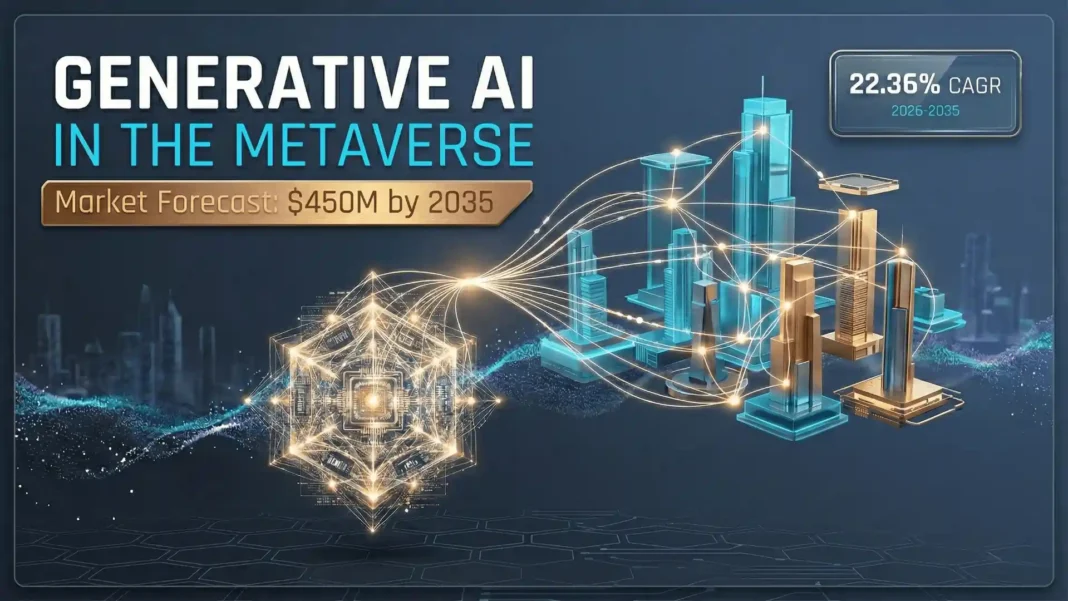
Generative AI is no longer a feature the metaverse experiments with it is the infrastructure the metaverse now runs on. A market valued at USD 59.89 million in 2025 is projected to reach USD 450.54 million by 2035, compounding at a CAGR of 22.36%. This analysis breaks down where that growth originates, which segments lead, and what it means for developers, investors, and digital users navigating the space in 2026.
Why the Generative AI Metaverse Market Is Accelerating in 2026
The core driver is development efficiency. Generative AI allows creators to build 3D assets, virtual environments, and interactive characters at a fraction of traditional production time and cost, directly reducing the barrier to metaverse content creation. What previously required large specialist engineering teams and months of manual work now runs on automated pipelines that update continuously without reworking from scratch.
A peer-reviewed study published in August 2025 by researchers at Beihang University, Yale University, and Hong Kong University of Science and Technology confirms this structural shift: traditional content creation methods are “labor-intensive and time-consuming and require significant domain expertise, making them inadequate for the real-time and large-scale demands of the Metaverse“. Generative AI resolves this directly by enabling the efficient and cost-effective creation of dynamic digital content at scale.
Businesses across entertainment, gaming, employee training, and design are integrating generative AI to automate content creation, customize user experiences, and enhance workflows. This broad adoption across industries is what sustains the 22.36% CAGR projected through 2035.

Who Controls the Market: Platforms, Functions, and End Users
VR Platforms Lead, AR Platforms Grow Fastest
Virtual reality platforms held approximately 31% of the market in 2025. VR fully relies on AI to create 3D spaces, characters, and engaging storylines, and generative AI reduces manual asset development while enabling more natural non-player character behavior in gaming. Advances in VR hardware and software, alongside rising enterprise investment in immersive simulations for healthcare, manufacturing, and defence, are sustaining this segment’s dominance.
Augmented reality platforms are growing at the fastest CAGR during the forecast period. Generative AI supports real-time object recognition, contextual content creation, and personalization in AR applications. Retailers are using AI-powered AR for virtual try-ons and interactive shopping, while healthcare institutions apply it for 3D surgical planning models.
Procedural Content Generation Dominates by Function
The procedural content generation segment held approximately 33% of the functionality market in 2025. AI systems generate large-scale virtual worlds based on predefined rules, reducing development time and cost while enabling continuous content updates without rebuilding from scratch. This makes the technology particularly suited for gaming studios and educational simulation platforms that require scalable, adaptive content.
NLP for virtual interactions is projected to grow at the fastest CAGR among all functionality segments. Instead of fixed commands and scripted responses, users can speak or type naturally and receive contextually meaningful replies, making virtual environments feel less mechanical and more conversational. In workplace settings, virtual assistants guided by NLP can support employee training, answer questions, and conduct onboarding in real time.
Entertainment and Gaming Drive End-User Demand
| End-User Segment | 2025 Market Share | Key Application |
|---|---|---|
| Entertainment and Gaming | ~32% | AI-generated NPCs, dynamic storylines, virtual concerts and events |
| Healthcare and Education | Fastest-growing CAGR | Surgical simulations, adaptive training scenarios |
| Social Media and Communication | Emerging | AI-driven avatars, personalized virtual social spaces |
Game developers use AI tools to design virtual worlds, characters, and complex storylines, reducing development timelines while increasing variety and replayability. Entertainment companies produce virtual events and concerts in AI-built immersive spaces, attracting broader audiences through personalized interactive experiences.
The Regional Map: North America Leads, Asia Pacific Accelerates
North America held approximately 34% of the global market in 2025, with the regional market valued at USD 20.36 million. Its advantage stems from advanced research institutions, wide cloud and AI infrastructure adoption, and strong partnerships between academia and industry across entertainment, gaming, and enterprise training verticals. The U.S. market alone was valued at USD 15.27 million in 2025 and is forecast to reach USD 117.82 million by 2035, growing at a CAGR of 22.67%.
Silicon Valley, Seattle, and Boston innovation corridors host the startups and firms pushing generative AI and immersive application development forward, while government funding for AI research institutes reinforces the region’s structural lead. Gaming studios and enterprise companies in the U.S. are deploying generative AI to build larger, more interactive digital worlds and employee training simulations simultaneously.
Asia Pacific is forecast to grow at the fastest CAGR of 22.3% through 2035. Rapid digitalization, rising internet access, government-backed digital transformation policies, and expanding 5G infrastructure all support this trajectory. Local companies are investing in AI, VR, and AR across gaming, social media, entertainment, and e-commerce.
India is a particularly significant growth contributor, driven by expanding startup activity, rising developer interest, a growing digital user base, and government policies supporting AI infrastructure development. Indian technology companies are implementing generative AI for gaming, marketing, education, and virtual training, with many startups building cost-effective, scalable solutions for both domestic and international clients.
What Generative AI Actually Does Inside the Metaverse
The peer-reviewed research from Beihang University, Yale, and HKUST identifies the specific technical functions generative AI performs in virtual environments:
- Scene and environment generation: AI produces realistic 3D landscapes, buildings, and immersive spaces, simulating natural phenomena including flowing water, smoke, and complex textures
- Avatar and character creation: Generative models create lifelike virtual characters with controllable appearances, facial features, and adaptive behaviors, including GAN-based tools achieving sub-70ms latency for real-time avatar generation
- NLP-driven interactions: Large language models and diffusion-based NLP systems enable natural, context-aware dialogue with virtual characters, replacing scripted command structures
- Adaptive narrative generation: Transformer-based models generate dynamic storylines and interactive scenarios that evolve based on user decisions
- 3D object and asset synthesis: Diffusion models generate 3D objects from text descriptions using point clouds, meshes, and neural radiance fields, enabling real-time asset creation for virtual environments
- Video and motion generation: Models including Meta AI’s Make-A-Video and ControlNet Video transform text inputs into dynamic video sequences for use in virtual event production and world-building
Researchers note that while these capabilities markedly accelerate metaverse development, technology must be “more closely aligned with development needs to deliver a truly immersive experience,” identifying model interpretability, real-time inference constraints, and ethical governance as the primary challenges requiring resolution.
Key Players Shaping the Market
The generative AI in metaverse market is dominated by a concentrated group of enterprise technology and AI-native companies. These include:
- NVIDIA Corporation
- Microsoft Corporation
- Meta Platforms (Facebook Reality Labs)
- Alphabet Inc. (Google)
- OpenAI
- Unity Technologies
- Epic Games
- Adobe Inc.
- Amazon Web Services
- Stability AI
- Midjourney
- Anthropic
- Hugging Face
- Synthesia Ltd.
Recent industry developments reinforce this competitive structure. In September 2025, Microsoft added Anthropic’s Claude AI model to its 365 Copilot platform, signaling that enterprise AI deployments are moving toward multi-model architectures rather than single-provider dependency. In the same month, Oracle announced a USD 300 billion cloud services agreement with OpenAI, marking one of the largest infrastructure commitments in the AI sector and directly expanding the compute backbone on which metaverse AI workloads run.
Considerations and Limitations
The generative AI metaverse market remains early-stage, and structural constraints limit near-term growth velocity. VR hardware costs and access disparities continue to restrict adoption outside higher-income consumer segments in both the US and India. Peer-reviewed research identifies data quality control, model interpretability, computational efficiency, ethical governance, and the absence of standardized evaluation frameworks as the primary unresolved challenges in deploying generative AI at metaverse scale.
Diffusion models and Transformer-based systems, which deliver the highest content quality, require more than 10 GB of VRAM and carry latency between 0.8 and 10 seconds, currently limiting their use in real-time interactive scenarios. Only GAN and VAE architectures are deployable on edge devices with under 8 GB VRAM, but these lack the open-domain flexibility required for dynamic world generation.

Frequently Asked Questions (FAQs)
What is the current size of the generative AI in metaverse market?
The generative AI in metaverse market was valued at USD 59.89 million in 2025 and is projected to reach USD 73.28 million in 2026. By 2035, the market is forecast to hit USD 450.54 million, growing at a CAGR of 22.36% from 2026 to 2035, according to Precedence Research.
Which region dominates the generative AI metaverse market?
North America holds approximately 34% of the global market share as of 2025, with a regional market value of USD 20.36 million. Asia Pacific is projected to record the fastest CAGR at 22.3% through 2035, supported by 5G infrastructure expansion, government digital transformation policies, and rising AI investment.
What is the largest end-user segment in this market?
Entertainment and gaming leads with approximately 32% of end-user demand in 2025. Game developers use AI to build dynamic virtual worlds, realistic non-player characters, and adaptive storylines, while entertainment companies deploy generative AI for virtual concerts and interactive events.
How does generative AI reduce metaverse development costs?
Generative AI automates the creation of 3D environments, characters, assets, and interactive narratives using AI-driven pipelines. This eliminates the need for large specialist engineering teams and enables continuous content updates without rebuilding environments manually, directly compressing development time and cost.
What is procedural content generation in the metaverse context?
Procedural content generation uses AI systems governed by predefined rules to automatically build large-scale virtual worlds and environments. It held approximately 33% of the functionality market in 2025. Its primary advantage is scalability: virtual spaces can expand and update dynamically without manual asset creation at each stage.
What are the technical limitations of generative AI in the metaverse today?
High-quality diffusion and Transformer models require more than 10 GB of VRAM and produce latency between 0.8 and 10 seconds, restricting real-time deployment. Key unresolved challenges include data quality control, model interpretability, cross-domain integration, and the absence of standardized evaluation frameworks for immersive content.
Which functionality segment is growing fastest in this market?
NLP for virtual interactions is forecast to grow at the fastest CAGR among all functionality segments. This technology enables users to interact with virtual environments through natural speech and text, replacing scripted input structures and making virtual character interactions feel contextually responsive.
Is the generative AI metaverse market only relevant to gaming?
No. While entertainment and gaming represents the largest current segment, healthcare and education are the fastest-growing end-user categories. Medical institutions use AI-generated simulations for surgical and emergency care training. Educational platforms deploy adaptive AI scenarios that adjust difficulty in real time based on learner performance.

