

Key Takeaways
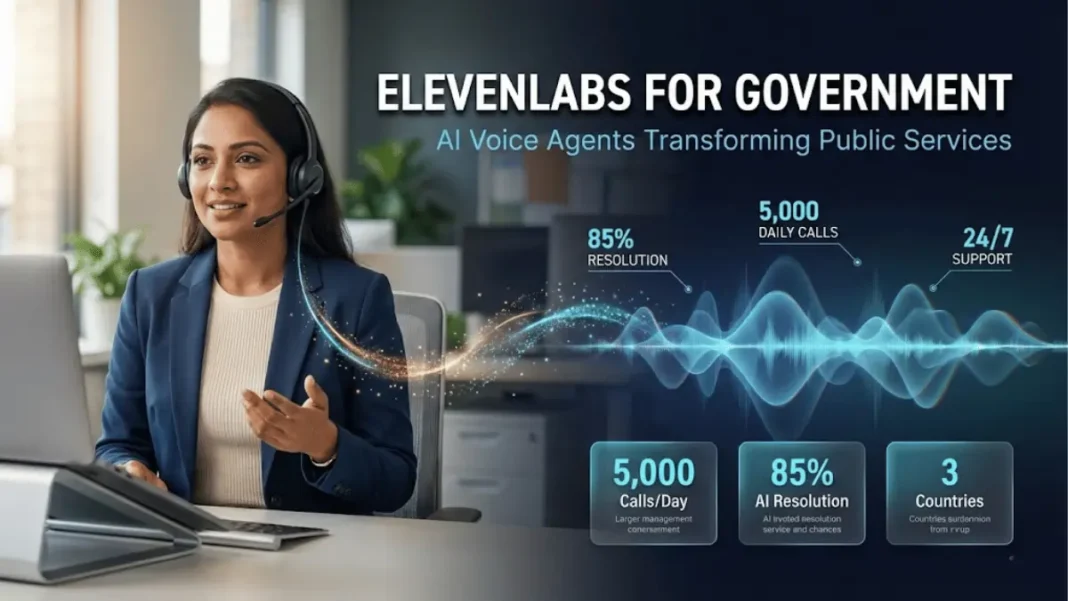
- ElevenLabs for Government handles approximately 5,000 calls daily in Czech Republic with 85% independent resolution rate
- Platform deployed across Ukraine, Czech Republic, and Midland, Texas with 24/7 multilingual support
- AI agents reduce missed calls by an estimated 7,000 per month while expanding answer rates from roughly 60% to near-universal coverage
- SOC 2 Type 2, GDPR, CPRA, HIPAA compliant ensuring public-sector-grade security for sensitive citizen data
ElevenLabs officially launched a dedicated government initiative on February 11, 2026, that changes how citizens access public services. The AI voice technology company announced ElevenLabs for Government targeting ministries, agencies, and local governments with voice and chat agents designed to replace rigid automated menus and long wait times. With deployments already operational in three countries and government AI adoption reaching 74% globally in 2026, this platform addresses the critical first moment of contact where access and responsiveness determine citizen satisfaction.
Why Government Agencies Need AI Voice Technology Now
Traditional government contact systems fail citizens at scale. Calls go unanswered, automated menus confuse rather than guide, and language barriers exclude non-native speakers from essential services. These failures compound during crises when call volume spikes and human staff become overwhelmed.
ElevenLabs for Government solves these systemic problems with conversational AI that engages citizens naturally across voice and chat channels. The platform operates 24/7 in multiple languages, understands intent with contextual awareness, and routes complex cases to human staff with full conversation history.
Nearly 90% of U.S. federal agencies now use some form of AI, according to Google Public Sector research published in January 2026. This widespread adoption reflects recognition that voice AI enables both digitally native and non-digitally native residents to interact with software-based services.

Four High-Impact Use Cases Transforming Government Services
Instant Answers for Residents
The platform resolves high-volume repetitive inquiries about operating hours, required documents, basic policy questions, and status checks across voice and digital channels. Citizens receive immediate responses instead of waiting on hold or navigating complex phone trees.
Government AI adoption data shows 30% of citizen chatbot interactions involve tax inquiries, 20% address passport applications, and 15% seek social welfare support. ElevenLabs agents handle these common requests instantly while freeing human staff for complex cases requiring judgment and empathy.
Guided Service Journeys
Multi-step processes like benefits applications, permit requests, and tax filing become manageable through conversational guidance. The AI walks residents through eligibility screening, provides instructions, assists with form completion, collects required documents, books appointments, and hands off to staff when necessary.
This guided approach reduces application abandonment and errors while accelerating processing times. Citizens receive personalized assistance rather than generic instructions that assume technical literacy.
Crisis Response Operations
Government agencies can rapidly deploy incident hotlines and outbound communication campaigns during emergencies. The AI captures structured reports, triages urgent needs based on severity, routes cases to appropriate response teams, and pushes consistent updates across channels.
Singapore demonstrated this capability during the COVID-19 pandemic when an AI-driven voice application provided real-time public health information, significantly reducing call center workloads while enhancing public trust.
Trusted Messengers and Digital Twins
Government leaders and spokespeople record messages once and have them delivered instantly in dozens of languages while preserving voice, tone, and authority. This capability ensures consistent policy communication across diverse populations without requiring multilingual staff or delayed translations.
Ukraine leverages this feature through a senior official digital twin that powers public services across different channels, enabling hundreds of thousands of natural interactions nationwide.
Real-World Deployments Demonstrate Measurable Impact
Czech Republic: National Benefits and Employment Hotlines
In the Czech Republic, ElevenLabs supports national benefits and employment hotlines with AI agents handling approximately 5,000 calls per day. These agents independently resolve around 85% of calls while dramatically increasing answer rates from roughly 60% to near-universal coverage. This deployment demonstrates how conversational AI scales government services without proportional staffing increases.
Ukraine: Strategic Digital Transformation
Ukraine partnered with ElevenLabs following a memorandum of understanding signed with Minister Mykhailo Fedorov at the IT Arena conference. ElevenLabs powers the voice layer of a senior official digital twin and continues expanding to power public services across different channels.
CEO Mati Staniszewski emphasized the collaboration aims to “add a clear human voice to digital services” that enhances speed and accessibility of public services. The digital twin enables hundreds of thousands of natural interactions with citizens.
Midland, Texas: Local Government Innovation
Midland, Texas replaced voicemail and deep IVR trees with a voice-first civic concierge named “Jacky”. The agent handles overflow calls, ensuring residents receive immediate responses rather than being dropped when all staff lines are busy.
This deployment is projected to reduce missed calls by an estimated 7,000 per month. The system currently supports English and Spanish, with additional languages planned to serve the city’s diverse population.
Technical Foundation: Security, Compliance, and Performance
ElevenLabs emphasizes public-sector-grade security and compliance as foundational requirements. The platform maintains SOC 2 Type 2, GDPR, CPRA, and HIPAA compliance, ensuring sensitive resident data is handled with the highest security standards.
This compliance framework addresses critical concerns identified in the Public Sector AI Adoption Index 2026, which found only 18% of public servants believe their governments currently use AI effectively despite 74% adoption rates. The gap between adoption and effectiveness stems from inadequate security frameworks, insufficient training, and unclear leadership guidance.
Platform Capabilities and Integration
The conversational AI agents listen, read, and interact like humans across phone, chat, email, and WhatsApp. This omnichannel approach meets citizens where they already communicate rather than forcing platform adoption.
Backend integration connects agents to government databases and information repositories for real-time data access. Citizens receive personalized service based on their specific circumstances, account history, and entitlements without repeating information across multiple touchpoints.
ElevenLabs announced a $500 million Series D funding round at an $11 billion valuation on February 3, 2026. The company plans to strengthen research capacity for emotional conversational models, dubbing, and audio intelligence.
Government AI Adoption Landscape in 2026
Public sector AI enthusiasm and adoption have accelerated dramatically. The Public Sector AI Adoption Index 2026 surveyed 3,335 public servants across 10 countries including the United States, UK, Germany, France, Japan, Brazil, South Africa, India, Singapore, and Saudi Arabia.
Key findings reveal 74% of public servants now use AI, with most adoption occurring within the past year. Additionally, 80% report AI is empowering them in their roles. However, significant gaps remain between policy ambition and practical implementation.
The research measures government effectiveness across five dimensions: enthusiasm, empowerment, enablement, embedding, and education. Countries vary significantly in their approaches, with progress in translating ambitious strategies into everyday practice remaining uneven.
India’s Rural E-Governance Initiative
India has deployed AI-powered conversational agents specifically designed for rural e-governance. These voice assistants understand regional dialects, resolve queries, and assist with government schemes to overcome language barriers, literacy challenges, and digital unfamiliarity.
The Kisan e-Mitra voice-based AI chatbot enables farmers to access PM-Kisan Samman Nidhi services in multiple languages. This approach demonstrates how voice AI eliminates technology barriers that exclude vulnerable populations from essential government support.
Implementation Through Forward Deployed Engineering
ElevenLabs assigns Forward Deployed Engineering teams to embed closely with government organizations during implementation. This hands-on approach ensures smooth, safe, and timely deployment of agents tailored to specific agency needs and regulatory requirements.
The implementation process includes system integration, workflow customization, staff training, security audits, and performance monitoring. Government partners receive dedicated support rather than generic software licenses that require in-house technical expertise.
This collaborative model addresses implementation barriers identified in government AI research, including insufficient technical capacity, unclear use cases, and inadequate change management.
Competitive Landscape and Alternative Solutions
While ElevenLabs leads in voice quality and conversational naturalness, government agencies evaluate multiple platforms based on specific requirements. Alternative solutions include Cartesia (40ms latency for time-critical applications), Resemble AI (on-premise deployment for security-first organizations), PlayHT (800+ voices for content diversity), and Smallest.ai (100ms response time).
Independent evaluations show Cartesia scoring 4.7/5, QCall.ai at 4.6/5, ElevenLabs at 4.6/5, Smallest.ai at 4.4/5, and PlayHT at 4.38/5. Human evaluators prefer Cartesia voices 81.1% of the time in blind comparisons.
Government buyers prioritize compliance frameworks, data residency options, and integration capabilities alongside voice quality. ElevenLabs typically charges $0.08 per minute for conversational AI, though enterprise pricing varies by deployment scale.
Getting Started with ElevenLabs for Government
Government agencies interested in deploying conversational AI agents can contact ElevenLabs at government@elevenlabs.io or submit a contact sales form. Initial consultation typically covers use case identification, system integration requirements, compliance framework review, pilot deployment planning, and success metrics definition.
Considerations and Limitations
Voice AI adoption in government requires careful attention to equity and inclusion concerns. Not all citizens have equal access to phones or internet connectivity, necessitating hybrid approaches that maintain traditional service channels alongside AI agents.
Privacy advocates emphasize the importance of transparent data handling policies, citizen consent mechanisms, and opt-out alternatives. The potential for AI-generated voices to impersonate senior leaders creates security risks that require robust authentication and verification protocols.
Government employees may experience anxiety about job displacement. Public sector leaders must invest in AI literacy training and clearly communicate how conversational agents enable staff to focus on complex cases requiring empathy and judgment.
Frequently Asked Questions (FAQs)
What is ElevenLabs for Government?
ElevenLabs for Government is a dedicated AI voice and chat agent platform launched February 11, 2026, designed specifically for public sector organizations. It provides 24/7 multilingual conversational support across voice and digital channels with public-sector-grade security compliance.
How much do government AI voice agents cost?
ElevenLabs typically charges $0.08 per minute for conversational AI. Government agencies should contact ElevenLabs directly at government@elevenlabs.io for custom enterprise pricing based on call volume, integration complexity, and compliance requirements.
Which countries have deployed ElevenLabs government AI agents?
ElevenLabs for Government currently operates in Ukraine (senior official digital twin and public services), Czech Republic (approximately 5,000 daily calls for national benefits and employment hotlines), and Midland, Texas USA (civic concierge reducing an estimated 7,000 missed calls monthly). The platform supports deployment in any country with multilingual capabilities.
What security certifications does ElevenLabs for Government maintain?
The platform is SOC 2 Type 2, GDPR, CPRA, and HIPAA compliant. These certifications ensure sensitive citizen data handling meets the highest security standards required for government applications involving personal information, health records, and financial data.
Can government AI voice agents understand regional dialects and accents?
ElevenLabs agents support multiple languages with contextual understanding. India specifically deployed AI voice assistants designed to understand regional dialects for rural e-governance applications. The platform can be trained on specific speech patterns to improve accuracy for diverse populations.
What percentage of government calls can AI agents resolve independently?
Czech Republic deployment data shows AI agents independently resolve approximately 85% of calls. Resolution rates vary based on use case complexity, knowledge base comprehensiveness, and handoff protocols. Simple inquiries about hours, locations, and documents achieve higher resolution than complex eligibility determinations requiring human judgment.
How quickly can government agencies deploy ElevenLabs voice agents?
Deployment timelines depend on integration complexity, security requirements, and customization needs. ElevenLabs assigns Forward Deployed Engineering teams to embed with agencies for smooth implementation. Basic FAQ and status check agents can launch within weeks, while complex guided service journeys require months for workflow mapping and testing.
Do AI voice agents replace government employees?
AI agents augment rather than replace government staff by handling routine inquiries. This allows human employees to focus on complex cases requiring empathy, judgment, and policy interpretation. Research shows 80% of public servants report AI empowers them in their roles.

