

Key Takeaways
- Skill-creator now helps authors write and run evals without writing any code
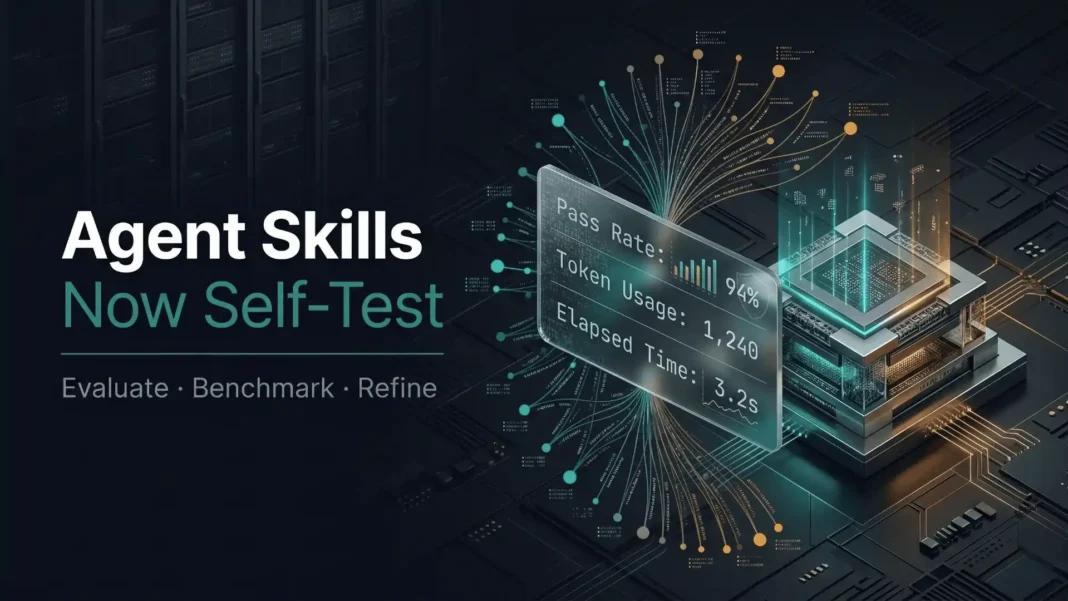
- Benchmark mode tracks pass rate, token usage, and elapsed time after every model update
- Multi-agent parallel testing eliminates context bleed between eval runs for cleaner results
- Improved triggering accuracy confirmed across 5 out of 6 Anthropic’s own public skills
Most AI tools break silently when the underlying model updates. Anthropic just changed that equation for Claude Agent Skills, and the fix requires zero engineering experience. Skill-creator now brings automated evals, parallel benchmarking, and blind A/B testing directly into the authoring workflow. Here is exactly what changed, what it means for teams building on Claude, and where this is heading.
Why Skill-Creator Needed an Upgrade
Since Anthropic launched Agent Skills in October 2025, a core problem persisted: most skill authors are domain experts, not engineers. They understood their workflows but had no reliable way to confirm whether a skill still worked correctly after a model update, whether it triggered when it should, or whether a recent edit actually improved performance.
The gap was not a lack of effort. It was a lack of infrastructure. Skill-creator’s March 2026 update addresses this directly by bringing some of the rigor of software development, specifically testing, benchmarking, and iterative improvement, into a no-code authoring environment.
 Grok 4.20 Beta 2 Prompt Engineering: The Instruction-Following Masterclass That Changes Everything
Two Skill Types, Two Testing Priorities
Understanding what to test starts with understanding what kind of skill you are building. Anthropic identifies two distinct categories.
Capability uplift skills help Claude perform tasks the base model handles inconsistently. Document creation skills are the clearest example: they encode specific patterns that reliably outperform unassisted prompting. As models improve, these skills may eventually become less necessary, and evals tell you exactly when that happens.
Encoded preference skills sequence existing Claude capabilities according to a team’s specific workflow. An NDA review process or a structured weekly update generator falls into this category. These skills are more durable but require ongoing verification that they still reflect the actual workflow they were built for.
This distinction matters for testing strategy. Capability uplift skills need monitoring against model progress. Encoded preference skills need verification against workflow fidelity.
How the New Eval System Works
Skill-creator now helps authors write evals: tests that check whether Claude does what you expect for a given prompt. Define some test prompts (include files where relevant), describe what good output looks like, and skill-creator tells you whether the skill holds up.
The practical value is immediate. Evals serve two primary purposes: catching quality regressions as models and infrastructure evolve, and knowing when a base model’s general capabilities have outgrown what the skill was built to provide.
Anthropic demonstrated this with their own PDF skill. The skill previously failed on non-fillable forms because Claude had to position text at exact coordinates with no defined fields as reference points. Evals isolated exactly where the failure occurred. The fix anchored positioning to extracted text coordinates, and the problem resolved.
Benchmark Mode: Track Changes Over Time
A single eval tells you whether a skill works today. Benchmark mode tells you whether it still works tomorrow. This standardized assessment runs across your full eval set and records pass rate, elapsed time, and token usage, creating a performance baseline you can compare against after model updates or after editing the skill itself.
Your evals and results stay with you. You can store them locally, integrate them with a dashboard, or plug them into a CI system.
This means teams running Claude-based workflows can detect model-driven performance shifts before they affect production outcomes, not after a team member notices something feels different.
Parallel Testing With Multi-Agent Support
Sequential eval runs create two problems: they are slow, and accumulated context can bleed between tests, distorting results. Skill-creator addresses this by spinning up independent agents to run evals in parallel, each in a clean context with its own token and timing metrics.
The result is faster testing with no cross-contamination between runs. For teams with large eval sets or complex skills, this represents a significant reduction in iteration time.
Alongside parallel testing, Anthropic added comparator agents that conduct blind A/B comparisons. Two versions of a skill, or skill versus no skill, are evaluated without the comparator agent knowing which output came from which configuration. This removes subjective bias from improvement assessment and produces objective data on whether a change helped or hurt.
Fixing the Triggering Problem
Evaluating output quality only matters if the skill actually activates when it should. As the number of skills in a workspace grows, description precision becomes critical. Descriptions that are too broad cause false triggers. Descriptions that are too narrow mean the skill never fires.
Skill-creator now analyzes a skill’s description against sample prompts and suggests edits that cut both false positives and false negatives. Anthropic applied this process to its own document-creation skills and measured improved triggering on 5 out of 6 public skills.
This is a meaningful operational improvement for enterprise teams managing many skills across multiple departments.
Considerations
Skill-creator’s eval tools require authors to define what “good” looks like before testing can begin. For teams without documented quality criteria, this upfront investment takes real time. Evals are only as useful as the prompts used to build them: poorly scoped test cases will produce misleadingly positive results. Teams should invest in representative, adversarial test prompts, not just typical-case scenarios.
What This Signals About the Future of Agent Skills
Anthropic is transparent about where this is heading. Today, a SKILL.md file is essentially an implementation plan that tells Claude how to perform a task in explicit detail. Over time, a natural-language description of what a skill should accomplish may be enough, with the model figuring out the rest.
The eval framework released today is a step in that direction. Evals already describe the “what.” Eventually, that description may be the skill itself.
All skill-creator updates are live now on Claude.ai and Cowork. Claude Code users can install the plugin or download from Anthropic’s repository.
Frequently Asked Questions (FAQs)
What is Claude skill-creator and what does it do?
Skill-creator is Anthropic’s authoring tool for building Claude Agent Skills. The March 2026 update helps authors write evals, run benchmarks, and keep skills working as models evolve. It brings software development rigor to skill authoring without requiring anyone to write code.
What are Claude Agent Skills?
Agent Skills are modular capability packages that extend Claude’s behavior within Claude.ai, Cowork, and Claude Code. Skills either uplift base model capabilities or encode team-specific workflows into a repeatable sequence. Anthropic launched Agent Skills in October 2025.
How do evals work in the updated skill-creator?
Authors define test prompts and describe what correct output looks like. Skill-creator runs these prompts through Claude with the skill loaded and reports pass rate, elapsed time, and token usage. Results help authors catch regressions or confirm that improvements actually worked.
What is the difference between capability uplift and encoded preference skills?
Capability uplift skills help Claude do something the base model handles inconsistently. Encoded preference skills sequence tasks Claude can already perform, but in a specific order matching a team’s workflow. Capability uplift skills may become unnecessary as models improve; encoded preference skills are more durable but need workflow fidelity checks.
Can skill-creator detect when a skill is no longer needed?
Yes. If the base model begins passing your evals without the skill loaded, that signals the skill’s techniques may have been incorporated into the model’s default behavior. The skill is not broken; it may simply no longer be necessary. Benchmark mode surfaces this signal proactively.
Who can use the new skill-creator features?
All updates are available now to Claude.ai and Cowork users. Claude Code users can install the skill-creator plugin or download it directly from Anthropic’s repository. No software engineering background is required to use evals or benchmarking.
Does skill-creator support A/B testing between skill versions?
Yes. Comparator agents run blind A/B evaluations between two skill versions or between skill-enabled and base model outputs. The comparator does not know which output came from which configuration, ensuring objective judgment on whether an edit improved performance.
Why does skill description precision matter as skill count grows?
When a workspace contains many skills, Claude must select the correct one based on description matching. Vague descriptions trigger wrong skills; overly narrow descriptions cause skills to never activate. Skill-creator analyzes descriptions against sample prompts and suggests specific edits to improve triggering accuracy.

