

Quick Brief
- Silicon One G300 delivers 102.4 Tbps switching capacity for gigawatt-scale AI clusters with 28% faster job completion
- New Cisco N9000 and 8000 systems ship with 100% liquid cooling, achieving nearly 70% energy efficiency improvement
- Intelligent Collective Networking increases network utilization by 33% through shared packet buffers and adaptive load balancing
- Systems support 1.6 Tbps OSFP optics and 800G LPO modules, reducing switch power consumption by 30%
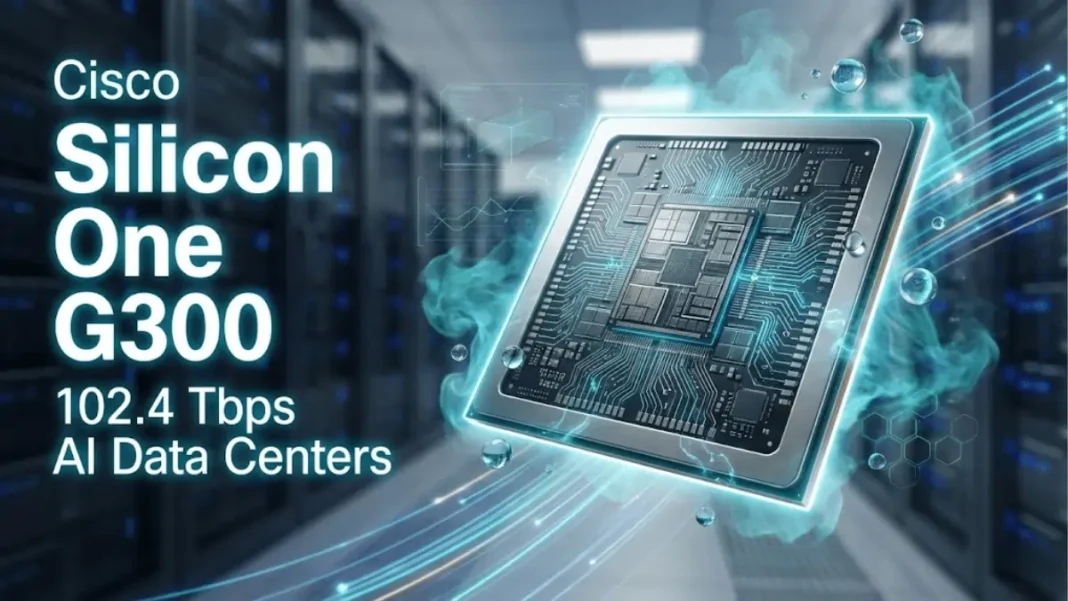
Cisco has fundamentally redefined AI data center networking with the Silicon One G300 and the performance benchmarks prove it. Announced February 10, 2026 at Cisco Live EMEA in Amsterdam, this 102.4 Tbps switching silicon directly addresses the three critical constraints choking AI infrastructure expansion: energy efficiency, GPU utilization, and operational complexity. Unlike incremental upgrades from competitors, the G300 combines hardware-level intelligence with liquid cooling to deliver measurable outcomes that translate into faster AI training and lower operating costs.
What Makes Silicon One G300 Different From Competing Chips
The G300 enters a fiercely competitive market dominated by Nvidia’s Spectrum-4 and Broadcom’s Tomahawk series, both offering similar 102.4 Tbps throughput. Cisco’s differentiation lies in Intelligent Collective Networking, a hardware architecture combining three interconnected capabilities that competing chips lack.
The system deploys an industry-leading fully shared packet buffer that absorbs bursty AI traffic without packet drops, a critical requirement since dropped packets can stall entire AI training jobs. Path-based load balancing monitors network flows in real-time and dynamically reroutes traffic around emerging bottlenecks, delivering 33% higher network utilization compared to static distribution methods. Proactive network telemetry provides job-aware visibility that correlates network performance with GPU behavior, enabling operators to identify bottlenecks before they impact training runs.
The G300’s advanced silicon architecture supports 512 lanes of 224-Gbps SerDes using both NRZ and PAM4 encoding to enable 1.6 Tbps Ethernet connectivity. This architecture powers 64-port switches running at 1.6 Tbps per port, consolidating bandwidth that previously required six separate systems into a single device.
What is the throughput capacity of Cisco Silicon One G300?
The Cisco Silicon One G300 delivers 102.4 terabits per second of full-duplex switching capacity. This throughput supports 64 ports of 1.6 Tbps Ethernet or equivalent lower-speed configurations, enabling high-density AI cluster connectivity with reduced physical infrastructure.

How G300 Improves GPU Utilization in AI Training
Network bottlenecks directly reduce GPU efficiency in distributed AI training, where thousands of processors must synchronize gradients across cluster-wide training jobs. The G300’s architecture tackles this through deterministic, congestion-free data movement that maximizes compute utilization.
Cisco’s testing demonstrates a 28% reduction in job completion time versus simulated networks using non-optimized path selection. This improvement stems from the G300’s ability to prevent the micro-stalls that occur when packets arrive out of order or buffers overflow during traffic bursts. For enterprises running LLM training or inference workloads, this translates into more tokens generated per GPU-hour, the fundamental unit of AI infrastructure economics.
The chip’s programmability enables it to adapt to emerging network protocols and use cases even after deployment. This future-proofs infrastructure investments as AI workload patterns evolve from pure training to mixed training-inference deployments and real-time agentic applications.
Liquid Cooling Systems Deliver 70% Energy Efficiency Gains
The new Cisco N9000 and 8000 systems powered by G300 ship in both air-cooled and 100% liquid-cooled configurations, with the liquid-cooled variant achieving nearly 70% energy efficiency improvement over equivalent air-cooled designs. This advancement arrives as data centers confront unprecedented power density challenges, with AI clusters pushing rack densities beyond 100 kW.
Liquid cooling systems use fluid circulation to dissipate heat fluxes exceeding 100W/cm², far surpassing the thermal management capacity of traditional air cooling. By transferring heat directly through liquid media with higher specific heat capacity, these systems reduce cooling energy consumption by up to 40%, driving power usage effectiveness (PUE) values closer to 1.0.
Cisco’s liquid-cooled switches consolidate the bandwidth of six previous-generation systems into a single device, reducing physical footprint, cabling complexity, and overall power draw. The systems support new 1.6 Tbps OSFP optics for scale-out connections between switches and network interface cards, plus 800G Linear Pluggable Optics (LPO) that cut optical module power consumption by 50% compared to retimed modules.
Combined with LPO technology across the network fabric, customers can reduce total switch power by 30%, a critical advantage as electricity costs become the dominant variable expense in AI infrastructure.
How does liquid cooling improve data center efficiency?
Liquid cooling systems use fluid circulation to manage heat dissipation, handling thermal loads exceeding 100W/cm² that overwhelm air-based cooling. This approach reduces cooling energy consumption by up to 40% and enables higher rack densities. Cisco’s liquid-cooled G300 systems consolidate six legacy systems into one device, cutting power usage by 70%.
Cisco N9000 and 8000 Systems: Hardware Built for AI Scale
The G300 silicon powers new generations of Cisco’s Nexus 9000 and Cisco 8000 platforms, designed specifically for AI back-end networking requirements. These systems address the operational reality that AI clusters require different network characteristics than traditional data center workloads, ultra-low latency, deterministic performance, and the ability to handle synchronized all-to-all traffic patterns generated during distributed training.
The Nexus 9000 series positions as the hardware foundation for diverse fabric architectures, including Nexus Hyperfabric optimized for GPU-to-GPU communication. Systems ship with unified management through Nexus One, providing a single control plane for multi-site deployments and API-driven automation capabilities.
Cisco also expanded its Silicon One P200-powered system portfolio, introducing new 51.2 Tbps switches for hyperscale, data center interconnect, and core routing applications. These P200 systems complement the G300 lineup by addressing front-end networking, spine layers, and inter-data center connections, enabling organizations to deploy a common Silicon One architecture across multiple network roles.
All new systems support 800G ZR/ZR+ coherent pluggable optics for long-distance connections, critical for distributed AI training across geographically separated data centers.
| Feature | Cisco Silicon One G300 | Nvidia Spectrum-4 | Market Context |
|---|---|---|---|
| Throughput | 102.4 Tbps | 102.4 Tbps | Industry standard for 2026 AI switches |
| Port Density | 64x 1.6 Tbps | 64x 800 Gbps | G300 doubles per-port bandwidth |
| Buffer Architecture | Fully shared packet buffer | On-chip buffer | Shared buffers handle AI traffic bursts better |
| Cooling Options | Air + 100% liquid | Air-cooled | Liquid cooling reduces energy by 70% |
| Job Completion | 28% faster | Standard performance | Cisco’s path-based load balancing advantage |
| Energy Efficiency | 70% improvement with liquid cooling | Standard efficiency | Critical for lowering operational costs |
Nexus One Platform: Unified Management for Multi-Site AI Infrastructure
Cisco enhanced Nexus One to deliver a unified management plane that consolidates silicon, systems, optics, and software into a single operational framework. This addresses a major pain point for enterprises deploying AI infrastructure: the operational complexity of managing heterogeneous network fabrics across multiple sites with different workload requirements.
The platform introduces AgenticOps for data center networking through AI Canvas, enabling troubleshooting through guided, human-in-the-loop conversations that translate complex network issues into actionable remediation steps. This capability becomes essential as AI clusters scale beyond the management capacity of traditional network operations teams.
Nexus One delivers AI job observability with network-to-GPU visibility, correlating network telemetry data with AI workload behavior. Native Splunk platform integration, launching March 2026, allows customers to analyze network telemetry directly where data resides without moving sensitive information to external platforms, a requirement for sovereign cloud deployments and compliance-sensitive environments.
The unified fabric capability lets customers deploy and adapt networks as demands shift, even across geographically distributed sites, while maintaining centralized visibility and control.
What is Cisco Nexus One’s role in AI networking?
Nexus One provides unified management for Cisco AI networking infrastructure, combining fabric deployment, job-aware observability, and AI-driven troubleshooting. The platform correlates network telemetry with GPU performance and integrates with Splunk for on-premises data analysis. This simplifies multi-site operations and accelerates fabric deployment.
Market Timing: Why AI Networking Becomes a $600 Billion Opportunity
Cisco’s G300 launch targets a market inflection point where AI infrastructure spending shifts from hyperscalers to a broader ecosystem including neoclouds, sovereign clouds, service providers, and enterprises. This expansion drives data center Ethernet switch sales to unprecedented levels, with back-end AI networks projected to push the market above $100 billion annually.
The rapid adoption of Ethernet over InfiniBand in AI deployments accelerates this trend. Just two years ago, InfiniBand accounted for nearly 80% of data center switch sales in AI back-end networks, but Ethernet’s cost advantages, operational familiarity, and ecosystem maturity have reversed that ratio. Organizations building AI infrastructure increasingly prefer Ethernet’s standards-based approach and compatibility with existing skill sets.
IDC analyst Matt Eastwood noted that network architecture has become “a defining constraint on performance, cost, and sustainability” as AI adoption scales beyond hyperscalers. The G300 directly addresses these constraints through its combination of performance, programmability, and power efficiency.
Cisco’s ecosystem partnerships with AMD, Intel, Nvidia, DDN, NetApp, and VAST Data ensure interoperability across the AI infrastructure stack, from GPUs and CPUs to storage and management layers. These validated configurations reduce deployment risk and accelerate time-to-production for organizations building AI clusters.
Technology Roadmap: When Systems Ship and What Comes Next
Silicon One G300-powered systems will ship in 2026, with Cisco providing advance access to strategic customers for validation testing. The phased rollout prioritizes hyperscale and neocloud deployments before expanding to enterprise and service provider segments.
The 1.6 Tbps OSFP optics and 800G LPO modules ship concurrently with G300 systems, ensuring customers can immediately deploy full-bandwidth configurations. Nexus One’s Splunk integration launches in March 2026, ahead of the hardware availability to allow customers to establish observability frameworks before production deployment.
Cisco’s Silicon One roadmap maintains the architectural promise introduced in 2019: a unified, programmable networking platform that serves multiple use cases through software configuration rather than hardware replacement. This approach protects infrastructure investments as workload requirements evolve from today’s LLM training focus toward inference-heavy and real-time agentic applications.
The G300’s programmability enables it to adapt to new protocols and AI frameworks through firmware updates, extending the useful lifespan of deployed systems without requiring hardware swaps.
Limitations and Deployment Considerations
Organizations evaluating the G300 should consider several constraints. Liquid cooling systems require facility infrastructure modifications that may not be viable for existing data centers without significant capital investment. The systems’ 100% liquid-cooled configuration delivers maximum efficiency but demands compatible coolant circulation systems and facility design.
The G300’s advantages in AI-specific workloads may not translate to general-purpose data center applications, where traditional air-cooled systems remain cost-effective. Organizations with mixed workloads should assess whether the G300’s premium pricing justifies deployment beyond dedicated AI clusters.
Organizations needing immediate AI infrastructure deployment should evaluate existing platforms while awaiting G300 availability. For time-sensitive projects, Cisco’s Silicon One P200-based systems provide an interim solution, though without the G300’s AI-optimized features.
The G300 competes directly with established solutions from Nvidia and Broadcom that have proven track records in production AI environments. Organizations should conduct thorough testing to validate Cisco’s claimed performance advantages in their specific workload patterns before committing to large-scale deployments.

Frequently Asked Questions (FAQs)
What is the main advantage of Cisco Silicon One G300 over competing chips?
The G300’s Intelligent Collective Networking combines shared packet buffers, path-based load balancing, and proactive telemetry to deliver 33% higher network utilization and 28% faster AI job completion. Competitors like Nvidia and Broadcom offer similar throughput but lack this integrated traffic management architecture.
How much does liquid cooling reduce data center energy consumption?
Cisco’s 100% liquid-cooled G300 systems achieve nearly 70% energy efficiency improvement versus air-cooled equivalents. Liquid cooling can reduce overall cooling energy consumption by up to 40%, helping data centers achieve PUE values closer to 1.0.
When will Cisco Silicon One G300 systems be available for purchase?
G300-powered Cisco N9000 and 8000 systems will ship in 2026. Cisco is providing advance access to strategic customers for validation testing before general availability.
What network speeds does the G300 support?
The G300 supports 512 lanes of 224-Gbps SerDes, enabling 64 ports of 1.6 Tbps Ethernet or equivalent lower-speed configurations including 800G, 400G, and 200G connections. The chip delivers 102.4 Tbps total throughput.
Which companies partner with Cisco on G300 deployments?
Cisco partners with AMD, Intel, Nvidia, DDN, NetApp, VAST Data, and other ecosystem vendors to deliver validated AI infrastructure configurations. These partnerships ensure interoperability across compute, networking, and storage layers.
How does the G300 improve GPU utilization in AI training?
The G300’s deterministic, congestion-free networking prevents packet drops and out-of-order delivery that cause GPU stalls during distributed training. Cisco testing shows 28% faster job completion, translating into more tokens generated per GPU-hour.
What is the difference between G300 and P200 Silicon One chips?
The G300 delivers 102.4 Tbps throughput optimized for AI back-end networking with features like shared buffers and path-based load balancing. The P200 provides 51.2 Tbps throughput designed for front-end networking, data center interconnect, and core routing applications.
Do I need to upgrade my entire data center infrastructure for liquid cooling?
Liquid-cooled G300 systems require compatible coolant circulation infrastructure and facility modifications. Cisco offers both air-cooled and liquid-cooled variants, allowing organizations to adopt liquid cooling selectively for high-density AI clusters while maintaining air cooling elsewhere.

