

Key Takeaways
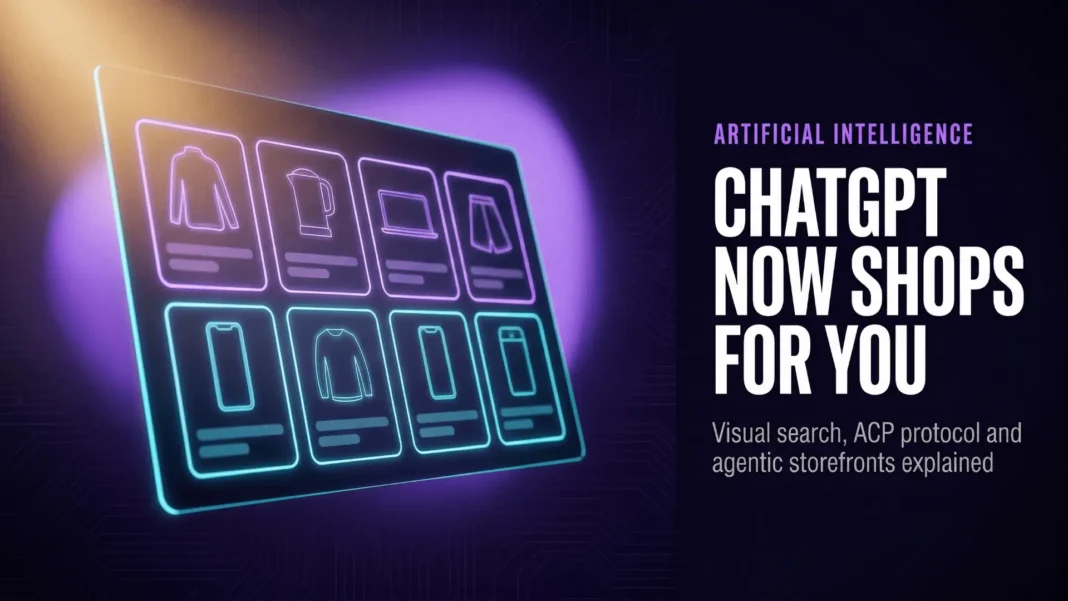
- ChatGPT now surfaces visual product cards with price, ratings, and specs side-by-side inside the chat window
- Confirmed live ACP partners include Etsy, Instacart, DoorDash, Target, and over one million Shopify merchants
- Instant Checkout is discontinued; all purchases now complete on the merchant’s own storefront via an in-app browser
- Shopify’s agentic storefronts launch by default for all stores in late March 2026 with zero merchant setup required
OpenAI launched a redesigned product discovery experience inside ChatGPT on March 24, 2026, shifting AI from a research tool to the starting point of the purchase journey. This update introduces visual product cards, side-by-side comparison, and photo-based search directly inside the chat window. What previously required multiple browser tabs and separate searches now resolves inside a single conversation.
What Actually Changed in ChatGPT Shopping on March 24, 2026
Until this update, ChatGPT’s shopping responses were text-heavy: brand names, short descriptions, and redirect links to external sites. The March 24 release introduces visual product cards that display price, star ratings, availability, and key specs in a card grid format. Users can upload a photo of a product and ChatGPT returns visually similar options filtered by budget and stated preferences.
The comparison experience is the sharpest upgrade. Instead of reading three separate product pages, users now see a structured side-by-side view inside the chat. This directly reduces the cognitive load of cross-referencing multiple tabs during high-consideration purchase decisions.
Search intent matching has also improved. When a user types “waterproof hiking boots under $150 for wide feet,” ChatGPT parses the query for multiple dimensions simultaneously: product category, price ceiling, use case, and fit constraint. The result reflects all four requirements rather than matching only the primary keyword.
How the Agentic Commerce Protocol Powers This Experience
The Agentic Commerce Protocol (ACP) is an open standard developed by OpenAI. Instacart co-developed key elements of the ACP infrastructure alongside OpenAI, with payments powered by Stripe’s Shared Payment Token, a new payment primitive for agentic commerce. Merchants connect product feeds, pricing, and availability to ChatGPT through ACP so users see accurate, real-time product information in their results.
ACP supports implementation through third-party platforms including Salesforce Commerce Cloud and Stripe, so merchants using existing commerce infrastructure do not need to rebuild their stack. Retailers integrate through dedicated ChatGPT Apps, which are purpose-built retailer applications inside the ChatGPT interface, rather than through a single monolithic checkout system.
The practical effect for users is seamless: a query triggers retrieval from ACP-connected merchant catalogs, returns ranked product cards, and routes the purchase to the merchant’s own checkout environment through an in-app browser.
Confirmed ACP Partners Live as of This Launch
Retailers confirmed live inside ChatGPT through ACP or dedicated ChatGPT Apps as of March 24, 2026:
- Etsy: U.S. sellers integrated since September 2025 through Etsy’s Offsite Ads program; Etsy was the first live marketplace on Instant Checkout
- Instacart: First grocery partner via ChatGPT Apps, launched December 8, 2025; enables recipe-to-grocery-cart ordering inside ChatGPT
- DoorDash: Grocery shopping app inside ChatGPT launched December 2025; users turn recipes into delivered grocery orders within the chat
- Target: Expanded partnership confirmed alongside the February 16, 2026 launch; also a confirmed ChatGPT Ads pilot participant
- Walmart: Confirmed approximately 200,000 products available for purchase inside ChatGPT during the Instant Checkout phase
- Shopify merchants: Over one million merchants including Glossier, SKIMS, Spanx, and Vuori, connected through Shopify Catalog
Retailers including Sephora, Nordstrom, Lowe’s, Best Buy, and Wayfair appear in ACP pipeline discussions but are not confirmed as live ChatGPT partners as of this publication date.
What Shopify Sellers Get Without Any Extra Work
Shopify told merchants via email in March 2026 that all stores will appear inside ChatGPT by default through agentic storefronts. The Shopify Catalog uses specialized language models to categorize and standardize product data, making it discoverable inside ChatGPT without merchants submitting separate ACP applications.
Purchases initiated through ChatGPT complete on the merchant’s own storefront via an in-app browser on mobile or a new tab on desktop. This preserves the merchant’s brand identity, customer relationship, loyalty program, and post-purchase experience throughout the transaction.
Shopify first announced agentic storefronts in December 2025 as a channel for merchants to distribute products across AI shopping interfaces while keeping their own checkout systems central. For Indian D2C brands selling globally through Shopify, this creates passive discovery exposure to ChatGPT’s user base with no integration cost or developer work required.
Instant Checkout Is Out. Merchant-Owned Checkout Is In.
OpenAI’s Instant Checkout feature, which launched in September 2025 and allowed purchases to be completed inside ChatGPT through Stripe-powered payments, is discontinued as of this update. OpenAI confirmed the reasoning directly: “Instant Checkout is moving to Apps, where purchases can happen more seamlessly“.
The practical shift means users clicking a buy option inside ChatGPT now land on the merchant’s own checkout page rather than completing a transaction through ChatGPT-native payment infrastructure. Merchants retain full control over customer data, returns, and loyalty programs.
Multiple retailers had raised concerns about routing customer transaction data through a third-party AI platform. The ACP-plus-retailer-app model directly addresses that friction, and OpenAI has confirmed this is now the permanent architecture going forward.
ChatGPT Shopping vs. Traditional Search: A Direct Comparison
| Feature | ChatGPT Shopping | Google Shopping | Amazon Search |
|---|---|---|---|
| Query type | Natural language, multi-dimensional | Keyword-based | Keyword-based |
| Product source | ACP merchant feeds + web crawl | Google Merchant Center | Amazon catalog only |
| Comparison format | Conversational side-by-side cards | Grid listings with ad placements | Sponsored + organic listings |
| Ad influence on results | ChatGPT Ads pilot active (limited) | Ad-funded placements | Sponsored product placements |
| Checkout location | Merchant’s own site via in-app browser | Merchant’s site | Amazon |
| Image-based search | Yes (upload photo, find similar) | Yes (Google Lens) | Limited |
| Grocery delivery integration | Yes (Instacart, DoorDash) | No | Yes (Amazon Fresh) |
What This Means for Indian Shoppers and Brands
India is one of ChatGPT’s largest user bases, and the visual discovery update carries direct relevance to Indian consumers making high-consideration purchases including smartphones, appliances, and apparel. The ability to upload a photo from a local listing and find global alternatives significantly reduces the research burden without requiring platform-specific knowledge.
For Indian brands exporting through Shopify, the agentic storefronts integration creates a discovery channel that did not exist before December 2025. Any Shopify merchant in India with international shipping enabled and a complete product catalog now has passive visibility inside ChatGPT conversations with no additional setup.
Major Indian e-commerce platforms including Flipkart and Meesho are not confirmed ACP partners as of this launch. Payment localization for Indian users, including UPI and EMI options, is not part of the current in-app browser checkout flow.
How ChatGPT Decides Which Products to Show
ChatGPT’s product discovery pulls from two primary data sources: ACP-connected merchant product feeds providing real-time inventory and pricing, and open web crawl data including review sites and product databases. When both sources conflict on details like stock availability or shipping estimates, ACP feed data takes precedence. Web-scraped data alone produced outdated or inaccurate information in earlier tests, which was a key driver behind the shift to ACP as the primary data layer.
Product content quality directly influences visibility. A product with structured review data, accurate specifications, and a description that matches user query dimensions surfaces more reliably than a more popular product with sparse or outdated feed data. For merchants, structured product data is now a discoverability asset inside an AI interface, not only an SEO signal for Google.
Limitations and Honest Considerations
ChatGPT’s product discovery coverage is currently weighted toward U.S. retailers and U.S. users. Grocery delivery through Instacart and DoorDash is U.S.-only at launch. Major Indian and non-U.S. e-commerce platforms are absent from the confirmed partner list. Web-scraped product data for non-ACP merchants remains prone to accuracy issues including outdated stock and pricing.
How to Get Your Products Into ChatGPT Discovery: Practical Steps
- If you sell on Shopify, verify your product catalog is complete with accurate titles, current pricing, high-quality images, and detailed descriptions. Shopify Catalog handles ChatGPT integration automatically from late March 2026.
- If you operate on a custom platform, apply for ACP integration through OpenAI’s developer portal or through third-party connectors including Salesforce Commerce Cloud and Stripe.
- Improve product review volume on crawlable review sites. ChatGPT’s discovery layer incorporates web-crawled review data into its product ranking alongside ACP feed data.
- Structure product descriptions to answer specific user queries (“waterproof to IPX7,” “fits wide feet up to 4E”) rather than marketing language. Dimensional specificity improves AI retrieval accuracy.
- For Discover and Search visibility, publish explainer content on your site contextualizing ACP-enabled shopping and link to your product pages with descriptive anchors.
Frequently Asked Questions (FAQs)
What is ChatGPT’s new product discovery feature?
ChatGPT’s product discovery update, launched March 24, 2026, lets users browse visual product cards, compare options side-by-side, and initiate purchases without leaving the chat. It uses the Agentic Commerce Protocol to pull real-time product data from partnered merchants including Etsy, Instacart, DoorDash, Target, and Shopify merchants.
What is the Agentic Commerce Protocol (ACP)?
ACP is an open standard developed by OpenAI that enables AI agents to access merchant inventory, pricing, and checkout systems. Instacart co-developed key ACP infrastructure elements, and Stripe powers payments through a Shared Payment Token. Retailers connect through dedicated ChatGPT Apps or third-party platforms like Salesforce and Stripe.
Which retailers are confirmed live on ChatGPT shopping in 2026?
Confirmed live partners as of March 24, 2026 include Etsy, Instacart, DoorDash, Target, Walmart (approximately 200,000 products), and over one million Shopify merchants through Shopify Catalog. Other retailers including Best Buy and Sephora have been discussed in ACP context but are not confirmed live as of this date.
Does ChatGPT shopping work in India?
ChatGPT’s product discovery update is rolling out globally, including India. However, grocery delivery integrations (Instacart, DoorDash) are U.S.-only at launch. Indian sellers using Shopify’s global storefronts gain automatic visibility through Shopify’s agentic storefronts integration. Major Indian platforms like Flipkart are not confirmed ACP partners.
What happened to ChatGPT’s Instant Checkout feature?
OpenAI launched Instant Checkout in September 2025 to process purchases inside ChatGPT via Stripe. OpenAI discontinued it in March 2026, stating that checkout completes more seamlessly on merchants’ own platforms. All purchases now route to the merchant’s own checkout via an in-app browser or a new browser tab.
How is ChatGPT shopping different from Google Shopping?
ChatGPT parses natural language queries across multiple dimensions simultaneously and returns results from ACP merchant feeds without ad-ranked placements in the core discovery results. Google Shopping uses keyword-based matching with ad-funded grid placements. ChatGPT also supports conversational refinement and photo-based product search.
How do Shopify merchants appear in ChatGPT product results?
Shopify is activating agentic storefronts by default for all stores in late March 2026. No application or developer work is required. Products surface in relevant ChatGPT conversations through Shopify Catalog. Purchases complete on the merchant’s own storefront via an in-app browser, preserving brand identity and customer data ownership.
Can users upload images to find products in ChatGPT?
Yes. The March 2026 update enables image-based product search. Users upload a photo and ChatGPT returns similar products filtered by the user’s stated budget and preferences. Results are refined through conversational follow-up within the same chat session.

