

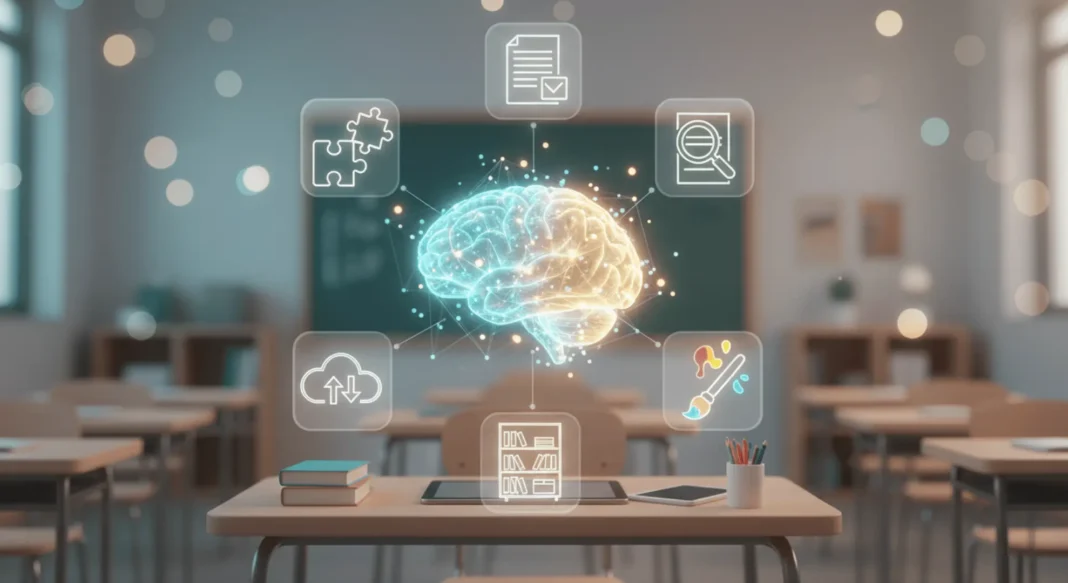
OpenAI’s ChatGPT for Teachers is now available free to verified K-12 educators in the US through June 2027, offering advanced AI features including GPT-5.1 Auto, file analysis, image generation, and workspace integrations. Teachers using AI tools weekly save an average of 5.9 hours per week equivalent to six weeks annually primarily through automated lesson planning, grading assistance, and personalized learning materials. The platform includes built-in privacy controls, teacher-tested prompts, and district-level management, though educators should verify outputs and maintain pedagogical oversight.
Teaching has always been a time-intensive profession, with educators spending countless hours on lesson planning, grading, parent communication, and administrative tasks outside classroom instruction. OpenAI’s newly launched ChatGPT for Teachers addresses this productivity challenge by offering a specialized, education-focused version of its popular AI chatbot completely free to verified K-12 teachers in the United States until June 2027. According to recent Gallup survey data, approximately 60% of teachers already used AI tools during the 2024-25 school year, with weekly users reporting time savings averaging 5.9 hours per week. This translates to an “AI dividend” of roughly six additional weeks per year that educators can redirect toward direct student interaction, professional development, or personal well-being.
Table of Contents
What Is ChatGPT for Teachers
ChatGPT for Teachers is an education-grade version of OpenAI’s conversational AI platform, specifically designed with features, controls, and safeguards tailored to K-12 educational environments. Unlike the standard ChatGPT consumer version, this specialized offering includes teacher-specific functionalities such as personalized memory for grade levels and curricula, enhanced privacy protections compliant with education data regulations, and district-level administrative controls that allow schools to manage deployment at scale. The platform provides access to GPT-5.1 Auto, OpenAI’s most advanced language model, along with integrated tools for file uploads and analysis, DALL-E image generation for creating visual learning materials, and direct connectors to Google Workspace and Microsoft 365 to streamline workflow integration.
The timing of this release aligns with broader trends in education technology adoption, as OpenAI previously partnered with the American Federation of Teachers in July 2025, pledging $10 million over five years to fund resources, engineering support, and technical guidance for educators implementing AI tools in classrooms. Teachers in India have also gained access through a separate pilot program offering 500,000 free ChatGPT Plus accounts for a six-month testing period. This global expansion reflects growing recognition that AI literacy and integration represent essential skills for modern educators navigating increasingly digital learning environments.
Key Features That Matter
Personalized Teaching Memory
ChatGPT for Teachers includes a memory function that allows the AI to remember specific details about your teaching context, including grade level, subject area, curriculum framework, and preferred formatting styles. This eliminates the need to repeatedly provide context with each new request, making interactions more efficient and outputs more consistently aligned with your classroom needs. Teachers can control what information the system remembers and delete stored preferences at any time, maintaining full autonomy over personalization settings.
File Upload & Analysis
The platform supports uploading and analyzing various file types, including lesson plans, worksheets, student writing samples (with personal information removed), curriculum documents, and assessment rubrics. This feature enables teachers to quickly generate study guides from existing materials, create differentiated versions of assignments at multiple reading levels, extract key concepts from lengthy curriculum documents, or receive formatting suggestions for instructional materials. For example, educators can upload a complex novel excerpt and request simplified versions for English language learners or students reading below grade level.
Image Generation for Visuals
Integrated DALL-E image generation capabilities allow teachers to create custom visual learning aids directly within ChatGPT for Teachers. This proves particularly valuable for elementary educators needing illustrations for story problems, science teachers requiring diagrams of biological processes or physical phenomena, language teachers seeking culturally specific images for vocabulary instruction, or any educator creating visually engaging presentation materials. The ability to generate on-demand, contextually appropriate images eliminates time spent searching stock photo libraries or attempting to create visuals without design expertise.
Google Workspace & Microsoft Integration
Direct connectors to Google Workspace and Microsoft 365 streamline workflow by allowing teachers to export AI-generated content directly to Google Docs, Sheets, or Slides, or to Microsoft Word, Excel, or PowerPoint. This integration eliminates the copy-paste step and maintains formatting consistency when moving content from ChatGPT into the productivity tools educators already use for classroom materials. Teachers can also potentially import content from these platforms for analysis or transformation, though specific integration capabilities continue to expand.
Curated Prompt Library
OpenAI has assembled a library of teacher-tested prompts specifically designed for common educational tasks. These ready-to-use prompt templates help educators who are new to AI tools get started quickly without needing to learn prompt engineering techniques, while also demonstrating effective approaches that more experienced users can adapt and refine. The library covers categories including lesson planning, assessment creation, parent communication, classroom management, and differentiation strategies.
How Teachers Actually Use It
Lesson Planning & Curriculum Design
Lesson planning represents one of the most time-intensive responsibilities for educators, requiring research, creativity, alignment with standards, and differentiation for diverse learners. Teachers use ChatGPT to generate initial lesson plan frameworks that they then customize with their expertise, brainstorm creative engagement activities like subject-specific raps or games that make abstract concepts memorable, create discussion prompts that encourage critical thinking at various cognitive levels, and develop project-based learning scenarios with real-world applications. A geometry teacher, for instance, had students use ChatGPT to write mathematical proofs in rap format, which they then performed in a classroom competition combining technical learning with creative expression and peer presentation skills.
Educators emphasize that AI-generated lesson plans serve as starting points requiring professional judgment to refine, rather than finished products to implement directly. Teachers input curriculum objectives, student ability levels, available resources, and time constraints, then review and adapt the AI’s suggestions based on their knowledge of individual students, classroom dynamics, and pedagogical best practices.
Assessment & Grading Automation
ChatGPT assists with various assessment-related tasks throughout the teaching cycle. Teachers use it to generate quiz and test questions aligned with learning objectives at appropriate difficulty levels, create answer keys and grading rubrics with clear criteria, provide initial feedback on student writing that teachers then review and personalize, and develop differentiated assessments for students with varied learning needs. Some educators have students fact-check AI-generated essays as a learning activity, simultaneously testing subject knowledge while developing critical digital literacy skills.
One teacher reported using AI to create personalized report card comments that align with data, standards, and growth mindset language a time-consuming task where individual writing style matters less than clear communication with families. This frees substantial time for activities where the teacher’s unique expertise adds more value.
Parent Communication & Admin Tasks
Administrative communication consumes significant teacher time but often doesn’t require highly personalized language. Educators use ChatGPT to draft emails to parents about classroom updates, upcoming events, or general academic progress, compose newsletters with classroom highlights and important dates, create permission slip language for field trips or special activities, and write professional communications to administrators or colleagues. Teachers consistently emphasize that they review and edit all AI-generated communications before sending to ensure accuracy and appropriate tone.
Differentiated Learning Materials
Creating multiple versions of learning materials at different complexity levels represents a best practice in inclusive education, but manually producing these variations is extremely time-intensive. Teachers leverage ChatGPT to break down complex texts into simpler reading levels while preserving core concepts, translate content into multiple languages for multilingual classrooms, create scaffolded worksheets with varying levels of support, and develop vocabulary glossaries with student-friendly definitions and contextual examples. A teacher in Scotland, for instance, used ChatGPT to instantly produce simplified versions of readings on terrorism causes for 14-year-old students who read below grade level or were learning English as a second language.
Classroom Management Support
Beyond instructional tasks, teachers use ChatGPT for classroom organization and management needs. Applications include generating lists of classroom rules with actionable student expectations, creating behavior intervention plans with specific strategies, developing time-allocated lesson segments to avoid rushing or dragging, designing transition activities and buffer tasks for students who finish early, and planning seating arrangements that optimize learning or manage specific behavioral concerns.
Real Time Savings & Productivity
The quantifiable productivity impact of AI tools in education has become clearer through recent research. Teachers who engage with AI tools on a weekly basis report saving an average of 5.9 hours per week on tasks including lesson planning, material creation, grading, and administrative communication. Over a typical 40-week school year, this accumulates to approximately 236 hours equivalent to nearly six additional weeks of time that educators can redirect toward direct student instruction, individualized support, professional development, or personal well-being.
A Walton Family Foundation survey found that 33% of teachers who had heard of ChatGPT used it specifically to generate creative ideas for classes. Beyond pure time savings, teachers report that AI assistance helps reduce burnout by automating repetitive tasks, enables more ambitious project designs that would be impractical without AI support, facilitates more frequent formative assessment through faster feedback creation, and allows greater attention to students requiring individualized support.
The efficiency gains prove particularly significant for early-career teachers still developing their resource libraries and experienced educators teaching new subjects or grade levels where they have fewer existing materials to draw upon. However, educators universally emphasize that time savings only materialize when teachers develop effective prompting skills and establish clear workflows for reviewing and customizing AI outputs.
Privacy & Data Security
Educational data privacy represents a paramount concern for schools, parents, and teachers considering AI tool adoption. ChatGPT for Teachers includes enhanced privacy protections specifically designed for K-12 environments. The platform provides district-level administrative controls allowing schools to manage access and usage policies centrally, data handling compliant with education privacy regulations including FERPA (Family Educational Rights and Privacy Act), and teacher-controlled settings determining what information the system remembers or stores.
Educators should follow fundamental privacy practices when using any AI tool, including never inputting personally identifiable student information such as names, student ID numbers, or specific family details, removing identifying information from student work samples before upload, using general descriptions rather than specific student data when requesting differentiated materials, and consulting school or district policies regarding approved AI tools and acceptable use parameters. Many schools are developing formal AI policies that specify which tools teachers can use, what types of data may be shared, and required review processes before distributing AI-generated content to students.
Free Access Details & Pricing
OpenAI is offering ChatGPT for Teachers completely free to verified K-12 educators in the United States through June 2027. This represents a significant value proposition, as the comparable ChatGPT Plus consumer subscription costs $20 per month, meaning the free access provides approximately $480 in value over the two-year period. Teachers in India have access through a separate pilot program offering 500,000 free ChatGPT Plus accounts for six months, with the standard Indian pricing of ₹1,950 per month waived during the pilot.
Eligibility requires verification as a K-12 teacher, though specific verification processes may vary by implementation partner or school district. After June 2027, OpenAI has stated that pricing may change, but has committed to providing advance notice so teachers and schools can plan budgets accordingly. The extended free access period gives schools substantial time to evaluate effectiveness, develop implementation protocols, and secure funding if they choose to continue subscriptions after the complimentary period ends.
For educators outside the US or teaching in higher education, post-secondary, or adult education contexts, ChatGPT Plus ($20/month) or the free ChatGPT version remain available, though without the education-specific features and controls included in ChatGPT for Teachers.
ChatGPT vs Other AI Teaching Tools
The AI education technology landscape has expanded rapidly, with numerous specialized tools targeting teacher needs. Key alternatives worth considering include MagicSchool, which offers a suite of over 60 AI tools covering lesson planning, differentiation, assessment creation, and administrative tasks in one platform designed specifically for educators. Curipod creates interactive slide presentations with embedded polls, drawings, and student response elements, excelling at engagement during live instruction. EssayGrader provides specialized AI for evaluating student writing with detailed feedback, rubric alignment, and grade-level appropriate suggestions. Claude (by Anthropic) has gained educator attention for nuanced writing and coding assistance, with some teachers preferring its outputs for certain tasks.
ChatGPT for Teachers distinguishes itself through the combination of advanced GPT-5.1 Auto model access, integrated image generation unavailable in most education-specific alternatives, comprehensive file upload and analysis capabilities, direct productivity suite integration with Google and Microsoft tools, and zero cost through June 2027 for verified K-12 teachers. However, specialized tools like MagicSchool offer pre-built templates for highly specific education tasks that may require more prompt engineering in ChatGPT, while tools like Curipod provide interactive student engagement features not available in ChatGPT’s text-based interface.
Many educators adopt a multi-tool approach, using ChatGPT for general content creation and brainstorming while employing specialized tools for specific functions like interactive presentations, automated grading, or standards-aligned assessment generation. The optimal choice depends on individual teaching context, technical comfort level, specific workflow needs, budget constraints, and district-approved tool lists.
Getting Started Step-by-Step
Step 1: Verify Your Educator Status – Visit the ChatGPT for Teachers registration page and complete the verification process confirming your K-12 teaching position. Verification methods may include school email domain confirmation, submission of teaching credentials, or integration with existing education platforms your school uses.
Step 2: Complete Initial Setup – Configure your personalized teaching memory by telling ChatGPT your grade level, subject areas, curriculum framework, and preferred output formats. This one-time setup ensures all future interactions produce more relevant, immediately usable outputs tailored to your specific teaching context.
Step 3: Explore the Prompt Library – Browse OpenAI’s curated collection of teacher-tested prompts to understand effective approaches for common tasks. Try several examples from different categories to experience the range of capabilities and identify which applications best address your most time-consuming responsibilities.
Step 4: Start with Low-Stakes Tasks – Begin your AI integration with administrative or planning tasks rather than materials going directly to students. Draft parent communication emails, brainstorm lesson ideas, or create initial assessment questions that you’ll review and refine. This builds comfort and develops your editing skills before creating student-facing materials.
Step 5: Develop Your Prompting Skills – Effective AI use requires learning to write clear, specific prompts that provide necessary context. Include relevant details like student age/grade, learning objectives, time constraints, available resources, and desired format. Refine prompts through iteration if initial outputs miss the mark, add clarifying details rather than abandoning the approach.
Step 6: Always Review and Customize – Treat AI outputs as drafts requiring your professional expertise to finalize. Verify factual accuracy, ensure alignment with your curriculum and pedagogical approach, add personal touches reflecting your classroom culture, and adjust difficulty or language for your specific students. Your teaching judgment remains irreplaceable. AI is an assistant, not a replacement.
Common Challenges & Limitations
Despite significant benefits, educators implementing ChatGPT encounter several consistent challenges. The AI occasionally generates factually incorrect information presented with confidence, requiring teachers to verify content accuracy particularly in specialized subjects or current events. Outputs may lack depth in highly specific subject areas or advanced topics, necessitating expert review and supplementation. Generic suggestions sometimes miss the nuanced understanding of individual student needs, classroom dynamics, or school culture that experienced teachers naturally incorporate.
Technical limitations include ChatGPT not being designed as a student-facing tutor without teacher mediation and oversight, the inability to access real-time information or current events beyond its knowledge cutoff, limited understanding of specific local curriculum requirements or assessment frameworks, and potential for perpetuating biases present in training data, requiring critical review. Implementation challenges involve the learning curve for effective prompt writing discouraging some educators, time investment required upfront before productivity gains materialize, varying technical infrastructure and internet access across schools, and concerns about over-reliance on reducing teacher creativity or pedagogical skill development.
Educators emphasize maintaining AI as a supplementary tool that enhances rather than replaces teacher expertise, professional judgment, and the irreplaceable human elements of education including relationship-building, emotional support, adaptive real-time instruction, and ethical guidance.
Practical Prompts & Examples
Lesson Planning Prompt:
“I teach 10th grade World History and need a 50-minute lesson plan on the causes of World War I. Include a 5-minute warm-up activity, 20-minute direct instruction with discussion questions, 15-minute primary source analysis activity in small groups, and 10-minute closure. Provide differentiation strategies for English language learners.”
Assessment Creation Prompt:
“Generate 15 multiple-choice questions on cellular respiration for 9th grade biology, aligned with Next Generation Science Standards. Include 5 knowledge-level, 7 application-level, and 3 analysis-level questions. Provide an answer key with brief explanations for each correct answer.”
Differentiation Prompt:
“Take this article excerpt on climate change [paste text] and create three versions: one at 6th grade reading level, one at 8th grade level, and one at 10th grade level. Preserve the key scientific concepts but adjust vocabulary and sentence complexity.”
Parent Communication Prompt:
“Draft a professional email to parents explaining our upcoming geometry unit on transformations. Include what students will learn, how they can support at home, and when the unit assessment will occur. Keep tone warm and encouraging, approximately 150 words.”
Time Management Prompt:
“I have a 45-minute class period and need to cover an introduction to variables in 6th grade math. Break this into time-allocated segments including activation of prior knowledge, direct instruction, guided practice, independent practice, and closure. Include transition time and buffer activities.”
Comparison Table: Chatgpt For Teachers Vs Alternatives
| Feature | ChatGPT for Teachers | MagicSchool | Curipod | EssayGrader | Claude |
|---|---|---|---|---|---|
| Cost (K-12) | Free until June 2027 | Free tier + paid | Free tier + paid | Paid plans | $20/month |
| AI Model | GPT-5.1 Auto | Various models | Proprietary | Specialized | Claude 3.5 |
| Lesson Planning | Yes | 60+ templates | Limited | No | Yes |
| Assessment Creation | Yes | Yes | Quiz integration | Grading focus | Yes |
| Image Generation | Yes (DALL-E) | No | No | No | No |
| File Upload | Yes | Limited | Yes | Yes | Yes |
| Interactive Slides | No | No | Yes | No | No |
| Writing Feedback | General | General | No | Specialized | Advanced |
| Privacy Controls | District-level | Education-grade | Education-grade | Education-grade | Standard |
| Best For | General teaching tasks | Education-specific workflows | Live engagement | Essay grading | Writing/coding |
Featured Snippet Boxes
What is ChatGPT for Teachers?
ChatGPT for Teachers is a free, education-grade AI platform from OpenAI available to verified K-12 US educators through June 2027. It includes GPT-5.1 Auto, file analysis, image generation, workspace integrations, and privacy controls designed specifically for classroom use. Teachers use it for lesson planning, grading, differentiation, and administrative tasks.
How much does ChatGPT for Teachers cost?
ChatGPT for Teachers is completely free for verified K-12 educators in the United States through June 2027, providing access to premium features typically requiring paid subscriptions. After June 2027, pricing may change with advance notice. This represents approximately $480 in value compared to ChatGPT Plus consumer pricing.
How do teachers save time with ChatGPT?
Teachers using AI tools weekly save an average of 5.9 hours per week, totaling about six weeks annually. Time savings come from automated lesson planning, assessment creation, grading assistance, differentiated material generation, and administrative communication drafting. Educators review and customize all AI outputs using professional expertise.
Is ChatGPT safe for classroom use?
ChatGPT for Teachers includes education-specific privacy protections, district-level controls, and compliance with education data regulations. Teachers should never input personally identifiable student information and must follow school AI policies. The tool is designed for teacher use, not direct student interaction without supervision.
What’s better than ChatGPT for teachers?
Alternatives include MagicSchool (60+ education-specific AI tools), Curipod (interactive presentations), EssayGrader (writing assessment), and Claude (advanced writing assistance). ChatGPT for Teachers offers broader capabilities and zero cost through 2027, while specialized tools provide pre-built templates for specific tasks. Many educators use multiple tools.
Can ChatGPT replace teachers?
No, ChatGPT assists with time-consuming tasks but cannot replace teacher expertise. Irreplaceable human elements include building student relationships, emotional support, adaptive real-time instruction, ethical guidance, and nuanced understanding of individual needs. Effective implementation frees teacher time for high-value human interactions.

