

Quick Brief
- Bing AI Performance tracks citations across Microsoft Copilot, AI summaries, and partner integrations starting February 10, 2026
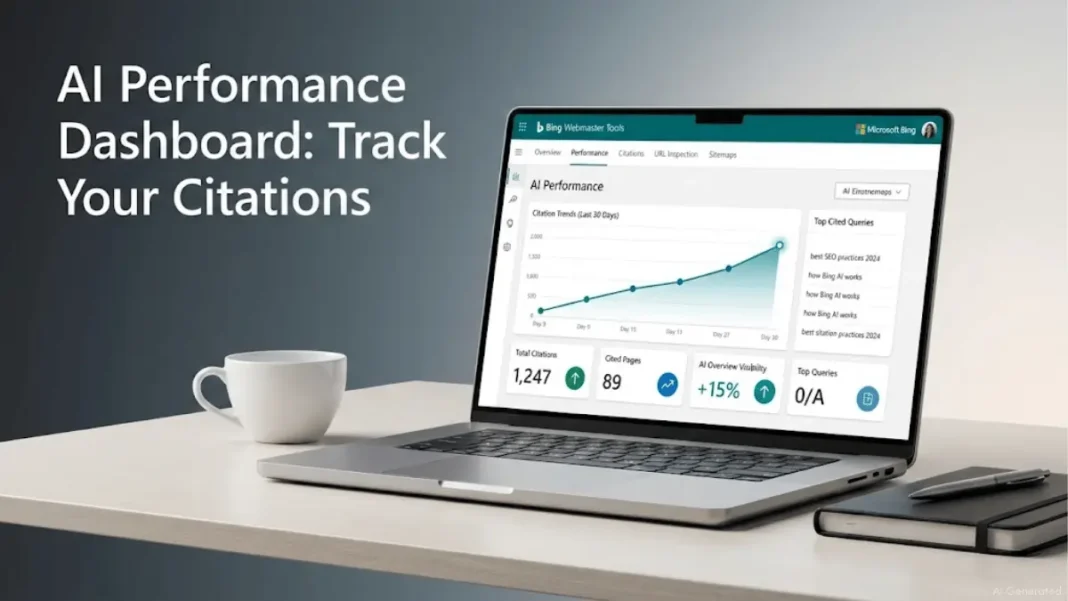
- Dashboard shows total citations, average cited pages, grounding queries, and page-level activity with trend analysis
- Microsoft positions this as the first step toward dedicated Generative Engine Optimization (GEO) tooling
- Publishers gain visibility into AI-driven discovery without relying on traditional click or ranking metrics
Microsoft has fundamentally shifted webmaster visibility from blue links to AI citations and Bing AI Performance proves it. For the first time, publishers can see exactly which URLs feed Microsoft Copilot, how citation patterns evolve, and which queries trigger content references. Launched February 10, 2026 in public preview, this tool provides transparency that competing platforms have yet to offer.
What Bing AI Performance Actually Measures
Bing AI Performance extends traditional search console insights into AI-generated answer environments. According to Microsoft Product Managers Krishna Madhavan, Meenaz Merchant, Fabrice Canel, and Saral Nigam, the dashboard consolidates citation data from Microsoft Copilot, Bing’s AI-generated summaries, and select partner integrations. Unlike search ranking reports, this tool focuses on whether your content grounds AI responses not whether users click through.
The platform introduces five core metrics designed specifically for AI visibility:
Total Citations counts how many times AI systems display your site as a source during a selected timeframe. Microsoft clarifies this metric reflects citation frequency without indicating placement or prominence within individual answers.
Average Cited Pages shows the daily average of unique URLs from your domain referenced across AI experiences. Because data aggregates across multiple AI surfaces, this metric highlights overall citation patterns rather than ranking or authority signals.
Grounding Queries reveals the key phrases AI systems used when retrieving your content for citation. Microsoft notes this represents a sample of overall activity as processing continues to expand.
Page-Level Citation Activity breaks down citation counts by specific URL, identifying which individual pages AI systems reference most often. This shows citation frequency without indicating the importance, ranking, or role of any page.
Visibility Trends Over Time provides timeline views showing how citation activity changes across supported AI experiences. This helps publishers identify patterns in their content’s AI visibility.
 KB5075941: Microsoft’s February 2026 Update Addresses 58 Security Vulnerabilities in Windows 11
Why AI Citations Matter More Than Traditional Metrics
Traditional search metrics measure clicks and impressions, but AI-generated answers often bypass both. When Microsoft Copilot cites your content in a response, users may receive the information they need without visiting your site. This creates a new form of visibility where content shapes answers users see, independent of traffic generation.
What distinguishes citation from traditional ranking?
Citations indicate that AI systems used your content as a reference source when generating answers. Traditional rankings show where your page appears in search results. Citations confirm content utility to AI models; rankings measure user-facing placement. AI Performance tracks the former; Search Performance tracks the latter.
Microsoft’s announcement confirms that visibility now extends beyond traditional search metrics. Rankings no longer guarantee citation, creating a need for separate measurement and optimization strategies for AI-mediated discovery.
How to Access and Use the AI Performance Dashboard
Bing AI Performance appears as a dedicated section within Bing Webmaster Tools. Publishers with verified properties can access the dashboard immediately without additional setup.
The interface displays citation metrics in aggregate view, allowing date range selection to track performance over time. Page-level breakdowns reveal which URLs drive the most citation activity, while grounding query samples show the search phrases that triggered content retrieval.
Microsoft designed the tool to help publishers validate which pages already serve as AI references, identify consistently cited topics, and spot improvement opportunities on indexed pages with lower citation rates. The official guidance emphasizes clear headings, evidence-backed claims, current information, and consistent entity representation across formats.
Generative Engine Optimization: From Theory to Tools
Microsoft Product Managers explicitly position AI Performance as “an early step toward the integration of generative engine optimization (GEO) practices into Bing Webmaster Tools”. GEO represents a discipline focused on maximizing content visibility in AI-generated answers rather than traditional search results.
Unlike SEO, which optimizes for ranking algorithms and click-through rates, GEO optimizes for citation by AI models. This requires different content signals: structured data helps AI systems extract key information, clear headings surface topic focus, and cited sources build trust when content feeds generative answers.
Third-party GEO platforms emerged throughout 2025 and early 2026 to fill monitoring gaps. Tools like Otterly AI, Semrush AI Toolkit, and Ahrefs Brand Radar monitor Google’s AI Overviews alongside other AI platforms. HubSpot offers a free AI Search Grader for entry-level visibility checks. Comprehensive solutions like Peec AI and Goodie AI combine monitoring with optimization recommendations.
How does GEO differ from traditional SEO practices?
GEO optimizes content for citation in AI-generated answers, focusing on structured data, clear entity representation, and grounding value. SEO optimizes for search engine rankings and click-through rates. GEO prioritizes how AI models extract and reference information; SEO prioritizes how users discover and click listings.
Bing’s AI Performance dashboard provides Microsoft-specific GEO visibility, but broader strategies require multi-platform monitoring. Content that performs well in Bing Copilot may not surface in ChatGPT, Perplexity, or Google’s AI Overviews each system uses different retrieval and ranking mechanisms.
Actionable Strategies to Increase AI Citations
Microsoft’s official announcement outlines specific strategies publishers can use to improve citation rates. The guidance provides a framework for systematic content optimization based on how AI systems evaluate and cite content.
Strengthen Depth and Expertise by expanding coverage in areas where your pages already earn citations. Grounding query phrases often reflect clear subject focus and domain authority. Deepening related topic coverage reinforces topical authority signals that AI models recognize.
Improve Structure and Clarity through better heading hierarchies, tables, and FAQ sections. These elements help AI systems locate and extract key information accurately. Structured content reduces ambiguity, making pages easier to cite with confidence.
Support Claims with Evidence by adding examples, data points, and cited sources. Well-documented pages build trust when AI systems evaluate content for citation.
Keep Content Fresh and Accurate through regular updates. AI models reference the most current indexed version of a page. Microsoft emphasizes that accurate, current content increases the likelihood of citation in AI-generated answers.
Reduce Ambiguity Across Formats by aligning text, images, and video to consistently represent the same entities, products, or concepts. Microsoft notes that clear, consistent content across formats helps AI systems understand and cite information with greater confidence.
IndexNow Integration: The Speed Advantage
Microsoft explicitly connects AI Performance with IndexNow, the instant indexing protocol that notifies participating search engines when content changes. The official announcement states that “accurate, current content makes a page more likely to be cited in AI-generated answers”.
IndexNow enables faster discovery of content updates, helping AI systems reference the latest page versions when generating responses. The protocol works across Bing, Yandex, and other participating engines without requiring separate submissions.
Does IndexNow improve AI citation rates directly?
IndexNow accelerates content discovery, ensuring AI systems access updated pages faster. Microsoft states this helps ensure “Copilot and other Bing AI experiences can reference the most current version of your pages”. While IndexNow doesn’t guarantee citations, it removes the lag between publishing updates and AI model retrieval.
Bing Webmaster Tools provides native IndexNow submission alongside complete webmaster analytics. Publishers can generate API keys for programmatic submission or use the web interface for batch URL submissions.
Local Business Implications for AI Visibility
Microsoft highlights local business information as especially important for AI-driven location-based queries. When AI experiences surface answers to “near me” searches or location-specific questions, accurate business details determine inclusion.
The official announcement recommends that “local businesses should ensure their information is up to date in Bing Places for Business”. This dual-registration approach separates site-level citation tracking (Webmaster Tools) from entity-level business data (Bing Places).
The distinction matters because AI systems may cite business information without citing the website or vice versa. A restaurant’s hours might appear in Copilot from Bing Places data, while recipes from the restaurant’s blog earn separate citations tracked in AI Performance.
What This Means for Search Strategy in 2026
AI Performance confirms that visibility now extends across multiple channels: paid search, organic listings, and AI-mediated answers. Each requires separate optimization strategies and measurement frameworks.
Publishers can no longer rely exclusively on ranking and click metrics to assess content performance. Microsoft’s data shows that “rankings do not guarantee citations” a page ranking position one might generate zero citations if AI systems favor competitor content for answer grounding.
Should publishers prioritize ranking or citations in 2026?
Both metrics serve different goals. Rankings drive direct traffic; citations build visibility in AI-mediated discovery. Microsoft recommends monitoring both to understand complete content performance. Prioritize rankings for commercial pages where clicks convert. Prioritize citations for informational content where presence in AI answers builds authority.
The dashboard reveals that traditional authority signals may not transfer fully to AI citation algorithms. This suggests AI models weight content factors differently than traditional search ranking systems.
Limitations and Content Control
Microsoft states that Bing AI Performance “respects all content owner preferences expressed through robots.txt and other supported control mechanisms“. Publishers can exclude content from AI citation using existing robots.txt directives or meta tags.
The data shown represents samples, not complete citation logs. Grounding queries in particular reflect “a sample of overall citation activity,” which Microsoft will expand as processing capacity increases. This means low-visibility pages may earn citations that don’t appear in initial reports.
Citation counts reflect frequency without indicating “ranking, authority, or the role of any page in an AI-generated answer”. A page cited once in a prominent position may drive more visibility than a page cited ten times in footnote references but the dashboard treats both equally in aggregate counts.
Competing with Google’s Approach to AI Attribution
Google has not released equivalent tools for AI Overviews as of February 2026. Google Search Console does not currently provide citation metrics or visibility data specific to AI-generated answers. Third-party GEO platforms like Otterly AI and Semrush AI Toolkit fill this gap by monitoring Google’s AI search results alongside other platforms.
This gives Microsoft a transparency advantage in publisher relations. By providing granular citation data, Bing positions itself as offering publisher tools that Google’s Search Console does not yet provide.

Frequently Asked Questions (FAQs)
What platforms does Bing AI Performance track?
Bing AI Performance tracks citations across Microsoft Copilot, AI-generated summaries in Bing, and select partner integrations. The dashboard aggregates data from these supported AI surfaces into unified metrics. Microsoft has not disclosed the complete list of partner integrations.
Can AI Performance data improve Google rankings?
AI Performance tracks Bing-specific citation data and does not directly affect Google rankings. However, content improvements that increase Bing citations such as better structure, clarity, and cited sources align with content quality principles that may benefit overall search performance.
How often does the AI Performance dashboard update?
Microsoft has not specified the exact refresh frequency for AI Performance data. The dashboard allows date range selection for tracking citation patterns over time.
Do citations from AI answers count as backlinks?
No, AI citations do not function as traditional backlinks. Citations indicate content usage by AI models but do not pass link equity or authority signals in the way HTML backlinks do. They represent a separate visibility metric.
Is AI Performance available for all Bing Webmaster Tools users?
AI Performance is currently in public preview and available to verified property owners in Bing Webmaster Tools. Microsoft has not announced regional restrictions or phased rollout limitations.
What is the relationship between IndexNow and AI citations?
IndexNow accelerates content discovery by notifying search engines of updates. Microsoft states this helps “ensure Copilot and other Bing AI experiences can reference the most current version of your pages.” IndexNow does not directly cause citations but removes discovery lag.
How do I optimize content specifically for AI citations?
Microsoft recommends using clear headings, structured data, and FAQ sections to help AI systems extract information. Support claims with evidence and cited sources. Keep content current through regular updates. Align text, images, and video to reduce ambiguity. Focus on depth and expertise in specific topic areas.
Does blocking AI crawlers affect AI Performance reporting?
Bing respects robots.txt and meta tag directives. Blocking AI crawlers prevents content from being cited in AI-generated answers and removes it from AI Performance tracking. Microsoft confirms the tool “respects all content owner preferences expressed through robots.txt”.

