

Quick Brief
- Intel Core Ultra Series 2 processors (265U/235U) enable AI acceleration in fanless design
- Operates -25°C to 70°C with MIL-STD-810H 5Grms vibration resistance for harsh environments
- Four Ethernet ports, dual CAN Bus, and isolated DIO enable multi-sensor industrial integration
- Compact 63×110×160mm DIN-rail form factor fits space-constrained robotics and AMR deployments
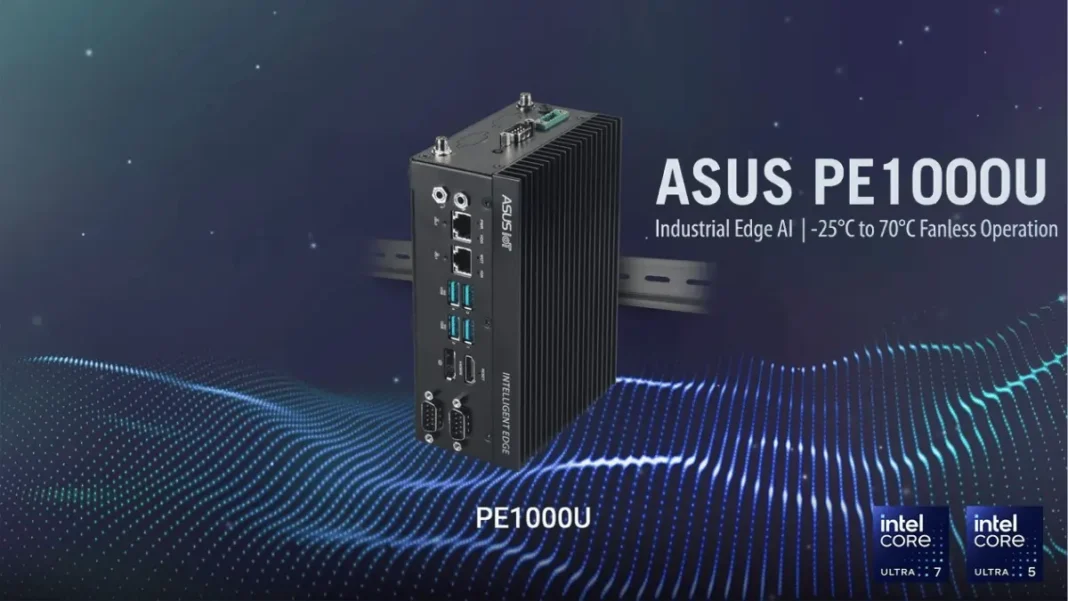
ASUS IoT redefined industrial edge computing limits on February 5, 2026, with the PE1000U a palm-sized DIN-rail computer that survives factory floors, outdoor kiosks, and moving vehicles without compromising AI performance. The fanless design eliminates mechanical failure points while Intel Core Ultra Series 2 processors handle real-time motion control and computer vision simultaneously. This matters for manufacturers deploying autonomous mobile robots (AMR) and collaborative robots where space constraints meet brutal operating conditions.
Intel Core Ultra Series 2: Hybrid Architecture for Industrial AI
The PE1000U integrates Intel Core Ultra 265U or 235U processors featuring distinct CPU, GPU, and NPU acceleration pathways. This hybrid architecture enables sustained AI inference workloads and deterministic motion control without throttling during extended operation cycles. The processors deliver the computational power needed for real-time computer vision and predictive maintenance without cloud connectivity.
What makes Intel Core Ultra Series 2 suitable for industrial edge computing?
Intel Core Ultra Series 2 processors combine multiple CPU cores with dedicated neural processing units (NPU) for AI acceleration. The architecture supports real-time computer vision and sensor fusion workloads essential for industrial deployments. Industrial applications benefit from deterministic compute power for motion planning and predictive maintenance algorithms.
Memory support includes dual SO-DIMM slots for expanded capacity when processing multi-camera arrays and high-resolution sensor data. The integrated GPU drives dual 4K displays via DisplayPort and HDMI outputs for human-machine interface (HMI) monitoring and machine vision analysis.
Thermal Architecture: Fanless Operation from -25°C to 70°C
ASUS engineered a wave-pattern aluminum heatsink that creates a direct thermal pathway from CPU and memory modules to the exterior chassis surface. The completely sealed IP40-rated enclosure excludes dust and contaminants without requiring vents or fans. This passive cooling approach eliminates acoustic noise and moving parts that degrade in high-vibration environments.
The thermal design withstands MIL-STD-810H testing for 5Grms vibration across 5-500 Hz frequency ranges. Screw-lock I/O connectors prevent cable disconnection during continuous vibration exposure typical in collaborative robot arms and moving AMR platforms. Operating temperature range extends from -25°C to 70°C, covering semi-outdoor installations and factory environments without climate control.
Connectivity Density: Four Ethernet Ports in 63mm Footprint
Front-access I/O simplifies cabinet wiring in space-constrained deployments where rear access proves impractical. The single-side connector layout includes four USB ports for peripheral devices and up to four COM ports (RS-232/422/485) for legacy industrial equipment integration.
| Connectivity Feature | PE1000U Specification | Industrial Application |
|---|---|---|
| Ethernet Ports | Up to 4 (dual 2.5GbE standard) | Multi-camera vision arrays, fleet management |
| CAN Bus | Dual onboard | Motor controllers, automotive protocols |
| DIO Module | Isolated digital I/O | Strobe triggering, noise-free illumination control |
| Wireless | WiFi 6E or 5G options | Cloud connectivity, remote monitoring |
| Storage | M.2 + 2.5″ bay | High-speed data logging, edge inference models |
Dual 2.5 Gigabit Ethernet ports handle simultaneous sensor streams from LiDAR units, thermal cameras, and depth sensors without network congestion. Expansion to four independent Ethernet interfaces accommodates machine vision systems requiring dedicated bandwidth per camera.
DIN-Rail Mounting: Industrial Standard Integration
The 63×110×160mm chassis mounts directly to standard 35mm DIN rails ubiquitous in electrical cabinets and control panels. This form factor eliminates custom mounting hardware while enabling tool-free installation and removal for maintenance. The compact dimensions minimize space requirements in crowded electrical enclosures.
Why is DIN-rail mounting preferred for industrial edge computers?
DIN-rail mounting standardizes equipment placement in electrical enclosures and control cabinets used across factory automation. The design provides mechanical stability, simplified cable routing, and rapid replacement without disrupting adjacent equipment. Industrial technicians recognize DIN-rail systems universally, reducing installation training requirements and field errors.
Single-side I/O placement concentrates all connections on the front panel, eliminating the need for rear cabinet access during commissioning or troubleshooting. This proves essential in wall-mounted cabinets or space-limited installations where technicians cannot reach equipment backsides.
Power Flexibility: 9-36V DC with Ignition Control
Wide-voltage DC input (9-36V) accommodates variable power sources in vehicles, solar installations, and industrial plants with fluctuating electrical infrastructure. Built-in ignition control automatically powers the system on/off based on vehicle ignition state, extending battery life in mobile deployments.
The power architecture tolerates voltage spikes and brownouts common in factory environments without requiring external conditioning equipment. This reduces bill-of-materials costs and installation complexity for system integrators.
Application-Specific Optimization
Autonomous Mobile Robots (AMR)
The fanless thermal design prevents dust accumulation that degrades cooling performance in warehouse and manufacturing environments. Four LAN ports connect simultaneously to LiDAR sensors, navigation cameras, safety scanners, and facility WiFi without external switches. Dual CAN Bus interfaces link to motor controllers using automotive-grade protocols prevalent in mobile robotics.
Collaborative Robots (Cobots)
MIL-STD-810H vibration certification ensures operational stability when mounted on robot arms executing high-speed pick-and-place operations. Screw-lock connectors maintain signal integrity during continuous acceleration cycles that loosen standard friction-fit cables. Real-time processing capability supports motion planning and force-torque sensor feedback for human-safe collaboration.
Computer Vision Systems
Isolated digital I/O triggers machine vision strobes and structured light projectors with precise timing without introducing electrical noise into camera sensor circuits. Up to four independent Ethernet ports eliminate network contention when streaming image data from multi-camera inspection rigs. DisplayPort outputs drive 4K monitors for live operator feedback during quality control inspection.
Deployment Considerations
Certification and Compliance
FCC, ISED, CE, UKCA, BSMI, and CB certifications enable global deployment across North America, Europe, and Asia-Pacific markets. MIL-STD-810H Method 516.8 shock testing validates impact resistance for transportation and handling scenarios.
Integration Planning
System integrators benefit from the PE1000U’s compatibility with standard industrial protocols including Modbus, OPC UA, and MQTT for seamless integration with existing automation infrastructure. The platform supports Linux and Windows operating systems for application flexibility.
Total Cost of Ownership
Fanless operation eliminates maintenance costs associated with fan replacement and filter cleaning typical in industrial computing. The sealed chassis extends the mean time between failures (MTBF) in contaminated environments compared to vented designs requiring regular cleaning intervals.
Technical Specifications Summary
| Component | Specification | Source |
|---|---|---|
| Processor Options | Intel Core Ultra 265U / 235U | Series 2 architecture |
| AI Capabilities | NPU-accelerated inference | Hybrid CPU+GPU+NPU design |
| Memory | Dual SO-DIMM slots | Expandable capacity |
| Dimensions | 63×110×160mm | DIN-rail mountable |
| Operating Temp | -25°C to 70°C | Fanless passive cooling |
| Vibration Rating | 5Grms, 5-500 Hz | MIL-STD-810H certified |

Frequently Asked Questions (FAQs)
What is the ASUS IoT PE1000U?
The ASUS PE1000U is a compact DIN-rail industrial edge computer powered by Intel Core Ultra Series 2 processors (265U or 235U). Measuring 63×110×160mm, it features fanless operation, IP40 dust protection, and extensive I/O connectivity for AMR, robotics, and computer vision applications. The rugged design operates from -25°C to 70°C.
What processor does the ASUS IoT PE1000U use?
PE1000U utilizes Intel Core Ultra 265U or 235U processors from the Series 2 architecture. These chips combine CPU, GPU, and NPU acceleration to enable AI inference and real-time processing. The hybrid design supports simultaneous motion control and computer vision workloads without cloud connectivity.
What are the durability features of the ASUS IoT PE1000U?
The PE1000U features IP40-rated fanless chassis, MIL-STD-810H vibration resistance (5Grms across 5-500 Hz), and -25°C to 70°C operating temperature range. Wave-pattern aluminum heatsink provides passive cooling without moving parts. Screw-lock connectors prevent cable disconnection during vibration. The sealed enclosure excludes dust contamination.
What connectivity options are available on the ASUS IoT PE1000U?
PE1000U provides four USB ports, up to four COM ports (RS-232/422/485), and up to four Ethernet ports with dual 2.5GbE standard. Additional interfaces include dual CAN Bus, isolated DIO module, DisplayPort, and HDMI outputs supporting dual 4K displays. M.2 slots support WiFi 6E or 5G cellular connectivity.
What makes the ASUS IoT PE1000U ideal for AMR and robotics?
The compact 63mm footprint fits space-constrained mobile platforms while fanless design prevents dust-related failures. Four LAN ports connect LiDAR, cameras, and fleet management systems simultaneously. Dual CAN Bus interfaces with motor controllers using automotive protocols. 5Grms vibration resistance ensures stability during robot motion.
What storage options does PE1000U support?
The system includes M.2 slot for solid-state storage and a standard 2.5-inch drive bay for additional storage capacity. This dual-storage configuration enables fast system operation while providing bulk storage for data logging or video recording in surveillance applications.
What is the power input specification for PE1000U?
PE1000U accepts wide 9-36V DC power input with built-in ignition control for vehicle installations. The design tolerates voltage fluctuations common in industrial and mobile environments without external power conditioning equipment. Ignition control automatically manages power states based on vehicle operation.
When was the ASUS PE1000U announced?
ASUS IoT announced the PE1000U on February 5, 2026, targeting autonomous mobile robots, collaborative robotics, and industrial computer vision applications. The system is designed for deployment in harsh environments requiring fanless operation and extreme temperature tolerance.

