

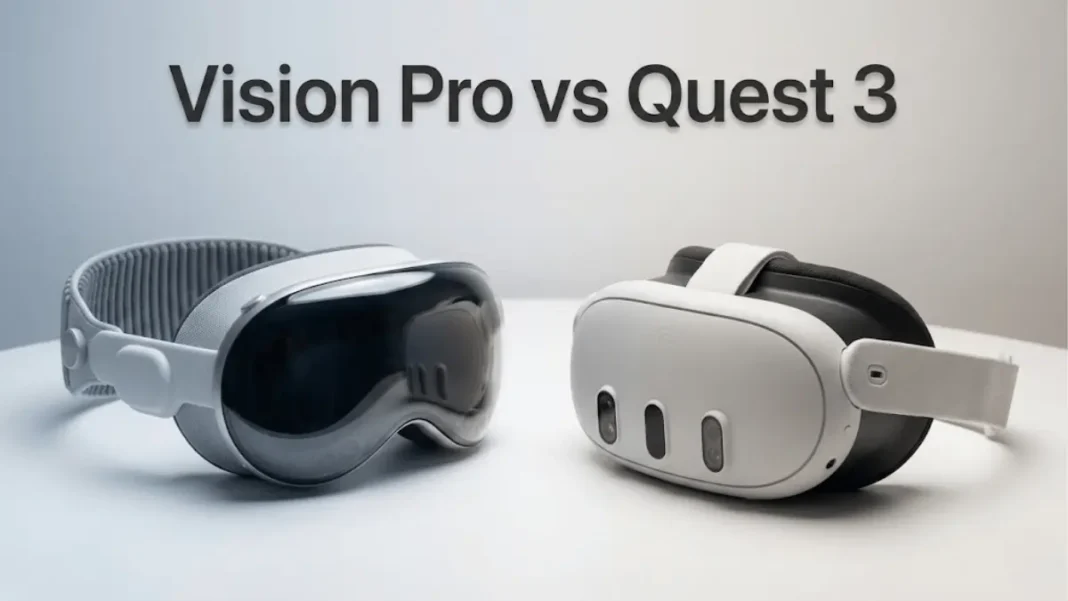
Apple Vision Pro with M5 chip offers superior display quality with 23 million pixels and advanced spatial computing starting at $3,499, while Meta Quest 3 delivers excellent mixed reality gaming at $499 for 512GB. Vision Pro excels in enterprise productivity with hardware-accelerated ray tracing and 16GB RAM, while Quest 3 dominates consumer gaming with extensive library and physical controllers. The $3,000 price gap makes Quest 3 the value choice for gaming, but Vision Pro justifies its premium for professional spatial computing applications.
Editor’s Note (January 2026): This comparison reviews the current Apple Vision Pro with M5 chip released October 2025, featuring improved performance, 120Hz refresh rate support, and enhanced battery life. Meta Quest 3 is now available exclusively in the 512GB configuration at $499.
Apple Vision Pro and Meta Quest 3 represent fundamentally different approaches to mixed reality. Vision Pro targets professionals with premium spatial computing at $3,499, while Quest 3 brings VR gaming to consumers at $499. This comparison examines verified specifications and real-world performance to help you choose the right headset.
What’s the Real Difference Between Vision Pro and Quest 3?
Apple Vision Pro ($3,499) uses micro-OLED displays with 23 million pixels and M5 chip for professional spatial computing, while Meta Quest 3 ($499) features LCD displays with Snapdragon XR2 Gen 2 for consumer VR gaming and mixed reality.
The core distinction lies in target audience and design philosophy. Vision Pro positions itself as a spatial computer for productivity and enterprise applications with premium materials, advanced eye tracking, and visionOS 26 operating system. Quest 3 focuses on gaming and entertainment with physical controllers, standalone capability, and extensive VR game library.
Vision Pro features dual Apple chips: the M5 providing desktop-class performance, and R1 chip processing sensor data with 12-millisecond photon-to-photon latency. Quest 3 uses Qualcomm’s Snapdragon XR2 Gen 2 processor optimized for standalone VR without external hardware requirements.
Display and Visual Quality
Resolution and Pixel Density
Apple Vision Pro delivers 23 million pixels total across two micro-OLED displays with 7.5-micron pixel pitch. This creates remarkably sharp text rendering and detailed spatial environments with virtually imperceptible screen door effect. The displays achieve 92% DCI-P3 color gamut for accurate color reproduction.
Meta Quest 3 features 2,064 x 2,208 pixels per eye with LCD technology. The resolution supports clear gaming visuals and mixed reality experiences at consumer price point, though pixel density falls below Vision Pro’s professional-grade displays.
Display Technology Comparison
Vision Pro’s micro-OLED panels provide superior contrast ratio and color accuracy compared to Quest 3’s LCD screens. The stereoscopic 3D camera system captures spatial photos and videos at 6.5 stereo megapixels with 18mm ƒ/2.00 aperture lenses. Vision Pro includes 12 cameras, five sensors, and six microphones for environmental tracking.
Quest 3 uses pancake lenses to reduce headset bulk while maintaining optical clarity. The color passthrough cameras enable mixed reality applications, though with lower fidelity than Vision Pro’s high-resolution passthrough system.
Refresh Rate Performance
Vision Pro now supports 90Hz, 96Hz, 100Hz, and 120Hz refresh rates. The 120Hz option, added with the M5 upgrade, provides smoother motion for Mac Virtual Display and spatial experiences. The system supports playback multiples of 24 fps and 30 fps for judder-free video.
Quest 3 offers 72Hz, 80Hz, 90Hz, and 120Hz options for flexible performance across different applications. The higher peak refresh rate benefits fast-paced gaming experiences.
Performance and Hardware Specifications
Processing Power
Apple Vision Pro features the M5 chip built using third-generation 3-nanometer technology. The 10-core CPU includes 4 performance cores and 6 efficiency cores delivering higher multithreaded performance. The 10-core GPU adds hardware-accelerated ray tracing and mesh shading for enhanced graphics rendering.
The M5 chip includes neural accelerators in every GPU core, with a 16-core Neural Engine running AI features up to 50% faster than previous generation. This enables advanced Persona generation and spatial photo processing with lower latency. The chip provides 153GB/s memory bandwidth.
Meta Quest 3 uses Qualcomm Snapdragon XR2 Gen 2 processor optimized for mobile VR experiences. While less powerful than M5 in absolute terms, the processor provides efficient standalone performance without requiring external computing connections.
RAM and Storage Options
Vision Pro includes 16GB unified memory supporting complex multitasking across multiple spatial applications. Storage configurations include 256GB ($3,499), 512GB ($3,699), and 1TB ($3,899). The higher RAM allocation enables Mac Virtual Display alongside native visionOS apps simultaneously.
Quest 3 is currently available only in 512GB configuration at $499, as Meta discontinued the 128GB model in 2024. This single-SKU strategy simplifies purchasing while providing ample storage for game libraries.
Battery Life and Design
Vision Pro provides up to 2.5 hours of general use and up to 3 hours of video playback on a single battery charge. The external battery pack weighs 353 grams and connects via cable. Vision Pro can be used while charging the battery for extended sessions. The improved battery life represents a 25% increase over the original M2 model.
Quest 3 integrates batteries directly into the headset chassis, providing approximately 2.2-2.9 hours depending on activity. The self-contained design eliminates cables for greater movement freedom during active gaming.
Price and Value Analysis
Upfront Costs
Meta Quest 3 is priced at $499 for the 512GB model, positioning it as an accessible entry point for VR experiences. The consumer-friendly pricing targets mainstream adoption.
Apple Vision Pro starts at $3,499 for 256GB, reflecting professional target market and premium positioning. The cost aligns with high-end laptops and professional equipment rather than consumer gaming devices.
Storage Configuration Pricing
Vision Pro offers three storage tiers: 256GB ($3,499), 512GB ($3,699), and 1TB ($3,899). The storage options target professional users working with large 3D models, 8K spatial videos, and extensive app collections.
Quest 3’s single 512GB option at $499 provides straightforward purchasing without configuration decisions. The lower-cost Quest 3S starts at $299 but compromises on lens quality and display performance.
Apps and Ecosystem
Gaming Library Comparison
Meta Quest 3 dominates gaming with an extensive VR game library including platform exclusives and Steam VR compatibility through Virtual Desktop or Quest Link. The physical Touch Plus controllers with haptic feedback enable precise gaming control.
Apple Vision Pro supports spatial gaming with hand tracking and eye tracking input. The headset now supports PlayStation VR2 Sense controller and Logitech Muse as spatial accessories for gaming applications. Game controllers are also supported as input accessories.
Productivity and Enterprise Applications
Vision Pro leads enterprise productivity with visionOS 26, Mac Virtual Display integration, and specialized professional applications. The M5 chip’s hardware-accelerated ray tracing enables detailed architectural visualization and design review applications.
Built-in productivity apps include Keynote, Freeform, Mail, Notes, Safari, Calendar, and compatibility with keyboard and trackpad accessories. The 16GB unified memory supports demanding professional workflows.
Quest 3 supports productivity through third-party applications, though the platform prioritizes consumer entertainment over professional workflows.
Entertainment and Streaming
Vision Pro includes built-in apps for Apple TV, Music, Podcasts, and spatial content viewing. The micro-OLED displays deliver theater-quality video playback with support for HEVC, MV-HEVC, H.264, AV1, HDR with Dolby Vision, HDR10, and HLG formats. Spatial Audio with dynamic head tracking and audio ray tracing enhance immersive entertainment.
Quest 3 provides access to major streaming platforms with VR-optimized viewing experiences. The platform emphasizes social viewing and multiplayer entertainment.
Design and Comfort
Weight and Build Quality
Apple Vision Pro weighs 26.4-28.2 ounces (750-800 grams) including Light Seal, Light Seal Cushion, and counterbalanced Dual Knit Band. The weight varies depending on configuration. The external battery pack adds 353 grams. The Dual Knit Band, introduced with the M5 upgrade, provides improved comfort and weight distribution.
The frame uses 100% recycled aluminum, with a curved laminated glass display on the front. Vision Pro is made with 20% recycled content overall.
Meta Quest 3 weighs 515 grams with an integrated battery. The lighter weight and integrated design provide better mobility for active gaming experiences.
Input Methods
Vision Pro relies on hand tracking, eye tracking, and voice input. Four eye-tracking cameras enable precise selection by looking at interface elements. The advanced eye tracking uses Optic ID for iris-based biometric authentication.
Vision Pro now supports spatial accessories including Logitech Muse and PlayStation VR2 Sense controller, expanding gaming and creative input options. Traditional keyboards, trackpads, mouse devices, and game controllers are also supported.
Quest 3 includes Touch Plus controllers with haptic feedback, trigger buttons, thumb sticks, and grip sensors for precise gaming control. The headset also supports hand tracking for controller-free experiences.
Battery Configuration
Vision Pro uses external battery pack design to reduce headset weight and heat generation. The battery clips to belt or pocket with a cable connecting to headset. This design enables battery swapping for extended sessions without removing the headset.
Quest 3 integrates batteries into the headset for cable-free operation. The self-contained design provides complete freedom of movement essential for room-scale VR gaming.
Pros and Cons
- Industry-leading 23 million pixel micro-OLED displays with 7.5-micron pixel pitch
- M5 chip with hardware-accelerated ray tracing and 30% faster graphics
- 16GB unified memory supporting complex multitasking
- 120Hz refresh rate support for smooth motion
- Advanced eye tracking with Optic ID biometric authentication
- Enhanced battery life: 2.5 hours general use, 3 hours video playback
- PlayStation VR2 Sense controller and game controller support
- Improved Dual Knit Band for better comfort
- 50% faster AI features with 16-core Neural Engine
- Premium build with 100% recycled aluminum frame
- Premium $3,499 starting price limiting consumer adoption
- Heavier weight at 750-800g plus 353g external battery
- External battery pack creates cable management considerations
- Smaller gaming ecosystem compared to Quest 3
- Requires optical inserts for prescription lens users (separate purchase)
- Affordable $499 price for 512GB model
- Lighter weight at 515g with integrated battery
- Extensive gaming library with platform exclusives
- Physical Touch Plus controllers with haptic feedback
- Standalone operation without external hardware
- Cable-free design for active gaming
- 120Hz peak refresh rate
- Established VR platform with mature app ecosystem
- Lower resolution LCD displays compared to Vision Pro’s micro-OLED
- Less powerful Snapdragon XR2 Gen 2 processor
- Only 8GB RAM limiting multitasking
- Lower quality passthrough for mixed reality
- Limited enterprise features and professional applications
- No eye tracking for interface navigation
- No hardware-accelerated ray tracing
Use Case Scenarios
Best for Gaming
Meta Quest 3 dominates gaming through extensive ecosystem, controller support, and $499 price point. The platform’s mature game library and developer focus on VR gaming create an active gaming community.
Vision Pro now supports PlayStation VR2 Sense controller and game controllers, expanding gaming capabilities beyond hand tracking. However, Quest 3 remains the practical gaming choice due to price and game library advantages.
Best for Productivity
Apple Vision Pro leads productivity use cases with Mac Virtual Display, native Apple ecosystem integration, and superior text rendering for extended reading. The 16GB RAM supports multiple applications simultaneously.
The M5 chip’s 30% faster graphics performance compared to M4 enables demanding professional applications. Hardware-accelerated ray tracing supports architectural visualization and 3D design review.
Best for Enterprise
Vision Pro targets enterprise training, collaborative design reviews, remote assistance, and immersive data analytics. The visionOS 26 platform provides enterprise-grade features and security.
The M5 chip’s AI capabilities run enterprise machine learning applications with up to 2x faster performance for third-party apps. This enables real-time analysis and decision support applications.
Technical Specifications Comparison
| Specification | Apple Vision Pro (M5) | Meta Quest 3 |
|---|---|---|
| Price | $3,499 (256GB) | $499 (512GB only) |
| Display Type | Micro-OLED | LCD |
| Total Pixels | 23 million | ~8.6 million |
| Refresh Rate | 90Hz, 96Hz, 100Hz, 120Hz | 72Hz, 80Hz, 90Hz, 120Hz |
| Processor | Apple M5 + R1 | Snapdragon XR2 Gen 2 |
| RAM | 16GB unified memory | 8GB |
| Storage Options | 256GB, 512GB, 1TB | 512GB only |
| Weight | 750-800g (26.4-28.2 oz) | 515g |
| Battery Life | 2.5 hours general, 3 hours video | 2.2-2.9 hours |
| Battery Design | External (353g) | Integrated |
| Controllers | Hand/eye tracking + PS VR2/gamepad support | Touch Plus controllers + hand tracking |
| Operating System | visionOS 26 | Meta Horizon OS |
| Connectivity | Wi-Fi 6, Bluetooth 5.3 | Wi-Fi 6, Bluetooth 5.3 |
| Ray Tracing | Hardware-accelerated | Not specified |
Which Headset Should You Buy?
Choose Meta Quest 3 ($499) for VR gaming, entertainment, and casual mixed reality with extensive game library and physical controllers. Choose Apple Vision Pro ($3,499) for professional productivity, enterprise applications, premium spatial computing, and seamless Apple ecosystem integration.
Choose Vision Pro If:
You require professional-grade spatial computing with a budget exceeding $3,500. Your workflows involve architectural visualization, 3D design review, medical imaging, or data analytics requiring highest visual fidelity and processing power. You’re invested in the Apple ecosystem with Mac, iPhone, and iPad integration critical to productivity.
Enterprise deployments benefit from Vision Pro’s visionOS 26 platform, 16GB RAM, hardware-accelerated ray tracing, and M5 chip performance. The 120Hz refresh rate and improved battery life (2.5 hours general use) support extended professional sessions.
Choose Quest 3 If:
Gaming represents your primary VR interest with budget constraints making $3,500 investment unrealistic. You want standalone VR experiences without complex setup or external batteries. Your use cases include fitness apps, social VR experiences, movie watching, and mixed reality entertainment.
Quest 3 suits first-time VR buyers, families seeking entertainment devices, and gamers wanting wireless PC VR access through Steam VR compatibility. The $499 price point for 512GB storage provides exceptional gaming value.
The decision separates along professional versus consumer lines. Quest 3 delivers excellent gaming and entertainment value at an accessible price, while Vision Pro targets professionals requiring cutting-edge spatial computing capabilities.

Frequently Asked Questions (FAQs)
What chip does Apple Vision Pro use in 2026?
Apple Vision Pro uses the M5 chip released in October 2025, featuring 10-core CPU, 10-core GPU with hardware-accelerated ray tracing, and 16-core Neural Engine. The R1 chip handles sensor processing with 12-millisecond latency.
How much does Meta Quest 3 cost in 2026?
Meta Quest 3 costs $499 for the 512GB model, the only configuration available as of 2026 after Meta discontinued the 128GB variant in 2024.
Which headset has better display quality?
Apple Vision Pro has superior display quality with 23 million total pixels using micro-OLED technology with 7.5-micron pixel pitch and 92% DCI-P3 color gamut. Quest 3 uses LCD displays with approximately 8.6 million total pixels.
How long does the battery last?
Vision Pro provides up to 2.5 hours of general use and up to 3 hours of video playback with its external battery pack. Quest 3 delivers 2.2-2.9 hours depending on activity with an integrated battery.
How much does Vision Pro weigh?
Apple Vision Pro weighs 26.4-28.2 ounces (750-800 grams) including Light Seal and Dual Knit Band, with separate 353-gram external battery. Quest 3 weighs 515 grams with an integrated battery.
Can Vision Pro use game controllers?
Yes, Vision Pro supports game controllers, PlayStation VR2 Sense controller, Logitech Muse, keyboards, trackpads, and mouse devices as input accessories. Hand tracking, eye tracking, and voice remain the primary input methods.
Does Vision Pro support 120Hz refresh rate?
Yes, the M5-equipped Vision Pro supports 90Hz, 96Hz, 100Hz, and 120Hz refresh rates. Quest 3 also supports up to 120Hz.
Which is better for productivity work?
Vision Pro is better for productivity with 16GB unified memory, M5 chip performance, Mac Virtual Display integration, and visionOS 26 platform. The micro-OLED displays provide superior text rendering for extended work sessions.

