

Quick Brief
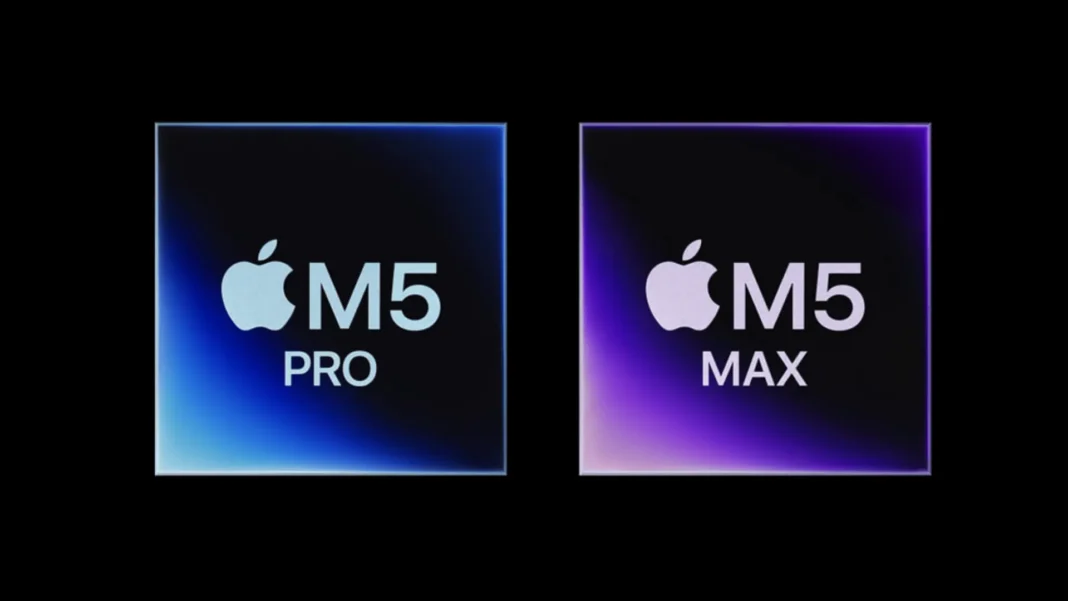
- Apple’s M5 Pro and M5 Max use a new Fusion Architecture, combining two third-generation 3nm dies into a single SoC for the first time
- M5 Pro delivers over 4x the peak GPU AI compute versus M4 Pro, with unified memory bandwidth reaching 307GB/s
- M5 Max scales to a 40-core GPU and 128GB unified memory at 614GB/s bandwidth, targeting AI researchers and 3D animators
- MacBook Pro with M5 Pro starts at Rs. 2,49,900 in India; pre-orders opened March 4, 2026
Apple just compressed two chips into one and called it progress. With M5 Pro and M5 Max, the company is not iterating on last year’s silicon. It is introducing an entirely new physical architecture that redefines what a laptop chip can hold, how fast it can move data, and how much AI it can run locally. If you use a MacBook Pro for serious work, the changes here are not marginal.
What Fusion Architecture Actually Changes
Every previous Apple silicon chip used a single die. M5 Pro and M5 Max break that convention entirely.
Apple’s Fusion Architecture connects two third-generation 3-nanometer dies using advanced packaging, binding them with high bandwidth and low latency into a single SoC. The result is a chip that houses an 18-core CPU, a scalable GPU reaching up to 40 cores, a 16-core Neural Engine, a Media Engine, a unified memory controller, and Thunderbolt 5 controllers, all on one package.
This is not simply more cores. It is a fundamentally different chip construction approach that allows Apple to scale performance without proportionally increasing power draw. For MacBook Pro users running large language models, multi-camera video workflows, or STEM simulations, this architectural shift directly translates to faster results per watt.
The 18-Core CPU: Super Cores and a New Performance Layer
The CPU architecture inside M5 Pro and M5 Max is a two-tier design that did not exist in previous Pro and Max generations.
Six “super cores” handle the heaviest single-threaded workloads. Apple describes these as the world’s fastest CPU cores, driven by increased front-end bandwidth, a new cache hierarchy, and enhanced branch prediction. Alongside them sit 12 all-new performance cores built specifically for power-efficient multithreaded workloads, a design new to the Pro and Max lineup.
Together, these 18 cores deliver up to 30 percent higher performance for pro workloads compared to M4 Pro, and up to 2.5x higher multithreaded performance than M1 Pro and M1 Max. For professionals still on M1-era hardware, the CPU upgrade alone makes a compelling case.
M5 Pro vs M5 Max: Which One Is Built for Your Work
The two chips share the same 18-core CPU architecture but diverge significantly on GPU core count, memory capacity, and memory bandwidth.
| Specification | M5 Pro | M5 Max |
|---|---|---|
| CPU Cores | 18 (6 super + 12 perf) | 18 (6 super + 12 perf) |
| CPU Uplift vs Prev Gen | Up to 30% over M4 Pro | Up to 15% over M4 Max |
| GPU Cores | Up to 20 | Up to 40 |
| Unified Memory | Up to 64GB | Up to 128GB |
| Memory Bandwidth | 307 GB/s | 614 GB/s |
| Peak GPU AI Compute | Over 4x M4 Pro; over 6x M1 Pro | Over 4x M4 Max; over 6x M1 Max |
| Ray Tracing Uplift | Up to 35% over M4 Pro | Up to 30% over M4 Max |
| Graphics Uplift | Up to 20% over M4 Pro; 2.2x over M1 Pro | Up to 20% over M4 Max; 2.2x over M1 Max |
| India Price (14-inch, base) | Rs. 2,49,900 (24GB RAM, 1TB) | Rs. 3,99,900 |
| India Price (16-inch, base) | Rs. 2,99,900 | Rs. 4,29,900 |
M5 Pro targets data modelers, post-production sound designers, and STEM students who need robust processing and ample memory for complex projects. M5 Max is aimed at 3D animators, app developers, and AI researchers who push maximum GPU compute and the highest memory bandwidth.
AI Performance: Where the Numbers Get Serious
The Neural Accelerator embedded in each GPU core is what separates M5 Pro and M5 Max from any previous Apple chip for on-device AI.
M5 Pro delivers over 6x the peak GPU AI compute compared to M1 Pro, while M5 Max delivers over 6x compared to M1 Max. The faster 16-core Neural Engine also features a higher bandwidth connection to memory, which accelerates Apple Intelligence features and on-device AI processing.
For users running local LLMs, M5 Max is the clear choice. Apple specifically notes the 614GB/s memory bandwidth increase enables higher token generation for large language models, making it purpose-built for AI-heavy workloads.
Graphics and Ray Tracing: A Real-World Differentiator
Apple’s third-generation ray-tracing engine inside M5 Pro pushes up to 35 percent more performance in ray-traced applications than M4 Pro. M5 Max reaches a 30 percent uplift over M4 Max in the same workloads.
For 3D rendering professionals, the enhanced shader core with second-generation dynamic caching and hardware-accelerated mesh shading in M5 Pro delivers graphics performance 2.2x higher than M1 Pro, and up to 20 percent higher than M4 Pro. M5 Max mirrors this improvement over its M4 Max and M1 Max predecessors.
Memory Integrity Enforcement: An Industry First
Apple describes Memory Integrity Enforcement as an industry-first, always-on memory safety protection that does not compromise device performance.
This feature is built directly into the silicon of both M5 Pro and M5 Max. For enterprise users, AI researchers, and developers handling sensitive data pipelines, this represents a meaningful security advancement at the hardware level. No comparable always-on implementation exists in competitive laptop chips as of Apple’s March 2026 announcement.
Thunderbolt 5: Each Port Gets Its Own Controller
M5 Pro and M5 Max include Thunderbolt 5 ports, each backed by its own custom-designed controller directly on the chip.
Apple calls this the industry’s most capable implementation of Thunderbolt 5. In practice, dedicated per-port controllers mean no bandwidth sharing when professionals connect high-resolution external displays, fast NVMe enclosures, or Thunderbolt docks simultaneously. MacBook Pro also ships with one HDMI port and one SDXC card slot alongside the two Thunderbolt 5 ports.
MacBook Pro 2026: Full Pricing in India
The new MacBook Pro opened for pre-order in India on March 4, 2026, via the Apple India online store, with availability beginning March 11. Both 14-inch and 16-inch models are offered in Silver and Space Black.
The 14-inch MacBook Pro with M5 Pro starts at Rs. 2,49,900 for 24GB RAM and 1TB storage. Upgrading to 48GB RAM adds Rs. 40,000, and 2TB storage adds another Rs. 40,000. The 14-inch M5 Max starts at Rs. 3,99,900, with the top-configuration 40-core GPU model carrying an additional Rs. 50,000 premium.
The 16-inch MacBook Pro with M5 Pro starts at Rs. 2,99,900, while the 16-inch M5 Max begins at Rs. 4,29,900. Upgrading the 16-inch M5 Max to 64GB RAM adds Rs. 60,000, and 4TB storage adds Rs. 1,00,000.
Display, Battery, and Connectivity
The MacBook Pro features a Liquid Retina XDR ProMotion display in both size options: 14-inch and up to 16.2-inch at 3,456 x 2,234 pixels. The display supports up to 1,600 nits of peak brightness, 1 billion colours, P3 wide colour gamut, up to 120Hz refresh rate, and an optional nano-texture upgrade.
Apple claims up to 24 hours of video playback and up to 17 hours of web browsing over Wi-Fi. The 100Wh battery supports 140W fast charging via USB-C. Connectivity includes Wi-Fi 7, Bluetooth 6, and Apple’s N1 networking chip. The 12-megapixel webcam supports Center Stage and Desk View.
Considerations Before You Upgrade
M5 Pro and M5 Max are engineered primarily for users on M4 Pro, M4 Max, or older hardware where the performance gaps are most meaningful.
For M4 Pro users, the CPU gain is up to 30 percent for multithreaded pro workloads, which is meaningful for compute-heavy tasks but less critical for light productivity use. The most dramatic uplift is in GPU AI compute, where M5 Pro exceeds M4 Pro by over 4x, a relevant threshold specifically for on-device AI and machine learning workflows. For users on M1 Pro or M1 Max, the upgrade delivers 2.5x higher multithreaded CPU performance, over 6x GPU AI compute, Thunderbolt 5, and the new Memory Integrity Enforcement security feature.
Frequently Asked Questions (FAQs)
What is Apple’s Fusion Architecture in M5 Pro and M5 Max?
Fusion Architecture is Apple’s new chip design that connects two third-generation 3nm dies into a single SoC using advanced packaging with high bandwidth and low latency. The package includes the CPU, GPU, Neural Engine, Media Engine, unified memory controller, and Thunderbolt 5 capabilities. It was announced on March 3, 2026.
How much faster is M5 Pro compared to M4 Pro?
M5 Pro delivers up to 30 percent higher CPU performance for pro multithreaded workloads than M4 Pro. GPU graphics performance is up to 20 percent higher, ray-tracing apps see up to a 35 percent uplift, and peak GPU AI compute is over 4x that of M4 Pro. Apple conducted testing in February 2026.
What is the MacBook Pro M5 Pro price in India?
The 14-inch MacBook Pro with M5 Pro starts at Rs. 2,49,900 in India for 24GB RAM and 1TB storage. The 16-inch M5 Pro model starts at Rs. 2,99,900. Pre-orders opened on March 4, 2026 via the Apple India online store, with availability from March 11.
What is the maximum RAM in MacBook Pro M5 Max?
M5 Max supports up to 128GB of unified memory with a bandwidth of 614GB/s. This is double the memory capacity and double the bandwidth of M5 Pro. Apple notes this increase specifically enables higher token generation for large language models and handles complex 3D scenes and massive datasets.
How does M5 Max compare to M5 Pro for AI workloads?
Both chips deliver over 4x the peak GPU AI compute versus their M4 predecessors. M5 Max provides double the GPU cores (40 vs 20) and double the unified memory bandwidth (614GB/s vs 307GB/s). Apple specifically calls out higher LLM token generation rates as a direct benefit of M5 Max’s bandwidth advantage.
Does the MacBook Pro M5 have Thunderbolt 5?
Yes. Both M5 Pro and M5 Max include two Thunderbolt 5 ports. Each port has its own dedicated custom controller built directly onto the chip, which Apple describes as the industry’s most capable Thunderbolt 5 implementation, ensuring no bandwidth sharing between ports.
What is MacBook Pro 2026 battery life?
Apple claims up to 24 hours of video playback and up to 17 hours of web browsing over Wi-Fi. The battery capacity is 100Wh and supports 140W fast charging via USB-C. These figures are Apple’s own estimates based on testing conducted in February 2026.
Should M1 Pro users upgrade to M5 Pro?
M5 Pro delivers up to 2.5x higher multithreaded CPU performance, over 6x the peak GPU AI compute, significantly higher memory bandwidth, Thunderbolt 5, and the new Memory Integrity Enforcement security feature compared to M1 Pro. For users running AI, video production, 3D rendering, or complex simulations, the performance delta is substantial.

