

Quick Brief
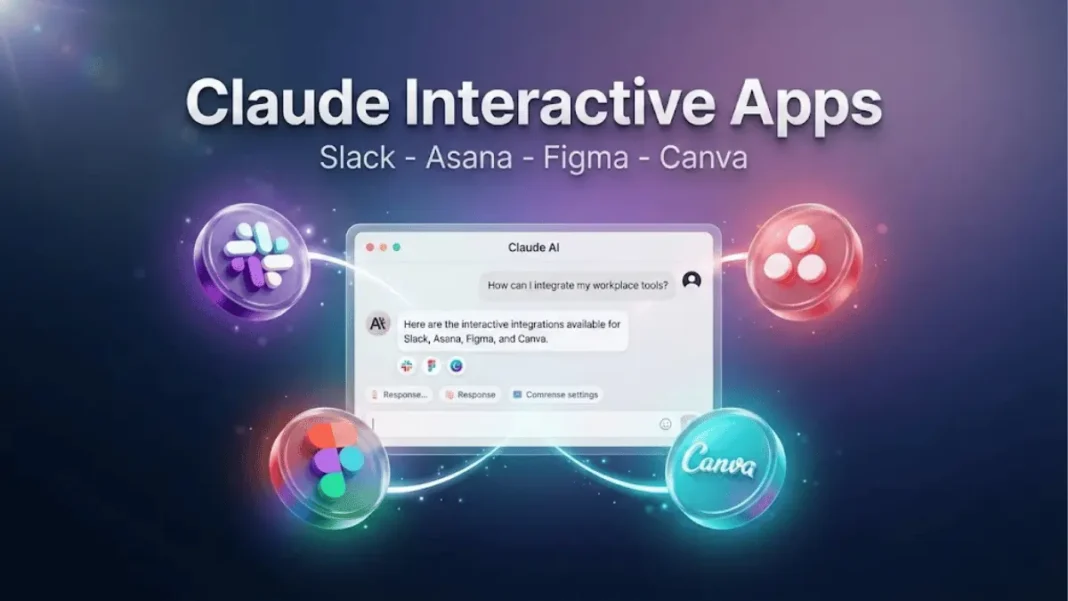
- The Launch: Anthropic deployed interactive apps for workplace tools including Slack, Asana, Figma, and Canva directly inside Claude’s chatbot interface on January 26, 2026.
- The Impact: Enterprise teams can now access productivity tools without context switching, building on Claude’s proven track record with 57,000 TELUS employees creating 13,000+ custom AI solutions.
- The Context: This follows Claude Code’s widespread adoption and positions Anthropic to compete with Microsoft’s Copilot ecosystem in workplace AI.
The Launch
Anthropic announced interactive apps for Claude on January 26, 2026, enabling users to invoke workplace tools directly inside the chatbot without leaving the interface. The integrations include Asana for project management, Figma for design collaboration, Slack for team messaging, and Canva for visual content creation. Users access these apps through natural language commands within Claude conversations, with Cowork integration scheduled to expand functionality.
The deployment builds on infrastructure from Claude Code, Anthropic’s command-line coding tool that achieved general availability on May 20, 2025 with the Claude 4 release and experienced accelerated adoption in late 2025. Anthropic reported significant usage growth over recent weeks, though specific user metrics remain undisclosed.
Architecture: From Chat to Embedded Workspace
Claude’s interactive app framework operates as a persistent layer within the chatbot environment. The system allows users to initiate tool-specific actions such as creating Asana tasks or editing Figma designs through conversational prompts rather than API calls or separate browser tabs.
The architecture extends Claude’s existing Artifacts feature, which launched on June 24, 2025 to create editable content like code snippets and charts within conversations. Interactive apps expand this model to third-party platforms, maintaining state across sessions and enabling multi-step workflows.
Anthropic leverages Slack’s Real-Time Search API to enable Claude to query workspace channels, messages, and files. This integration provides Claude with institutional knowledge from team discussions, allowing context-aware responses grounded in organizational data.
AdwaitX Analysis: The Battle for Workplace AI Infrastructure
This launch positions Anthropic directly against Microsoft’s Copilot ecosystem, which embeds AI across Office 365 and Azure services. The strategic difference: Anthropic deploys a centralized chatbot hub rather than distributed assistants across individual applications.
The timing aligns with enterprise adoption patterns. Anthropic’s TELUS case study shows 57,000 employees created 13,000+ custom AI solutions, with Claude Code achieving 99.9% numerical accuracy on autonomous seven-hour coding tasks according to Anthropic’s 2026 Agentic Coding Trends Report. The interactive apps framework aims to replicate this adoption across non-technical workflows.
Slack emerges as a critical integration battleground. Anthropic’s December 2025 beta enabled developers to trigger Claude Code sessions from Slack threads, converting chat discussions into executable coding tasks. The new interactive apps extend this model to design, project management, and content creation.
Workplace Integration Specifications
| Tool | Category | Primary Use Case | Claude Integration Method |
|---|---|---|---|
| Slack | Communication | Team messaging, collaborative debugging | Real-Time Search API + thread context |
| Asana | Project Mgmt | Task creation, workflow automation | Natural language commands |
| Figma | Design | Interface prototyping, collaborative editing | Embedded design canvas |
| Canva | Visual Content | Graphics generation, brand templates | In-chat content creation |
The interactive apps launched January 26, 2026 alongside Claude’s existing subscription tiers.
Roadmap: From Interactive Apps to Autonomous Agents
Anthropic’s product trajectory points toward increased agent autonomy. Cowork, announced January 11, 2026 and available in preview as of January 23, grants Claude folder-level access to edit files, generate reports, and execute tasks with minimal user supervision. The interactive apps framework provides the interface layer for Cowork’s backend automation.
The company’s Claude Agent SDK released as part of its developer platform enables third-party developers to build custom AI agents using Anthropic’s internal infrastructure. This opens pathways for vertical-specific interactive apps in healthcare (HIPAA-ready as of January 7, 2026) and life sciences.
Regulatory considerations remain undefined. Anthropic’s updated January 2026 Constitution acknowledges uncertainty about Claude’s “consciousness or moral status,” introducing constraints around bioweapons assistance while emphasizing user wellbeing over immediate task completion.

Frequently Asked Questions (FAQs)
What are Claude interactive apps?
Interactive apps are workplace tools like Slack, Asana, and Figma embedded directly inside Claude’s chatbot interface, accessible through conversational commands without switching contexts.
Which tools integrate with Claude as interactive apps?
Confirmed tools include Slack, Asana, Figma, and Canva, launched January 26, 2026, with Cowork integration scheduled for future deployment.
How does Claude’s Slack integration function?
Claude uses Slack’s Real-Time Search API to query workspace messages and files, then delivers AI-generated insights directly into Slack threads and channels.
What is Claude’s accuracy on coding tasks?
Claude Code achieved 99.9% numerical accuracy on autonomous seven-hour coding tasks according to Anthropic’s 2026 Agentic Coding Trends Report.

