

Key Takeaways
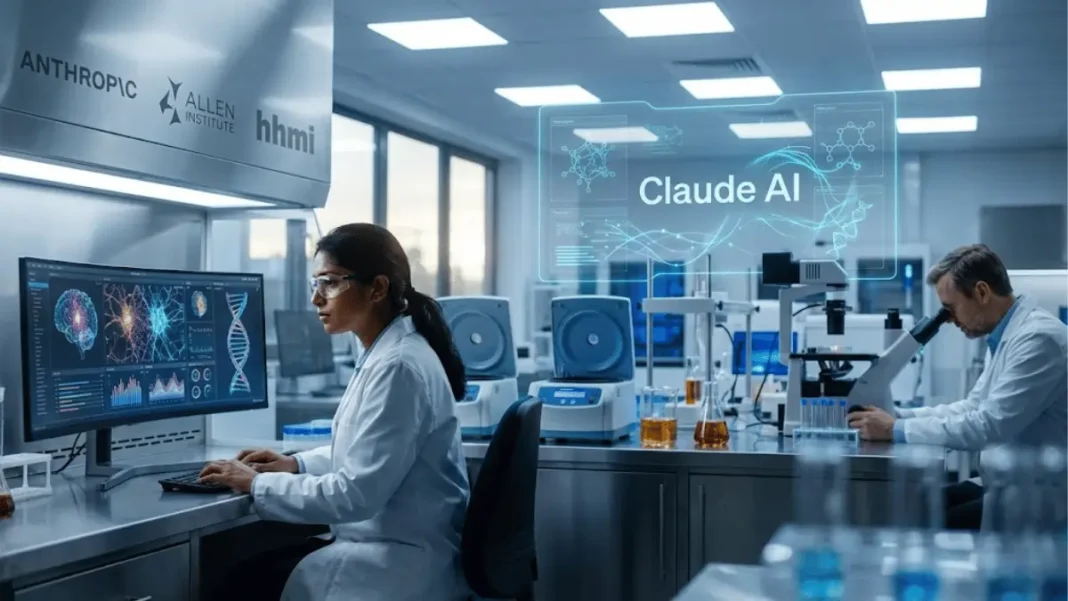
- Anthropic partners with Allen Institute and HHMI as founding life sciences collaborators on February 2, 2026
- Claude AI agents compress months of biological data analysis into hours for researchers
- HHMI’s Janelia Campus integrates Claude with experimental tools from calcium sensors to electron microscopes
- Allen Institute deploys multi-agent systems for multi-omic data integration and knowledge graph management
Anthropic just positioned its Claude AI at the center of biological research through two flagship partnerships that transform how scientists plan and execute experiments. Modern biology generates single-cell sequencing and whole-brain connectomics data faster than human researchers can interpret it, a bottleneck these collaborations aim to eliminate. The February 2, 2026 announcement establishes the Allen Institute and Howard Hughes Medical Institute (HHMI) as founding partners extending Claude’s capabilities to frontier scientific research.
Why These Partnerships Matter for Scientific AI
The Allen Institute and HHMI produce foundational tools and datasets used across global research communities, making them ideal environments for AI agent deployment. Allen Institute created widely-utilized biological datasets including brain maps showing gene activity at single-cell resolution. HHMI’s Janelia Research Campus developed genetically encoded calcium sensors (GCaMP) enabling real-time neuron activity observation and microscopy advances including electron microscopy and super-resolution techniques.
What is Claude’s role in biological research?
Claude AI agents serve as comprehensive sources of experimental knowledge integrated with cutting-edge scientific instruments and analysis pipelines. These specialized agents handle computational complexity in multi-modal data analysis, knowledge graph management, temporal dynamics modeling, and experimental design while keeping researchers in control of scientific direction.
Jonah Cool, head of life sciences at Anthropic, stated that accelerating analysis, annotation, and coordination at these institutions creates ripple effects throughout the scientific community rather than benefiting single labs. The partnerships evolved from researchers already using Claude models for specific research segments before Anthropic formalized comprehensive support.
HHMI Partnership: AI Infrastructure for Experimental Discovery
HHMI’s collaboration with Anthropic anchors at Janelia Research Campus as part of the AI@HHMI initiative launched in 2024. The partnership focuses on developing specialized AI agents for lab environments integrated with experimental instruments and analysis pipelines. HHMI projects using AI tools address computational protein design and neural cognition mechanisms.
The collaboration involves close work on AI model deployment and ongoing development, ensuring tools evolve in direct response to real experimental needs. Janelia’s two-decade history developing transformative technologies from calcium sensors to electron microscopes uniquely positions HHMI to shape how AI systems participate in research processes.
Allen Institute Partnership: Multi-Agent Systems for Data Integration
Allen Institute collaborates with Anthropic to develop multi-agent AI systems for multi-modal data analysis across the institute’s scientific focus areas. Grace Huynh, Executive Director of AI Applications at Allen Institute, explained these systems coordinate specialized agents for multi-omic data integration, knowledge graph management, temporal dynamics modeling, and experimental design.
How do multi-agent AI systems accelerate research?
Multi-agent AI systems compress months of manual analysis into hours while surfacing patterns human researchers might otherwise miss. These systems amplify scientific intuition rather than replace it, keeping researchers in control of scientific direction while handling computational complexity that slows discovery timelines.
The collaboration provides Anthropic in-depth feedback from real scientific workflows where reliability and judgment matter, surfacing usability gaps and failure modes absent in controlled settings.
Claude for Life Sciences Platform Evolution
Anthropic unveiled Claude for Life Sciences in October 2025 as its first formal life sciences entry, streamlining R&D processes from literature reviews and hypothesis generation to data analysis and regulatory submission. The platform leverages Claude Sonnet 4.5, optimized for laboratory protocols and life sciences workflows.
Claude for Life Sciences connects with scientific tools including Benchling, PubMed, 10x Genomics, and Synapse.org, plus consulting partners like KPMG and Deloitte alongside cloud services AWS and Google Cloud. Anthropic aims to deliver productivity gains in biology matching those software engineers’ experience with code generation, enabling teams to analyze and report findings in minutes rather than days.
Transparency and Scientific Rigor Standards
Both partnerships commit to transparency and advances helping the broader scientific community rigorously deploy AI tools across domains. Scientific AI systems must produce accurate predictions plus reasoning researchers can evaluate, trace, and build upon.
The collaborations position Claude as a tool augmenting rather than replacing human scientific judgment, ensuring AI-generated insights ground in evidence and remain legible to scientists using them. Anthropic prioritizes responsible development emphasizing scientific rigor, interpretability, and researcher autonomy.
Impact on Biological Research Timelines
The partnerships address fundamental bottlenecks where knowledge synthesis, hypothesis generation, and experimental interpretation depend on manual processes unable to match data production pace. Specialized AI agents integrated with instruments and analysis pipelines speed discovery by handling tasks prolonging research timelines unnecessarily.
Allen Institute’s brain map enhancements to single-cell resolution significantly boosted scientific value while complicating analysis exactly where AI agents deliver acceleration benefits. Tools and datasets from these institutions become more valuable when AI speeds analysis and annotation, creating multiplier effects across dependent research fields.
Broader AI and Biology Convergence Trends
The Anthropic partnerships reflect broader 2026 trends where biology and AI converge to unlock new frontiers in human health, food, materials, and planetary sustainability. Foundation models and machine learning apply across DNA, RNA, metabolites, proteins, cells, and ecosystems with approaches laying groundwork for predictive and programmable biology.
Berkeley Lab announced parallel efforts in February 2026 to build foundational AI models for autonomous research enabling prediction and precise design of biological systems. DOE user facilities produce large and precise biological datasets using automated experimental capabilities and supercomputing resources.
Frequently Asked Questions (FAQs)
What are the main goals of the Anthropic-Allen Institute partnership?
The partnership develops multi-agent AI systems for multi-modal data analysis across Allen Institute’s research areas, coordinating specialized agents for data integration, knowledge graphs, temporal modeling, and experimental design to compress analysis timelines from months to hours.
How does HHMI’s collaboration with Anthropic differ from Allen Institute’s approach?
HHMI focuses on building AI infrastructure for experimental discovery at Janelia Campus, integrating Claude agents with scientific instruments and analysis pipelines, while Allen Institute emphasizes multi-agent system coordination for data analysis and exploration.
When did Anthropic announce these partnerships?
Anthropic announced the flagship partnerships with Allen Institute and Howard Hughes Medical Institute on February 2, 2026, establishing them as founding partners in life sciences research.
What technologies does Claude integrate with at HHMI’s Janelia Campus?
Claude integrates with genetically encoded calcium sensors, electron microscopes, super-resolution microscopy systems, and analysis pipelines developed at Janelia over two decades.
How does Claude for Life Sciences support the research process?
Claude for Life Sciences streamlines the entire R&D process from literature reviews and hypothesis generation to data analysis and regulatory submission, connecting with tools like Benchling, PubMed, 10x Genomics, and cloud platforms.
What makes Allen Institute and HHMI ideal partners for scientific AI deployment?
Both institutions produce foundational tools and datasets used globally Allen Institute’s brain maps and HHMI’s calcium sensors and microscopy advances making AI acceleration benefits ripple across research communities rather than benefiting single labs.
Will AI replace human scientists in these partnerships?
No. The collaborations position Claude as augmenting rather than replacing human judgment, keeping researchers in control of scientific direction while AI handles computational complexity and surfaces patterns for human evaluation.
When was Claude for Life Sciences launched?
Anthropic launched Claude for Life Sciences in October 2025 as its first dedicated platform for life sciences research and development workflows.

