

Quick Brief
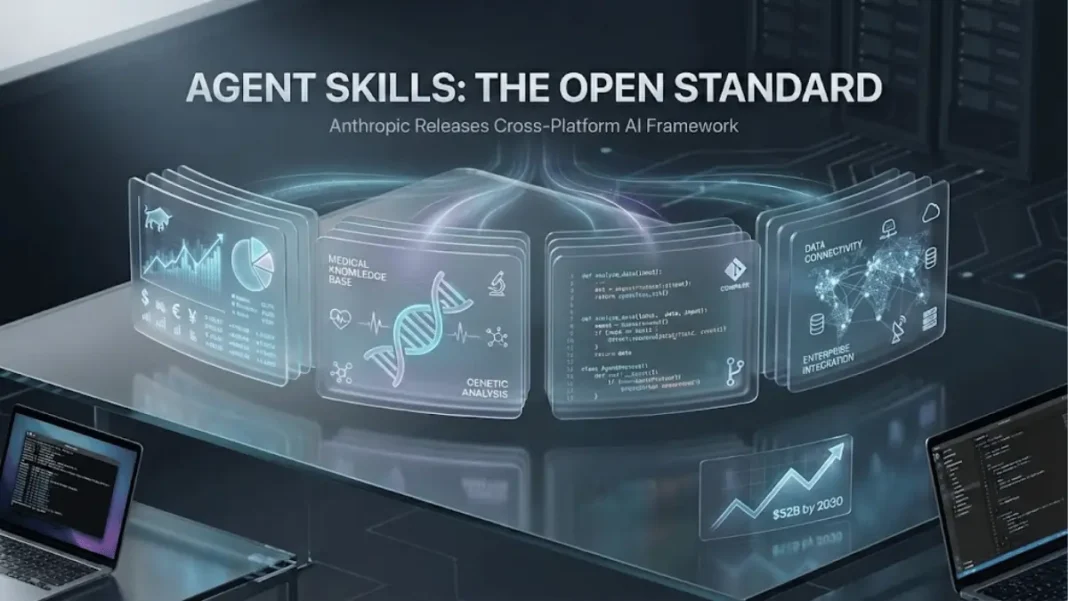
- The Launch: Anthropic released Agent Skills as an open standard on December 18, 2025, evolving technology first introduced October 16, 2025, with skills using progressive disclosure consuming 50 tokens for metadata, 500 tokens for documentation, and 2,000+ tokens for reference files.
- The Market: AI agents market projected to reach $52.62 billion by 2030 from $7.84 billion in 2025, registering 46.3% CAGR as enterprises deploy specialized workflows.
- The Adoption: Companies deploy skills in production across legal, finance, accounting, and healthcare sectors, while Model Context Protocol reaches 97 million monthly SDK downloads with 10,000+ active public servers.
- The Context: Move positions Anthropic against OpenAI in enterprise AI race, following Model Context Protocol donation to Linux Foundation December 9, 2025, and Agentic AI Foundation formation with Block, OpenAI, Google, Microsoft, and AWS.
Anthropic released Agent Skills as an open standard on December 18, 2025, marking a strategic shift from building specialized AI agents to equipping general-purpose agents with domain expertise packaged as portable code modules. The San Francisco-based AI firm evolved technology first introduced October 16, 2025, into an industry framework published at agentskills.io, challenging OpenAI’s enterprise dominance with cross-platform portability.
Architecture: Code as Universal Interface
Anthropic’s engineering team abandoned the industry’s initial approach of building domain-specific agents separate systems for coding, research, finance, and marketing converging instead on code as the universal interface for digital work. “We initially thought we’d need specialized agents for different domains,” stated Barry Zhang, Anthropic researcher, adding “but we discovered that the underlying agent architecture is more universal than we expected“.
Claude executes financial report generation by calling APIs for research, storing data in filesystems, analyzing with Python, and synthesizing insights through bash and filesystem scaffolding. Skills bridge the gap between general capability and domain expertise through organized collections of files packaging workflows, best practices, and scripts in formats agents progressively access.
The architecture employs three-tier progressive disclosure: metadata consumes approximately 50 tokens, full SKILL.md files use roughly 500 tokens, and reference documentation loads 2,000+ tokens only when specifically needed. This structure enables organizations to equip agents with hundreds of skills without overwhelming context windows, a critical constraint in production deployments.

Enterprise Adoption and Partner Ecosystem
Companies deploy skills in production across legal, finance, accounting, and data science operations, according to Mahesh Murag, Anthropic researcher. Real-world impact emerges from organizations implementing skills to capture institutional knowledge and standardize complex workflows.
The partner ecosystem includes K-Dense, Browserbase, and Notion building skills that integrate their services directly while maintaining the simplicity of the skills format. These companies create skills extending Claude’s capabilities in specific domains as the skills format standardizes how agents interact with specialized capabilities.
| Skill Component | Token Usage | Content Type | Access Pattern |
|---|---|---|---|
| YAML Metadata | ~50 tokens | Name, description, basic info | Always loaded |
| SKILL.md Documentation | ~500 tokens | Core workflows, guidelines | Loaded when relevant |
| Reference Files | 2,000+ tokens | Detailed specifications, examples | Loaded on-demand |
Vertical Market Deployments
Anthropic enhanced Claude for financial services with six specialized skills: DCF model builder with WACC calculations, comparable company analysis generating comps tables, earnings analysis processing quarterly results, initiation coverage building research reports, due diligence structuring M&A analysis, and pitch materials creating client presentations.
Healthcare and life sciences deployments include bioinformatics bundles for scVI-tools and Nextflow managing genomic pipelines, clinical trial protocol generation, scientific problem selection, FHIR development for health data interoperability, and prior authorization review cross-referencing coverage requirements. The FHIR development skill launched January 7, 2026, helps developers write accurate code for healthcare system connectivity with fewer errors.
“What makes skills powerful is that they’re just files you can version control them with git, store them in Google Drive, or share them with your team,” explained Keith Lazuka, Anthropic engineer. Skills creation expanded beyond engineers to product managers, analysts, and domain experts across disciplines.
AdwaitX Analysis: Infrastructure Play in $52B Market
The agentic AI market trajectory reveals Anthropic’s strategic positioning: global market size projected to reach $52.62 billion by 2030 from $7.84 billion in 2025, registering 46.3% CAGR driven by foundation model convergence and enterprise demand for intelligent copilots. Coding and software development segments project 52.4% CAGR, while BFSI (banking, financial services, insurance) end users represent the largest market share in 2025.
Organizations concentrate on developing and curating skills encapsulating institutional knowledge rather than constructing and maintaining numerous specialized AI systems, according to Zhang. This architectural shift carries profound implications for enterprise software development as companies standardize on general-purpose agent platforms equipped with domain-specific skills.
The open standard model follows Anthropic’s Model Context Protocol donation to the Linux Foundation on December 9, 2025. The Agentic AI Foundation announced December 9, 2025, operates under Linux Foundation governance with co-founders Anthropic, Block, and OpenAI, plus supporting members including AWS, Google, Microsoft, Bloomberg, and Cloudflare to oversee multiple open specifications.
Model Context Protocol Adoption Surge
MCP adoption accelerated dramatically since introduction, achieving 97 million monthly SDK downloads with more than 10,000 active public MCP servers deployed globally. Major platforms integrated MCP including ChatGPT, Cursor, Gemini, Microsoft Copilot, and Visual Studio Code, while Claude’s directory features over 75 connectors.
Skills and MCP servers coordinate naturally within Anthropic’s architecture, where agent loop provides core reasoning, agent runtime executes code, MCP connects external tools and data sources, and skills library supplies domain expertise. A competitive analysis skill coordinates web search, internal databases via MCP, Slack message history, and Notion pages to synthesize comprehensive reports.
MCP provides real-time access to live data rather than static information, promotes interoperability between AI systems and tools, and reduces vendor lock-in through standardized frameworks working across platforms. The protocol enables AI models to query MCP servers connected to CRM systems without requiring custom integration, shortening development cycles.
Standardization and Cross-Platform Strategy
Anthropic published Agent Skills as an open standard on December 18, 2025, with the specification released at agentskills.io and reference SDK available for community adoption. “By making this an open standard, we’re ensuring that skills can work across different AI platforms, not just Claude,” stated Anthropic in the official announcement.
The Agentic AI Foundation provides governance infrastructure to coordinate standards development across the agentic AI ecosystem, with Anthropic committing to collaborative development rather than proprietary lock-in. Skills creation tools enable non-technical users to build and test skills, democratizing AI customization beyond engineering teams.
Implementation Architecture
The emerging agent architecture combines four essential components according to Anthropic’s technical documentation:
Agent loop: The core reasoning system that determines what to do next and when tasks are complete.
Agent runtime: Execution environment where the agent can run code, use tools, and interact with systems.
MCP servers: Connections to external tools and data sources providing real-time access to information.
Skills library: Domain expertise packaged as code that guides the agent through specialized workflows.
Resources and Documentation
Anthropic provides comprehensive resources including skills documentation at docs.anthropic.com, public GitHub repository at github.com/anthropics/skills, skills cookbook with examples, Claude implementation guide, skills API quickstart, and best practices documentation. Organizations access centralized skill management through Team Enterprise plans, determining workflow accessibility across organizations while allowing individual customization.
The file-based architecture enables version control with Git, storage in cloud platforms, and team sharing without limiting creation to technical personnel. Product managers, analysts, and domain experts build skills using improved tooling and templates, capturing organizational expertise in portable formats.
Frequently Asked Questions (FAQs)
What are Anthropic Agent Skills?
File-based packages containing domain expertise and workflows that AI agents progressively access, consuming 50-2,000+ tokens based on need, released as open standard December 18, 2025.
How do Agent Skills differ from traditional AI tools?
Skills use code that’s self-documenting, modifiable, version-controlled, and loaded on-demand through three-tier progressive disclosure without bloating context windows.
Which companies adopt Anthropic Agent Skills?
Enterprises deploy skills in production for legal, finance, accounting, and data science, with partners including K-Dense, Browserbase, and Notion building integrations.
What is the Agent Skills market size?
AI agents market projects $52.62 billion by 2030 from $7.84 billion in 2025, registering 46.3% CAGR per MarketsandMarkets research.
How many organizations use Model Context Protocol?
MCP reaches 97 million monthly SDK downloads with 10,000+ active public servers, integrated in ChatGPT, Cursor, Gemini, Microsoft Copilot, and VS Code.

