

Quick Brief
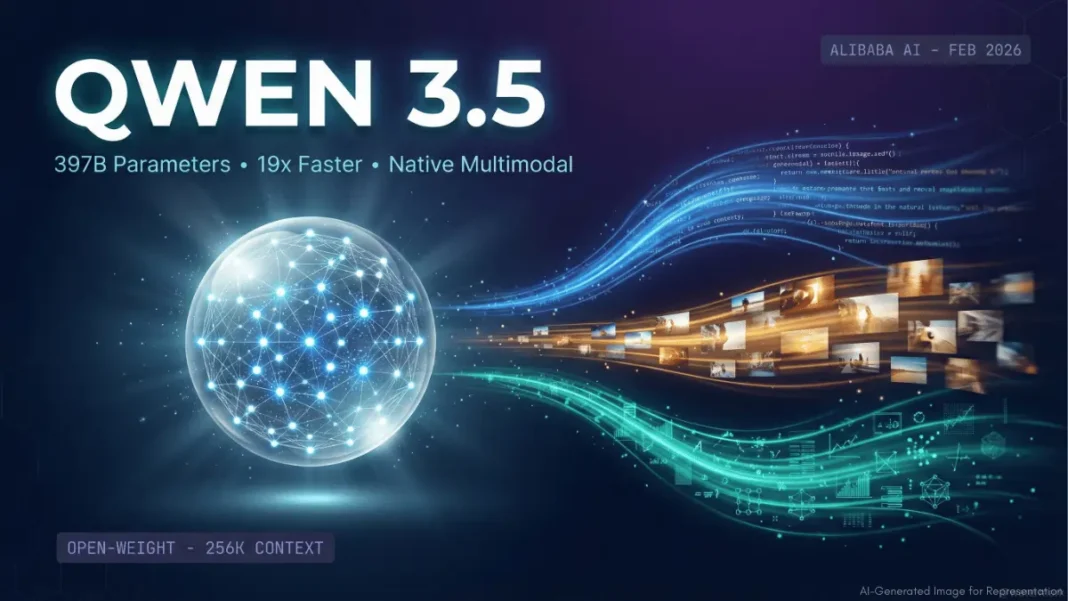
- Qwen 3.5 delivers 19x faster performance than predecessor with 397B parameters
- Native multimodal processing handles text, images, and extended video content
- Open-weight architecture costs 60% less to operate than Qwen3-Max
- Released February 16, 2026 with performance matching GPT, Claude, and Gemini models
Alibaba has fundamentally redefined efficiency in large language models and Qwen 3.5 proves it. Released February 16, 2026, this open-weight AI model processes information 19 times faster than its trillion-parameter predecessor while maintaining equivalent reasoning performance. The timing signals Alibaba’s aggressive push into China’s AI agent market, where ByteDance’s Doubao currently leads with nearly 200 million users.
Architecture That Breaks the Long-Context Bottleneck
Qwen 3.5 employs a Hybrid Attention Architecture that solves the quadratic complexity problem plaguing traditional transformers. The model uses Full Attention layers at set intervals (every 4th layer by default) combined with Gated Delta Networks that achieve linear complexity relative to sequence length. This architectural choice enables the model to handle massive 256,000-token contexts without exponential memory growth.
The 397 billion parameter model activates only 17 billion parameters per query through sparse Mixture of Experts routing with 512 experts 10 routed plus 1 shared expert activated per token. This sparse activation pattern delivers 3.5 to 7.2 times faster processing compared to Qwen3-235B at comparable performance levels.
How does Qwen 3.5 achieve linear scaling?
Qwen 3.5 uses Gated Delta Networks within its Hybrid Attention system to maintain linear complexity as context length increases. Traditional transformers require quadratic compute growth, but this architecture handles 256K-token contexts with significantly reduced overhead, enabling 19x faster decoding for long-context tasks compared to Qwen3-Max.

Native Multimodal Processing Without Adapters
Unlike previous models requiring separate vision modules, Qwen 3.5 integrates multimodal capabilities at the architectural level through early fusion training. The DeepStack Vision Transformer treats video as a third dimension, using Conv3d for patch embeddings to capture temporal dynamics natively. This approach merges features from multiple visual encoder layers rather than only the final layer, capturing both fine-grained details and high-level abstractions.
The model processes text, images, and video content concurrently within a unified system, leveraging architectural improvements from its Qwen3-VL predecessor’s proven extended video processing capabilities. In document recognition benchmarks, Qwen 3.5 achieved 90.8% on OmniDocBench v1.5 outperforming GPT-5.2 (85.7%), Claude Opus 4.5 (87.7%), and Gemini 3 Pro (88.5%).
Performance Benchmarks Against US Competitors
Alibaba provided self-reported benchmark comparisons showing Qwen 3.5 performing on par with leading models from OpenAI, Anthropic, and Google DeepMind. The model scored 87.5 on VideoMME (video understanding) and 88.6 on MathVision, achieving top scores among evaluated models. In the GPQA Diamond reasoning test, Qwen 3.5 achieved 88.7, placing third among evaluated large language models.
| Benchmark Category | Qwen 3.5 Score | Key Competitor Comparison |
|---|---|---|
| MathVision | 88.6 | Top score |
| OmniDocBench v1.5 | 90.8 | Beats GPT-5.2 (85.7%), Gemini 3 Pro (88.5%) |
| ERQA (Embodied Reasoning) | 67.5 | Qwen3-VL: 52.5, Gemini 3 Pro: 70.5 |
| MMLU-Pro (Knowledge) | 87.8 | Competitive with leading models |
| VideoMME (Video Understanding) | 87.5 | Strong multimodal performance |
| MMMU (Image Understanding) | 85.0 | Gemini 3 Pro: 87.2, GPT-5.2: 86.7 |
Cost Efficiency Designed for Agentic AI Era
Qwen 3.5 operates at 60% lower cost compared to its predecessor while delivering an eightfold improvement in handling extensive workloads. The model’s efficiency stems from its Mixture of Experts (MoE) architecture with 512 experts and shared expert routing, which activates only 17 billion of 397 billion parameters per query.
For developers, the open-weight model is available for download, customization, and deployment on private infrastructure. Alibaba simultaneously launched Qwen-3.5-Plus as a hosted version through its Model Studio cloud platform, featuring a 1 million token context window among the largest in the industry.
What is the pricing for Qwen 3.5 API access?
Qwen-Max models are priced at $1.2 per million input tokens and $6 per million output tokens for contexts up to 32K tokens, with tiered pricing for larger contexts. The open-weight Qwen 3.5 model can be self-hosted at no API cost, enabling developers to run it on their own infrastructure after downloading from Alibaba Cloud, Hugging Face, or GitHub.
Visual Agentic Capabilities for Autonomous Tasks
Qwen 3.5 introduces what Alibaba terms “visual agentic capabilities” the ability to autonomously perform actions across mobile and desktop applications. This functionality positions the model for the emerging AI agent market, where systems execute multi-step tasks without continuous human intervention.
The model’s embodied reasoning score of 67.5 on ERQA represents a 28.5% improvement over Qwen3-VL’s 52.5, approaching Gemini 3 Pro’s 70.5. This capability enables more sophisticated interaction with software interfaces, document workflows, and visual task planning.
Two Deployment Options for Different Use Cases
Alibaba released Qwen 3.5 in two configurations targeting distinct user needs:
- Qwen-3.5-Open-Source (397B-A17B parameters): Available for download with full customization rights through Hugging Face, GitHub, and Ollama. Despite fewer parameters than Qwen-3-Max-Thinking (over 1 trillion), benchmark scores show significant performance improvements.
- Qwen-3.5-Plus (closed-source hosted): Deployed on Alibaba’s Model Studio cloud platform with 1 million token context window. Alibaba claims performance “on par with state-of-the-art leading models”.
Both versions were released February 16, 2026, ahead of the Chinese New Year holiday.
Strategic Context in China’s AI Competition
The Qwen 3.5 launch caps a frenetic week where nearly every major Chinese AI developer released new flagship models. ByteDance launched Doubao 2.0 on February 14, 2026, emphasizing AI agent capabilities for its 200 million user base. Zhipu AI similarly upgraded its models with enhanced agent functionality.
Alibaba’s recent progress in China’s competitive AI landscape includes a coupon promotion through the Qwen chatbot that drove a sevenfold surge in active users despite technical issues. The company had previously responded to DeepSeek’s rapid rise by launching Qwen 2.5-Max, which it claimed outperformed DeepSeek’s popular models.
Limitations and Considerations
While Qwen 3.5 achieves top scores in document comprehension and certain visual tasks, it trails GPT-5.2 and Claude 4.5 Opus in general reasoning and coding performance benchmarks. The MMMU image understanding score of 85.0 falls below Gemini 3 Pro (87.2) and GPT-5.2 (86.7).
All performance comparisons rely on self-reported benchmarks that could not be independently verified. The comparisons also excluded the absolute latest model versions from OpenAI, Anthropic, and Google DeepMind.
How to Access Qwen 3.5
Developers can access Qwen 3.5 through three primary methods:
- Download the open-weight model from Hugging Face (Qwen/Qwen3.5-397B-A17B), GitHub (QwenLM/Qwen3.5), or Ollama repository
- Use the hosted API through Alibaba Cloud Model Studio with pay-as-you-go pricing
- Deploy on AMD Instinct GPUs with Day 0 optimization support announced February 15, 2026
Registration requires minimal information (email or phone number), followed by AccessKey ID generation for API authentication.
Frequently Asked Questions (FAQs)
What makes Qwen 3.5 faster than previous models?
Qwen 3.5 uses Hybrid Attention Architecture combining Full Attention layers with Gated Delta Networks that achieve linear complexity. This design processes 256K-token contexts 19 times faster than Qwen3-Max while activating only 17 billion of its 397 billion parameters per query through sparse MoE routing with 512 experts.
Can Qwen 3.5 process videos?
Yes. Qwen 3.5 handles video content natively using a DeepStack Vision Transformer with Conv3d patch embeddings. This architecture treats video as a third dimension, processing text, images, and video concurrently within a unified multimodal system, scoring 87.5 on VideoMME benchmark.
How does Qwen 3.5 compare to ChatGPT?
Self-reported benchmarks show Qwen 3.5 performing on par with OpenAI models in several tests, including outperforming GPT-5.2 in document recognition (90.8% vs 85.7%). However, it trails in general reasoning and coding benchmarks. Cost-wise, Qwen 3.5’s open-weight version enables free self-hosting.
What are AI agent capabilities in Qwen 3.5?
Qwen 3.5 features “visual agentic capabilities” that enable autonomous task execution across mobile and desktop applications. The model scored 67.5 on ERQA embodied reasoning tests, allowing it to interact with software interfaces, complete multi-step workflows, and make decisions without continuous human intervention.
Is Qwen 3.5 free to use?
The open-weight Qwen-3.5-397B-A17B model can be downloaded, customized, and self-hosted at no cost beyond infrastructure expenses from Hugging Face, GitHub, or Ollama. Alibaba also offers Qwen-3.5-Plus as a hosted API service with usage-based pricing starting at $1.2 per million input tokens for contexts up to 32K tokens.
When was Qwen 3.5 released?
Alibaba released Qwen 3.5 on February 16, 2026, just before the Chinese New Year holiday. The launch included both the open-weight 397B-parameter model (Qwen3.5-397B-A17B) and the hosted Qwen-3.5-Plus version through Alibaba Cloud’s Model Studio platform.
What is the context window size for Qwen 3.5?
The open-source Qwen 3.5 model supports up to 256,000 tokens (262,144 tokens precisely) in its context window. The hosted Qwen-3.5-Plus version extends this to 1 million tokens, one of the largest context windows available in the AI industry as of February 2026.

